
05 · Sampling Parameters
Most guides file these under "API reference" — a list of fields with one-line descriptions of what they do to your text. This page is in Core Concepts instead, because that framing hides the half that matters once you're operating a server:
Every sampling parameter has a text effect, which is documented everywhere, and a systems effect, which is documented almost nowhere.
max_tokens isn't a formatting preference; it's how long a request may hold a slot. n isn't "give
me options"; it's a question about copy-on-write. temperature=0 isn't determinism, whatever you've
been told. You can't reason about a batch until you know which requests are cheap and which are
expensive, and these parameters are what decides that.
The Problem
Symptoms, all of which come back to sampling parameters set by someone who was only thinking about the text:
- Your concurrency collapsed and nothing about the deployment changed. A client started sending
max_tokens: 4096"to be safe." - Output is repetitive, or it's incoherent, and you have five knobs that all plausibly relate. You change two at once, it gets worse, and you have no model of why.
- You set
temperature=0for reproducibility and the outputs still vary run to run. Not wildly — but enough to break a test suite, and it looks like a bug in the server. - Requests that never end. No stop sequence configured, so every response runs to
max_tokensregardless of finishing at token 40, holding a slot for the other 4,056. - A user requests
n=8and you brace for 8× the cost. It isn't 8×. It also isn't 1×, and you have no idea how to price it. - You copied a
top_p/temperaturepair from another model's documentation and the outputs are subtly worse in a way nobody can pin down.
The unifying observation: the API surface presents these as text-quality settings, so they get chosen by whoever cares about text quality — and their cost lands on whoever operates the server. On a single-user script that separation is harmless. On a shared server it is the difference between 200 concurrent users and 40.
The Idea
The model does not produce text. At every step it produces a probability distribution over the entire vocabulary — for Qwen2.5, that's roughly 152,000 numbers, one per possible next token.
Something has to collapse those 152,000 numbers into exactly one token. Sampling parameters are that policy, and nothing more.
Picture an advisor who, at every word, hands you a ranked list of every word in the language with a confidence score beside each:
the    0.41
a      0.22
this   0.11
that   0.06
       ... 151,996 more, most of them essentially zero
Your options:
- Always take the top one. Predictable, and repetitive — greedy decoding,
temperature=0. - Sample proportionally to confidence. Natural variety, but the long tail of near-zero options means occasionally you'll pick something absurd.
- Change how strongly you trust the confidences before sampling — sharpen them so the leader dominates, or flatten them so outsiders get a chance. That's temperature.
- Refuse to consider anything outside the top few — the top 40 suggestions (top_k), or as many as it takes to cover 90% of the confidence (top_p).
- Decide when to stop asking — after N words (max_tokens), or when they say something specific (stop).
That's the whole conceptual surface. Two families: reshape the distribution (temperature, penalties) and truncate it (top_k, top_p, min_p). Then sample from what's left.
The systems half of the idea is equally simple and much less discussed:
The parameters that decide when a request ends are the ones that decide what it costs. Everything else changes which token you get.
max_tokens,stopandnchange how long a slot is held and how many KV blocks are consumed.
Under the Hood
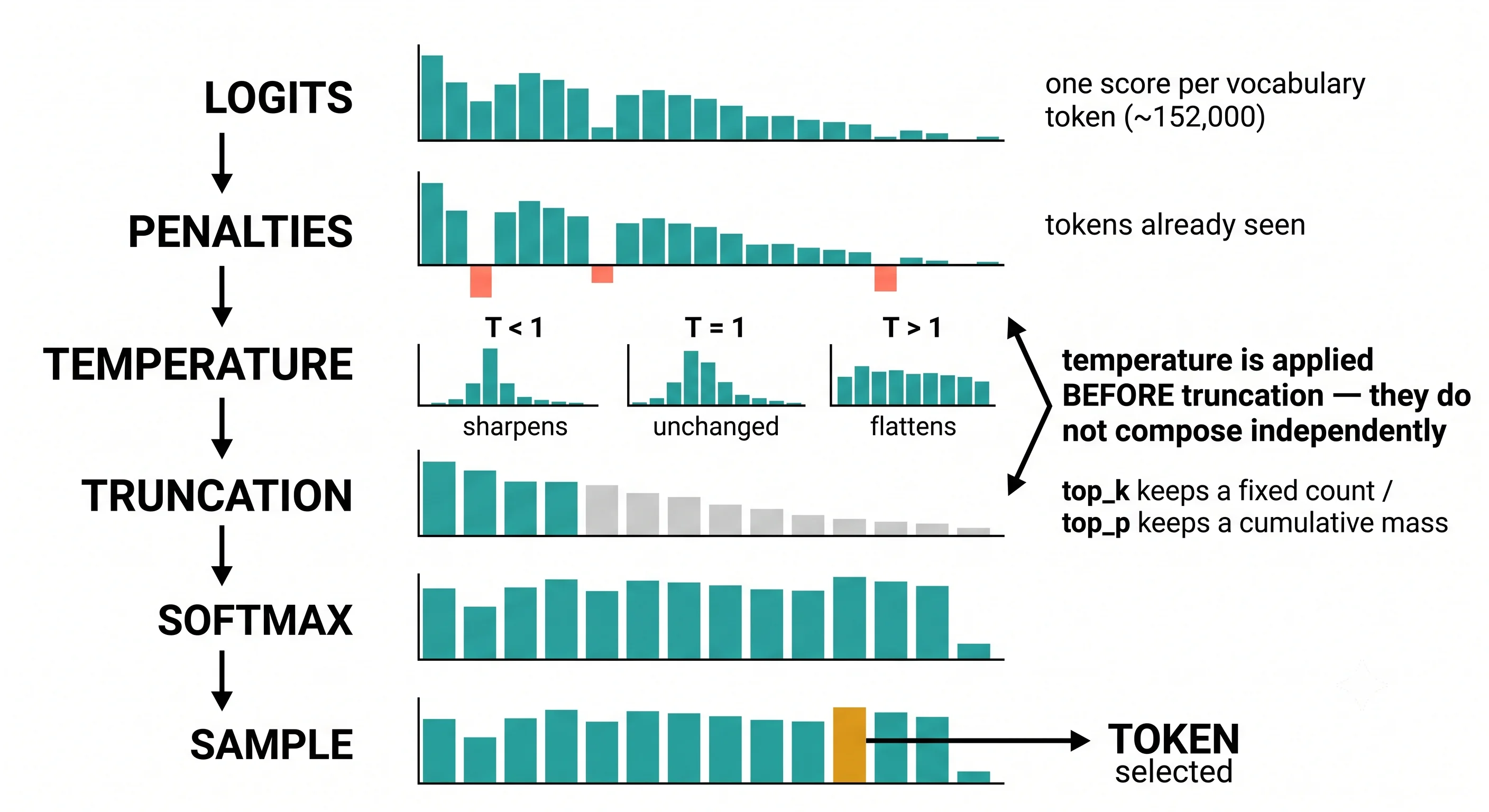
The pipeline
Every decode step, for every sequence in the batch:
model forward pass
      │
      ▼
   LOGITS            one raw score per vocabulary token (~152,000 of them)
      │
      ▼
   PENALTIES         presence / frequency / repetition — adjust scores of tokens
      │              already seen in this sequence
      ▼
   TEMPERATURE       logits ÷ T.   T<1 sharpens, T>1 flattens, T=0 → take the argmax
      │
      ▼
   TRUNCATION        top_k: keep the k highest
      │              top_p: keep the smallest set whose probabilities sum to p
      │              min_p: drop anything below (min_p × the top token's probability)
      ▼
   SOFTMAX           what remains becomes a probability distribution
      │
      ▼
   SAMPLE            draw one token   →   appended to the sequence, its KV cached
Order matters and is a common source of confusion. Temperature is applied before truncation, so
top_p=0.9 at temperature=2.0 selects from a very different candidate set than the same top_p at
temperature=0.5 — the flattening happens first, and then you take the nucleus of the already-flat
distribution. Tuning them independently, as though they compose cleanly, is why people end up with
pairs of values nobody can justify. ⚠️ Verify the exact order for your vLLM version; implementations
differ across engines.
The two families
Reshaping — temperature. Divide every logit by T.
T |
Effect | Use |
|---|---|---|
0.0 |
Argmax — always the top token. Sampling is bypassed entirely | Extraction, classification, code, anything graded against a reference |
0.1–0.5 |
Sharpened; the leader usually wins | Factual answers, RAG, tool calls |
~0.7–1.0 |
Roughly the model's own distribution | General chat |
> 1.2 |
Flattened; unlikely tokens get real probability | Creative work, and the region where incoherence starts |
Truncating — top_k, top_p, min_p. All three delete candidates before sampling; they differ in how they choose the cut.
| Parameter | Rule | Behaviour |
|---|---|---|
top_k |
Keep the k highest-probability tokens | Fixed count. Same width whether the model is certain or clueless — which is the weakness |
top_p (nucleus) |
Keep the smallest set summing to ≥ p |
Adaptive. Narrow when the model is confident, wide when it isn't. The usual choice |
min_p |
Keep tokens with probability ≥ min_p × (top token's probability) |
Adaptive, relative to the leader. Newer; robust at high temperature |
Set several and you get the intersection — every filter applies. top_k=50 with top_p=0.9
means "at most 50 candidates, and also only the 90% nucleus."
Penalties operate on tokens already generated in this sequence:
| Parameter | Mechanism | Range |
|---|---|---|
presence_penalty |
Flat penalty if a token has appeared at all | Encourages new topics |
frequency_penalty |
Penalty proportional to how often it has appeared | Suppresses repetition of common tokens |
repetition_penalty |
Multiplicative on the logit; a different formulation of the same idea | > 1 discourages repetition |
These are blunt instruments. They cannot distinguish "the model is stuck in a loop" from "this is
JSON and " legitimately appears forty times" — which is the failure mode in Where It Bites You.
The systems effects — the part that isn't in the API docs
This is the table that makes the page worth its place in Core Concepts.
| Parameter | Text effect | Systems effect |
|---|---|---|
max_tokens |
Caps output length | The worst case the scheduler must accommodate. Bounds KV blocks and slot-hold time. The single most expensive parameter a client can set carelessly |
stop / stop_token_ids |
Ends output at a string | Frees the slot and its blocks early. Often the biggest practical throughput lever available to a client |
ignore_eos |
Keeps generating past EOS | Guarantees every request runs to max_tokens. Useful for benchmarking, catastrophic in production |
min_tokens |
Forces a minimum length | Prevents early release of a slot — a floor on cost |
n |
n completions | Prompt blocks shared via copy-on-write (PagedAttention); only generated tokens cost n×. Sub-linear, and how sub-linear depends on your prompt-to-output ratio |
temperature=0 |
Greedy decoding | Cheaper sampling step, negligible overall. Does not guarantee reproducibility — see below |
logprobs / prompt_logprobs |
Returns probabilities | Real serialisation and bandwidth cost; prompt_logprobs over a long prompt can dominate the response payload |
seed |
Reproducible sampling | Per-request RNG state; same caveat as temperature=0 |
structured_outputs |
Constrains output to a grammar/schema | Constraint machinery per step; can restrict how sequences batch together |
The n arithmetic is worth doing explicitly, because it's the one people misprice in both
directions. A 2,000-token prompt with 100-token outputs at n=4:
naive assumption : 4 × (2000 + 100) = 8,400 token-slots
actual with COW  : 2000 + (4 × 100) = 2,400 token-slots     ← 3.5× cheaper than assumed
Flip it to a 50-token prompt with 1,000-token outputs and sharing buys you almost nothing. The saving is a function of your prompt-to-output ratio, which is exactly the workload shape you measured in Stage 0.
Why temperature=0 isn't deterministic
The most useful thing on this page for anyone building an eval suite.
Greedy decoding is deterministic given identical logits. But logits come from floating-point
reductions on a GPU, and floating-point addition is not associative — (a+b)+c can differ from
a+(b+c) in the last bits. The order of those reductions depends on kernel selection and batch shape,
and under continuous batching your request's batch composition depends on what other traffic is
present at that instant.
So the same prompt, same seed, same temperature=0, on the same server, can produce different logits
in the last few bits. Usually that changes nothing. Occasionally two candidate tokens are close
enough that the argmax flips — and from there the sequences diverge completely.
The practical consequences:
- Don't assert exact string equality in tests against a batching server.
- Reproducibility needs batch-invariance, not just a seed — that's a property of the engine's kernels and scheduling, not of your request.
- This is not a vLLM bug. It's inherent to batched GPU inference, and every engine that batches has it.
⚠️ Some engines offer batch-invariant or deterministic modes, usually at a throughput cost. Check whether your version has one before building a workflow that needs it.
Try It
Hardware: Colab T4 or any CUDA GPU.
vllm serve Qwen/Qwen2.5-0.5B-Instruct --max-model-len 2048Experiment 1 — watch the distribution, not the text
Reading about temperature is much less useful than seeing what it does to the candidate set.
# distribution.py — the actual probabilities the sampler is choosing from.
import math
from openai import OpenAI

client = OpenAI(base_url="http://localhost:8000/v1", api_key="EMPTY")
MODEL  = "Qwen/Qwen2.5-0.5B-Instruct"
PROMPT = "The capital city of France is"

for temp in [0.0, 0.7, 1.5]:
    r = client.completions.create(
        model=MODEL, prompt=PROMPT, max_tokens=1,
        temperature=temp, logprobs=5,          # top 5 candidates for the next token
    )   # NOTE: needs the server started with --logprobs-mode processed_logprobs — see below
    top = r.choices[0].logprobs.top_logprobs[0]
    print(f"\ntemperature = {temp}")
    for tok, lp in sorted(top.items(), key=lambda kv: -kv[1]):
        print(f"   {tok!r:<12} p = {math.exp(lp):.4f}")
⚠️ Start the server with
--logprobs-mode processed_logprobsfor this experiment. By default V1 returnsraw_logprobs— values taken from the model's raw output before any logit post-processing, including temperature scaling and top-p/top-k. With the default you will see the same numbers at every temperature, because you're looking at the distribution before temperature touched it. The four modes areraw_logprobs(default),processed_logprobs,raw_logitsandprocessed_logits.This is worth doing deliberately: run it once in each mode. Seeing raw logprobs refuse to move while the sampled text clearly changes is the most direct demonstration available that logprobs and sampling are separate stages.
What you should observe (with processed_logprobs): at temperature=0 the top candidate
dominates; as temperature rises the probabilities flatten and the gap between first and fifth
narrows. You're watching the sharpening and flattening directly, rather than inferring it from
prose.
Now change one thing: add top_p=0.5 and re-run at temperature=1.5. The candidates below the
cumulative-50% cut disappear from consideration entirely — flattened first by temperature, then
truncated. That's the ordering dependency, visible.
Experiment 2 — what n actually costs
This is the systems experiment, and it tests the copy-on-write claim from PagedAttention.
# cost_of_n.py — is n=8 eight times the cost?
import time
from vllm import LLM, SamplingParams

llm = LLM(model="Qwen/Qwen2.5-0.5B-Instruct", max_model_len=2048)

LONG_PROMPT  = "Summarise the following text.\n\n" + ("The system allocates memory in blocks. " * 100)
SHORT_PROMPT = "Write a haiku."

for label, prompt in [("long prompt", LONG_PROMPT), ("short prompt", SHORT_PROMPT)]:
    print(f"\n{label}")
    for n in [1, 2, 4, 8]:
        params = SamplingParams(n=n, max_tokens=128, temperature=0.8)
        t0 = time.perf_counter()
        out = llm.generate([prompt], params)
        dt = time.perf_counter() - t0
        toks = sum(len(o.token_ids) for o in out[0].outputs)
        print(f"  n={n}: {dt:>5.2f}s  {toks:>4} output tokens  {dt/ (dt if n==1 else 1):>4}")
What you should observe:
| Observation | What it proves |
|---|---|
For the long prompt, going from n=1 to n=8 costs far less than 8× |
Prompt blocks are shared by reference — copy-on-write, working |
For the short prompt, the cost is much closer to linear in n |
There's barely any prompt to share; the generated tokens dominate |
Output tokens scale exactly with n in both cases |
Sharing applies to the prompt only. Divergent generation always costs full price |
The takeaway you can act on: n is cheap when prompts are long relative to outputs and expensive
when they're not. That's a pricing rule you can defend, derived rather than guessed.
Experiment 3 — the determinism check (two minutes, worth it)
# determinism.py — is temperature=0 reproducible?
from openai import OpenAI
client = OpenAI(base_url="http://localhost:8000/v1", api_key="EMPTY")

PROMPT = "List three causes of memory fragmentation, briefly."
outs = {client.completions.create(
            model="Qwen/Qwen2.5-0.5B-Instruct", prompt=PROMPT,
            max_tokens=200, temperature=0.0, seed=42,
        ).choices[0].text for _ in range(20)}

print(f"distinct outputs from 20 identical greedy requests: {len(outs)}")
What you should observe on an idle server: very likely 1 — no other traffic, stable batch
shapes, identical logits. Now run it again while mixed_lengths.py from the
previous page hammers the server, and see whether it's still 1.
Whatever result you get, you've learned something worth knowing: either your setup is stable enough to rely on, or it isn't — and you found out in a test rather than in a failing CI pipeline.
Dial It In
⚠️ Before any of this: you may not be starting where you think. vLLM applies the model's
generation_config.jsonfrom its Hugging Face repository by default, so the temperature,top_pandtop_kin effect when you set nothing are the model author's recommendations — not vLLM's defaults and not the values below. Passgeneration_config="vllm"(offline) or--generation-config vllm(serve) to opt out, or setSamplingParamsexplicitly and make the question moot. See Offline Batch Inference.
Starting points by task. Treat these as defaults to depart from, not truths.
| Task | temperature |
top_p |
Notes |
|---|---|---|---|
| Extraction, classification, tool calls | 0.0 |
— | Greedy. Truncation is irrelevant when you take the argmax |
| RAG / factual Q&A | 0.0–0.3 |
0.9 |
Low variance; let the retrieved context dominate |
| General chat | 0.7 |
0.9 |
The common default, and a reasonable one |
| Code generation | 0.0–0.2 |
0.95 |
Correctness beats variety |
| Creative writing | 0.9–1.1 |
0.95 |
Raise temperature before loosening top_p |
The parameters that decide your cost:
| Parameter | Sane start | Rule of thumb |
|---|---|---|
max_tokens |
Your measured p99 output length, not the model's maximum | The most important one on the page. Enforce a server-side ceiling; never let clients set it unbounded |
stop |
Always set them for structured output | The cheapest throughput win available — it returns slots early |
n |
1 |
Only raise it with a long shared prompt, where COW makes it cheap |
logprobs |
Off | Turn on for debugging and evaluation; it's payload, not compute |
seed |
Set it for evaluation | Necessary for reproducibility, and not sufficient — see determinism above |
Change one at a time. Temperature and top_p interact through the pipeline order, so moving both
at once produces results you can't attribute. The usual sequence: fix top_p at 0.9, tune
temperature until the style is right, and only then touch truncation.
Where It Bites You
Letting clients set max_tokens freely. A client that sends 4,096 "to be safe" has reserved the
scheduler's worst case for a response that will average 150 tokens. Multiply by every client and your
concurrency ceiling is set by imagination rather than traffic. Enforce a server-side maximum, and
default it to your measured p99.
Forgetting stop sequences. Without them, generation runs until max_tokens or EOS. Models that
drift past a natural ending will happily produce 3,000 tokens of continuation you discard — paying
full price in slot time and KV blocks for output nobody reads.
Believing temperature=0 gives reproducibility. It gives greedy decoding. Reproducibility across
runs additionally needs batch-invariant kernels, which batching servers generally don't guarantee.
Tests asserting exact string equality against a live server will flake, and the flake will be blamed
on the model.
Setting temperature and top_p aggressively at once. They're not independent — temperature
reshapes the distribution before top_p truncates it. High temperature with tight top_p is a
narrow slice of an artificially flattened distribution, which is not what either setting suggests in
isolation.
Repetition penalties on structured output. JSON repeats ", : and , constantly; code repeats
indentation and keywords. A repetition penalty tuned to stop prose looping will quietly corrupt
syntax, and the failure looks like the model being bad at JSON. Use structured_outputs for
structure; leave the penalties alone.
Assuming "no parameters set" means vLLM's defaults. It means the model author's, via
generation_config.json. Change model and your effective sampling changes with no code change;
leave the revision unpinned and it can change under you. This is also why two people running "the
same" model with "no parameters" can get different behaviour.
Copying parameters between models. top_p=0.95 means "the 95% nucleus" of this model's
distribution. Different models — and different fine-tunes of the same base — have differently shaped
distributions, so the same numbers select differently-sized candidate sets. A value tuned elsewhere
is a starting point, not a setting.
ignore_eos escaping from a benchmark. It's there so benchmarks can produce exactly N tokens.
Left on in production, every request runs to max_tokens regardless of finishing, which is close to
the worst possible configuration.
Assuming best_of still exists. It generated several candidates and returned the best one, and
it appears throughout older vLLM and OpenAI-style examples. It was removed in V1 as a
little-used feature (RFC #13361), and it is absent from the current SamplingParams. Porting older
code that sets it will fail rather than silently degrade — which is the better outcome, but worth
knowing before you plan around it.
Ignoring prompt_logprobs payload size. It returns probabilities for every prompt token. On a
4,000-token prompt with several alternatives each, the response can dwarf the generated text and
cause client-side timeouts that look like server problems.
In Production
Sampling parameters are an API contract, so treat them like one. Decide which fields clients may
set, which you pin server-side, and which you clamp. The usual split: clients own temperature and
top_p; you own the ceiling on max_tokens and n; nobody in production gets ignore_eos. Enforce
it at the gateway rather than trusting well-behaved callers —
Security Posture.
max_tokens is your cost control, and it's the only hard one you have. Everything else affects
quality; this affects the bill and the capacity plan directly. A per-tenant ceiling is the
straightforward mechanism, and it's far better than discovering the limit as preemption.
Monitor the output-length distribution, not just the mean. It's the input to every capacity calculation in The KV Cache and the source of the variance that Continuous Batching depends on. A shift in it — a client changing their prompt template, a new use case arriving — changes your capacity without changing your configuration, and nothing else will alert you to it.
Pin parameters per endpoint rather than per request. /summarise and /chat want different
settings, and encoding that server-side gives you one place to change them, a testable surface, and
protection from a client shipping temperature=2.0 on a Friday. It also means your evaluation suite
tests the same configuration production runs.
Version your sampling configuration alongside your model. A change to default temperature changes output quality as surely as a model swap, and it will be invisible in your model registry. Both belong in the same rollout and the same rollback — Shipping a Model Version.
What changes at 10× traffic. Nothing about the parameters themselves — but the carelessly set
ones stop being free. At low load an over-generous max_tokens costs nothing because slots are
plentiful. At 10× it directly reduces how many users you serve, because the scheduler is now
rationing exactly the resource that parameter reserves.
Check Yourself
Recall the idea
What do sampling parameters actually operate on?
A probability distribution over the entire vocabulary — around 152,000 numbers for Qwen2.5 — produced at every decode step. They're the policy for collapsing that distribution into one token, and they split into two families: reshaping it (temperature, penalties) and truncating it (top_k, top_p, min_p).
Explain temperature without maths.
How much you trust the model's confidence ordering. Below 1 sharpens the distribution so the leading token dominates; above 1 flattens it so unlikely tokens get a real chance; at 0 you skip sampling entirely and take the most likely token every time.
Difference between top_k and top_p?
top_k keeps a fixed number of candidates regardless of how confident the model is. top_p keeps the
smallest set whose probabilities sum to p, so it adapts — narrow when the model is confident, wide
when it's uncertain. That adaptivity is why top_p is usually preferred.
Which parameters affect cost rather than text?
max_tokens (bounds the KV blocks and slot time the scheduler must plan for), stop and
stop_token_ids (release the slot early), min_tokens and ignore_eos (prevent early release), and
n (multiplies generated tokens while sharing the prompt). logprobs and prompt_logprobs cost
payload rather than compute.
Explain the mechanics
Walk the pipeline from logits to a token.
Logits out of the forward pass → penalties adjust scores of already-seen tokens → temperature divides the logits, sharpening or flattening → truncation drops candidates via top_k, top_p or min_p → softmax renormalises the survivors → one token is sampled and appended, its KV cached.
Why don't temperature and top_p compose independently?
Temperature is applied first, so it changes the distribution that top_p then measures. At high
temperature the distribution is flatter, so the 90% nucleus contains many more tokens than it would
at low temperature. The same top_p value therefore selects different-sized candidate sets depending
on temperature — which is why tuning both simultaneously produces results you can't attribute.
Why is temperature=0 not reproducible on a batching server?
Greedy decoding is deterministic given identical logits, but logits come from floating-point reductions whose order depends on kernel choice and batch shape. Floating-point addition isn't associative, so different batch compositions can produce last-bit differences. Under continuous batching your batch composition depends on concurrent traffic — so when two candidates are nearly tied, the argmax can flip and the sequences diverge from there. It's inherent to batched GPU inference, not a vLLM defect.
Compute the cost of n=4 with a 2,000-token prompt and 100-token outputs.
The prompt is stored once and shared by reference through copy-on-write, so it costs 2,000
token-slots regardless of n. Each completion's generated tokens are unique: 4 × 100 = 400. Total
2,400 rather than the naive 8,400 — about 3.5× cheaper than assumed. With a 50-token prompt and
1,000-token outputs the saving nearly vanishes, because there's almost nothing to share.
Reason about a trade-off
A client wants max_tokens=8192 by default "so responses are never truncated." Respond.
Establish the real distribution first: if p99 output is 400 tokens, the setting reserves twenty times the worst case for essentially no requests. Then make the cost concrete — it's the scheduler's worst-case planning bound, so it directly reduces how many users fit. The constructive answer is a ceiling near p99 plus headroom, a clear error when a response hits it, and an explicit opt-in for the rare long-form endpoint. What you're refusing is unbounded defaults, not long responses.
Your eval suite fails intermittently on exact-match assertions at temperature=0. Diagnose and
fix.
It's almost certainly batch-composition non-determinism, not a model or server bug. Confirm by running the eval against an idle server and then under concurrent load — if it's stable alone and flaky under load, that's diagnostic. Fixes, in order of preference: stop asserting exact strings and assert on semantics or a similarity threshold; run evals against a dedicated instance with controlled concurrency; or use a batch-invariant mode if your engine offers one, accepting the throughput cost. Pinning the seed alone will not fix it.
When is raising n a good deal, and when is it a trap?
Good when the prompt is long relative to the outputs — a 2,000-token prompt with 100-token completions shares almost all its memory, so extra samples are close to free, which makes it genuinely attractive for reranking or best-of-N selection. A trap when outputs are long relative to the prompt, where sharing buys nothing and cost is essentially linear. The deciding number is your prompt-to-output ratio, and you already measured it.
A team reports the model "got worse" after a deploy with no model change. Where do you look?
Sampling configuration, first. Defaults may have shifted, a client may have started sending its own
parameters, a chat template change may have altered stop tokens, or structured_outputs may have
been added or removed. All of these change output quality as surely as a model swap and none appear
in a model registry. The systemic fix is versioning sampling configuration alongside the model so
this is visible in a diff rather than discovered by users.
Cheat Sheet
The pipeline
logits → penalties → temperature → truncation (top_k / top_p / min_p) → softmax → sample
                     └─ applied BEFORE truncation; they do not compose independently ─┘
Text knobs
| Parameter | Does | Typical |
|---|---|---|
temperature |
Sharpen (<1) or flatten (>1); 0 = greedy | 0.0 factual · 0.7 chat · 1.0+ creative |
top_p |
Keep the smallest set summing to p. Adaptive |
0.9–0.95 |
top_k |
Keep the k highest. Fixed width |
40, or unset |
min_p |
Keep ≥ min_p × top token's probability |
0.05, robust at high temperature |
presence_penalty |
Flat penalty for any repeat | 0.0–0.5 |
frequency_penalty |
Penalty scaled by repeat count | 0.0–0.5 |
Cost knobs — the ones this page exists for
| Parameter | Systems effect |
|---|---|
max_tokens |
The scheduler's worst-case reservation. Your primary cost control |
stop |
Frees the slot and blocks early. Cheapest throughput win a client can give you |
n |
Prompt shared via copy-on-write; generated tokens cost n×. Sub-linear |
ignore_eos |
Forces every request to max_tokens. Benchmarks only |
min_tokens |
A floor on cost — prevents early slot release |
logprobs / prompt_logprobs |
Payload size, not compute. prompt_logprobs can be huge |
The n arithmetic
cost ≈ prompt_tokens + (n × output_tokens)        not  n × (prompt + output)
→ cheap when prompts are long relative to outputs; near-linear when they aren't
Three things to remember
temperature=0is greedy, not deterministic. Batch composition changes floating-point reduction order; near-ties can flip.- Temperature is applied before truncation. Tune one at a time.
max_tokensis a memory reservation, not a formatting preference. Cap it server-side.
Sources
- vLLM
SamplingParamsAPI reference — docs.vllm.ai/en/stable/api/vllm/sampling_params.html - Holtzman et al., The Curious Case of Neural Text Degeneration — the nucleus (
top_p) sampling paper — arxiv.org/abs/1904.09751
Cheat Sheet: Stage 1 complete
You can now compute what a model costs per token, predict how many users a GPU will hold, explain why throughput and per-user speed move in opposite directions, and read a request's parameters as a resource claim rather than a style preference.
Stage 2 — The Engine takes the next step: the component that has been implicit in all five pages — the scheduler actually making these decisions, step by step.
← Previous: Continuous Batching · Next: Stage 2 — The Engine →
⚠️ Verification checklist (delete before publishing)
Verified
- The current
SamplingParamsfield list was checked against the published API reference. It includesmin_p,min_tokens,bad_words,allowed_token_ids,logit_bias,structured_outputs,repetition_detection,thinking_token_budget,prompt_logprobs— and does not includebest_of, which is why the page flags it rather than documenting it.
Corrected after Stage 3
- The page previously implied its recommended values were departures from vLLM's defaults.
They aren't: vLLM applies the model's
generation_config.jsonby default. A warning has been added to Dial It In and a new entry to Where It Bites You.
Needs verifying
- The pipeline order (penalties → temperature → truncation → softmax → sample). This is the page's central mechanical claim and is asserted from general knowledge, not from reading vLLM's sampler. Confirm against the source for the pinned version; flagged inline but should be resolved rather than left flagged.
- Confirm
min_p's exact semantics (relative to the top token's probability). - Confirm
repetition_penaltyis multiplicative on logits whilepresence/frequencyare additive — the page implies this distinction. - Confirmed removed in V1 — vLLM's V1 guide lists
best_ofunder Removed Features, citing RFC #13361 ("removed due to limited usage"). The page now states this plainly. -
repetition_detectionandthinking_token_budgetappear in the current API and are not covered on this page. Decide whether they belong here or in Stage 2. - Confirm Qwen2.5's vocabulary size — the page uses ~152,000 (config says 151,936 for the 0.5B and 152,064 for the 7B; the two differ, so the round number is fine but say "about").
- Confirm whether vLLM currently offers a batch-invariant / deterministic mode, and name it if so. The page promises the reader to "check whether your version has one".
Code
- Found a real bug in this experiment. V1 returns
raw_logprobsby default — before temperature and top-p are applied — so the experiment as originally written could not show what it claimed. The page now requires--logprobs-mode processed_logprobsand turns the contrast into part of the lesson. - Run
distribution.pyin both modes; confirmlogprobs=5returnstop_logprobsin the shape used, and capture output for each mode. - Run
cost_of_n.py. The print statement's last column is malformed —dt/(dt if n==1 else 1)is nonsense left in by mistake. Replace with a proper ratio against then=1baseline before publishing. - Confirm
out[0].outputsyieldsncompletions and thatlen(o.token_ids)is the right accessor. - Run
determinism.pyidle and under load; record both results. If the idle case is not 1, the page's framing needs adjusting.
Rendering
- One image generated and placed; row added to
image-prompts.md. - The ASCII pipeline block renders correctly on the published site.
- All relative links resolve once target files exist — this page links forward to Stage 2, 5 and 6, none of which exist yet.