
Sections
AI System Architecture Concepts
July 11, 20263 min read
AI ArchitectureVector DatabaseRAGAgentic AIMCPSystem Design
Welcome to the definitive guide on modern AI system architecture. Building intelligent applications today goes far beyond simple API calls to a language model. To create robust, scalable, and secure AI systems, developers need to master a specific set of architectural patterns and tools.
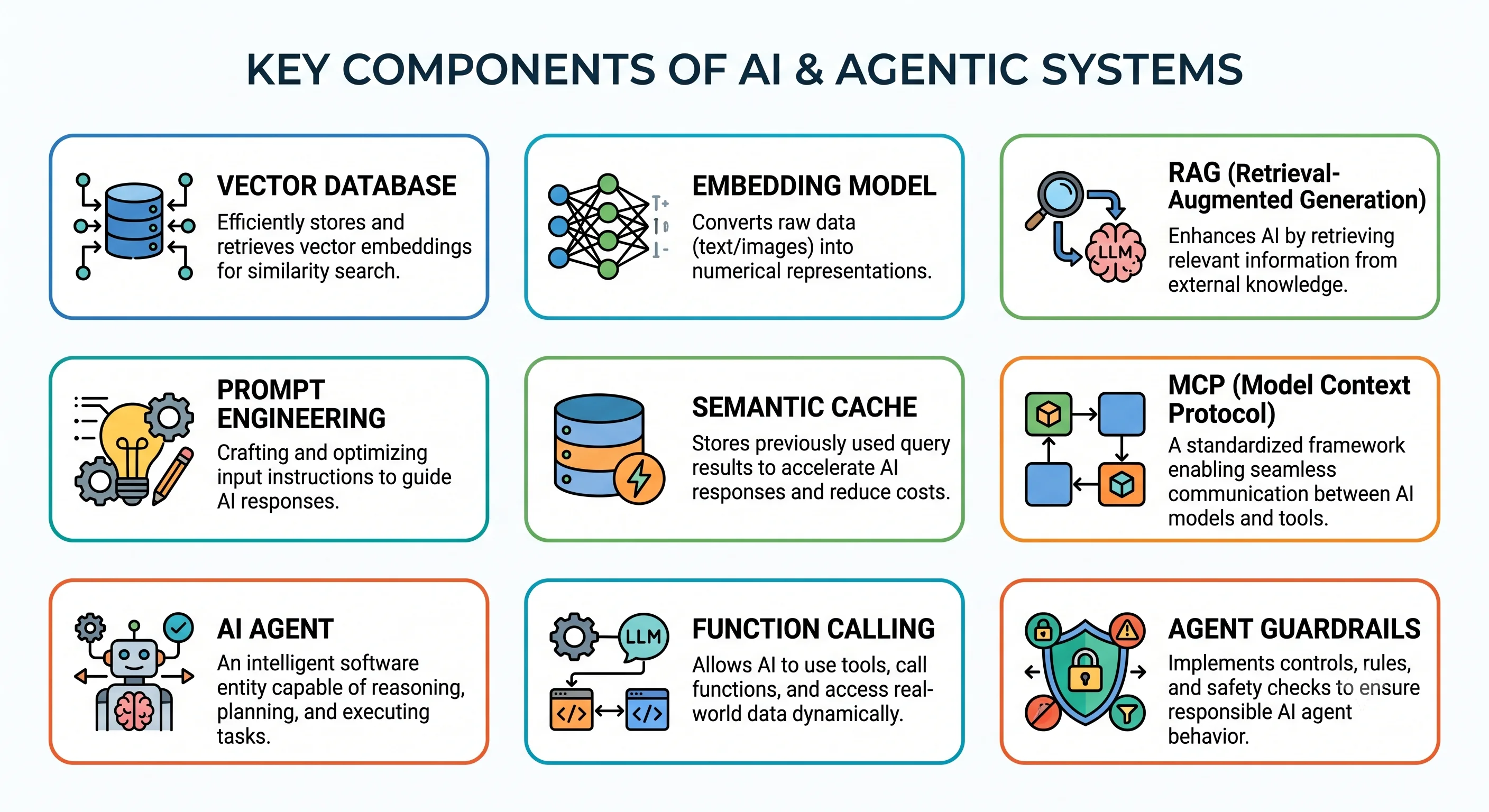
Overview of Key Concepts
Here is a high-level look at the nine foundational concepts you need to know:
| # | Concept | One-liner |
|---|---|---|
| 1 | Vector Database | Stores embeddings as vectors for semantic search and retrieval |
| 2 | Embedding Model | Converts text into high-dimensional vectors capturing semantic meaning |
| 3 | RAG | Retrieves relevant context from a knowledge base to augment LLM responses |
| 4 | Prompt Engineering | Designs effective prompts to guide LLMs for accurate and relevant responses |
| 5 | Semantic Cache | Caches similar queries and responses using semantic similarity to reduce costs |
| 6 | MCP | Standard protocol for connecting models with external data, tools, and services |
| 7 | AI Agent | Autonomous system that perceives, plans, and acts to achieve goals |
| 8 | Function Calling | LLM invokes external functions/APIs to get real-time data or take actions |
| 9 | Agent Guardrails | Enforces safety, policies, and quality checks to ensure reliable AI outputs |
How These Concepts Work Together
These nine concepts aren't isolated — they form a layered, interconnected AI system:
┌──────────────────────────────────────────────────────────────────┐
│                        USER / APPLICATION                        │
└──────────────────────────┬───────────────────────────────────────┘
                           │
                    ┌──────▼──────┐
                    │  AI AGENT   │  ← orchestrates everything
                    └──────┬──────┘
          ┌────────────────┼────────────────┐
          │                │                │
   ┌──────▼──────┐  ┌──────▼──────┐  ┌──────▼──────┐
   │  Function   │  │     RAG     │  │   Prompt    │
   │  Calling    │  │  Pipeline   │  │ Engineering │
   └──────┬──────┘  └──────┬──────┘  └─────────────┘
          │                │
   ┌──────▼──────┐  ┌──────▼──────┐  ┌─────────────┐
   │  External   │  │  Embedding  │  │  Semantic   │
   │   APIs      │  │   Model     │  │   Cache     │
   └─────────────┘  └──────┬──────┘  └─────────────┘
                           │
                    ┌──────▼──────┐
                    │   Vector    │
                    │  Database   │
                    └─────────────┘

All wrapped by:   Agent Guardrails + MCP (tool connectivity)
Sub-Pages
Dive into each concept in detail:
- 📦 Vector Database — How to store and search semantic data
- 🔢 Embedding Model — Converting meaning into numbers
- 🔍 RAG (Retrieval Augmented Generation) — Grounding LLMs in your data
- ✍️ Prompt Engineering — Communicating effectively with LLMs
- ⚡ Semantic Cache — Speed and cost optimisation
- 🔌 MCP (Model Context Protocol) — Universal tool connectivity
- 🤖 AI Agent — Autonomous, goal-driven AI systems
- 📞 Function Calling — LLMs that interact with the world
- 🛡️ Agent Guardrails — Safety, security, and policy enforcement