
2. Embedding Model
An AI/ML model that converts text, images, or other data into numerical vectors in a high-dimensional space. It bridges the gap between human language and machine computation.
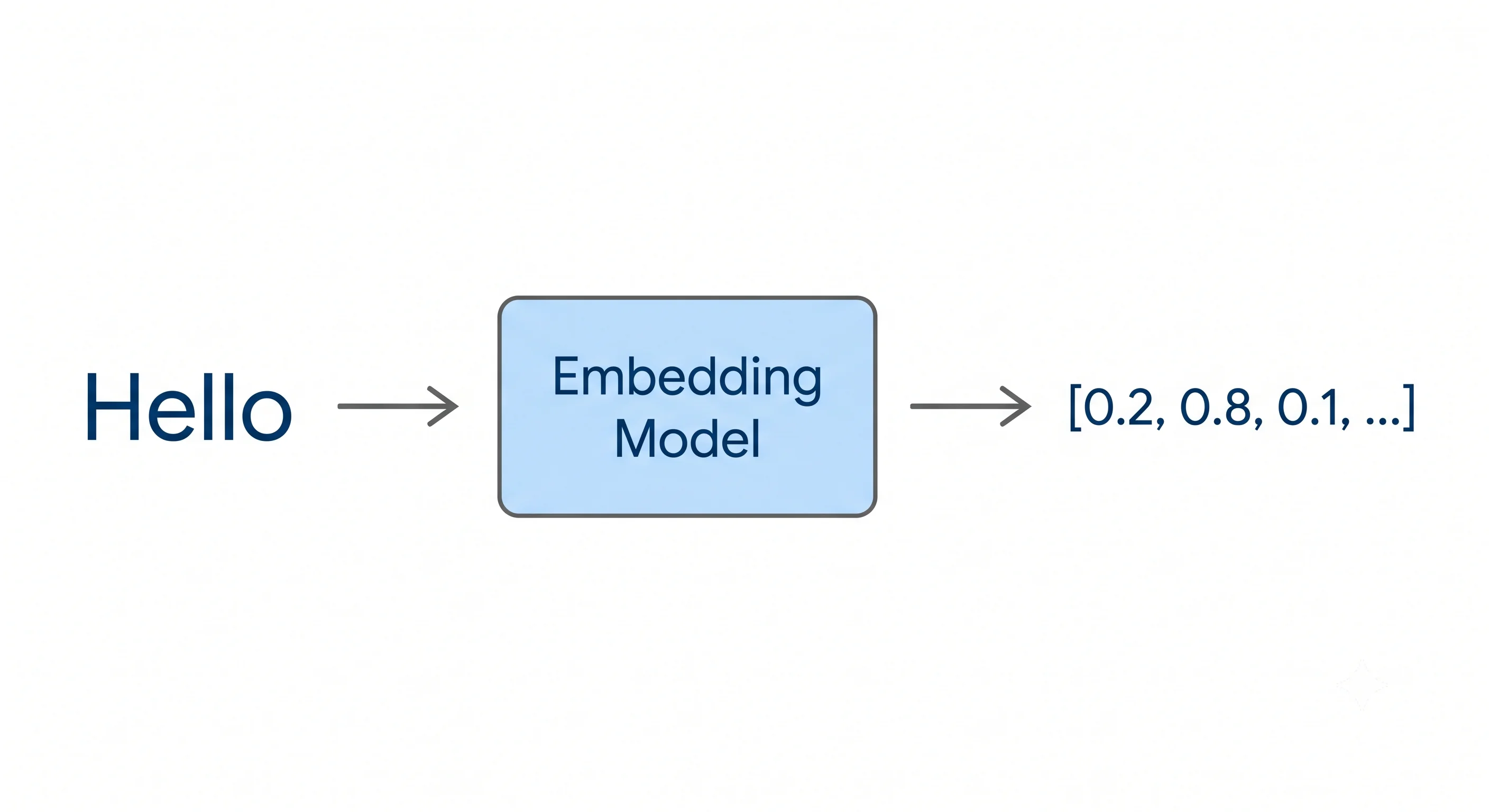
Table of Contents
- What is an Embedding Model?
- The Core Concept
- Types of Embeddings
- How Embeddings Capture Meaning
- Popular Embedding Models
- Choosing the Right Model
- Code Example
- Key Takeaway
What is an Embedding Model?
An embedding model is a neural network trained to map inputs — words, sentences, documents, images — into dense numerical vectors. These vectors live in a shared latent space where geometric proximity reflects semantic similarity.
  Input Text            Embedding Vector (1536 dimensions)
  ──────────            ──────────────────────────────────
  "I love pizza"   →   [0.21, 0.81, -0.11, 0.44, ..., 0.35]
  "I like pizza"   →   [0.19, 0.79, -0.09, 0.42, ..., 0.33]  ← very close!
  "Weather today"  →   [-0.45, 0.12, 0.66, -0.21, ..., 0.08] ← far away
The Core Concept
Embedding models are trained on massive datasets to learn that semantically similar inputs should produce numerically similar vectors. This is typically achieved via:
- Contrastive learning — pushing similar pairs closer, dissimilar pairs apart
- Masked language modelling — predicting hidden tokens to build contextual understanding
- Bi-encoder architecture — encoding two inputs independently, then comparing
The result is a model that "understands" meaning, enabling machines to reason about similarity without handcrafted rules.
Types of Embeddings
Word Embeddings
Early models that produce one vector per word. Limited — they don't capture context (the word "bank" has one vector regardless of whether it means a river bank or a financial bank).
| Model | Released | Dimensions | Notes |
|---|---|---|---|
| Word2Vec | 2013 | 100–300 | Shallow neural net, fast |
| GloVe | 2014 | 50–300 | Co-occurrence matrix based |
| FastText | 2016 | 100–300 | Subword-aware, handles rare words |
Sentence / Contextual Embeddings
Modern models produce one vector per sentence/passage, capturing full context.
| Model | Dimensions | Notes |
|---|---|---|
| Sentence-BERT (SBERT) | 384–1024 | Fast, open-source, great for similarity |
| Universal Sentence Encoder | 512 | Google, multilingual |
| E5 / BGE | 768–1024 | Strong benchmarks, open weights |
Document Embeddings
For encoding entire documents or long passages.
| Model | Provider | Notes |
|---|---|---|
text-embedding-3-small |
OpenAI | 1536 dims, great balance of quality/cost |
text-embedding-3-large |
OpenAI | 3072 dims, highest quality |
embed-english-v3.0 |
Cohere | Enterprise-grade, multilingual |
amazon-titan-embed-text |
AWS | Optimized for Bedrock ecosystem |
Multimodal Embeddings
Embed text and images into the same vector space, enabling cross-modal search.
| Model | Notes |
|---|---|
| CLIP (OpenAI) | Text ↔ Image in shared space |
| ImageBind (Meta) | Text, image, audio, video, IMU, depth |
How Embeddings Capture Meaning
Semantic Arithmetic
A famous property of embeddings: vector arithmetic preserves meaning.
vector("King") - vector("Man") + vector("Woman") ≈ vector("Queen")
vector("Paris") - vector("France") + vector("Germany") ≈ vector("Berlin")
Similarity Measurement
The most common metric for comparing embeddings is cosine similarity:
similarity = (A · B) / (|A| × |B|)

Range: -1.0 (opposite) → 0.0 (unrelated) → 1.0 (identical)| Score | Interpretation |
|---|---|
| > 0.9 | Near-identical meaning |
| 0.7–0.9 | Highly similar |
| 0.5–0.7 | Related |
| < 0.5 | Mostly unrelated |
Popular Embedding Models
                    Quality
                       ▲
              Large ●  │  ● text-embedding-3-large
                    │  │
         E5-Large ● │  │
                    │  │
      SBERT-Base ● ─┼──┼──────────────► Speed
                    │  │
         GloVe ●   │  │
Benchmark Performance (MTEB — Massive Text Embedding Benchmark)
| Model | Avg Score | Dims | Cost |
|---|---|---|---|
| text-embedding-3-large | 64.6 | 3072 | $$ |
| text-embedding-3-small | 62.3 | 1536 | $ |
| Cohere embed-v3 | 64.5 | 1024 | $$ |
| E5-large-v2 (open) | 62.2 | 1024 | Free |
| all-MiniLM-L6-v2 (open) | 56.2 | 384 | Free |
Choosing the Right Model
| Criteria | Recommendation |
|---|---|
| Best quality, don't mind cost | text-embedding-3-large (OpenAI) |
| Balanced quality/cost | text-embedding-3-small (OpenAI) |
| Open-source, high quality | E5-large-v2 or BGE-large |
| Fast, local, lightweight | all-MiniLM-L6-v2 (sentence-transformers) |
| Multilingual | Cohere embed-multilingual-v3 |
| Images + Text | CLIP or ImageBind |
⚠️ Important: When switching embedding models, you must re-embed all stored data in your vector database — different models produce incompatible vector spaces.
Code Example
Using OpenAI Embeddings (Python)
from openai import OpenAI
import numpy as np

client = OpenAI(api_key="YOUR_API_KEY")

def get_embedding(text: str, model="text-embedding-3-small") -> list[float]:
    response = client.embeddings.create(input=text, model=model)
    return response.data[0].embedding

def cosine_similarity(a: list, b: list) -> float:
    a, b = np.array(a), np.array(b)
    return np.dot(a, b) / (np.linalg.norm(a) * np.linalg.norm(b))

# Generate embeddings
emb1 = get_embedding("I love pizza")
emb2 = get_embedding("I really enjoy eating pizza")
emb3 = get_embedding("The stock market crashed today")

print(cosine_similarity(emb1, emb2))  # → ~0.93 (very similar)
print(cosine_similarity(emb1, emb3))  # → ~0.12 (unrelated)
Using sentence-transformers (local, free)
from sentence_transformers import SentenceTransformer

model = SentenceTransformer("all-MiniLM-L6-v2")

sentences = [
    "I love pizza",
    "I enjoy eating pizza",
    "The weather is nice today"
]

embeddings = model.encode(sentences)
print(embeddings.shape)  # → (3, 384)

# Compute similarity matrix
similarities = model.similarity(embeddings, embeddings)
print(similarities)
Key Takeaway
Embedding Models transform text (and other data) into numerical vectors that machines can understand, enabling semantic similarity search, smarter retrieval, and the foundation for RAG, recommendation systems, and modern AI memory.