
3. RAG (Retrieval Augmented Generation)
RAG combines the power of retrieval (searching relevant information) with generation (LLM) to provide accurate, up-to-date, and context-aware answers — grounding the AI in your specific data.
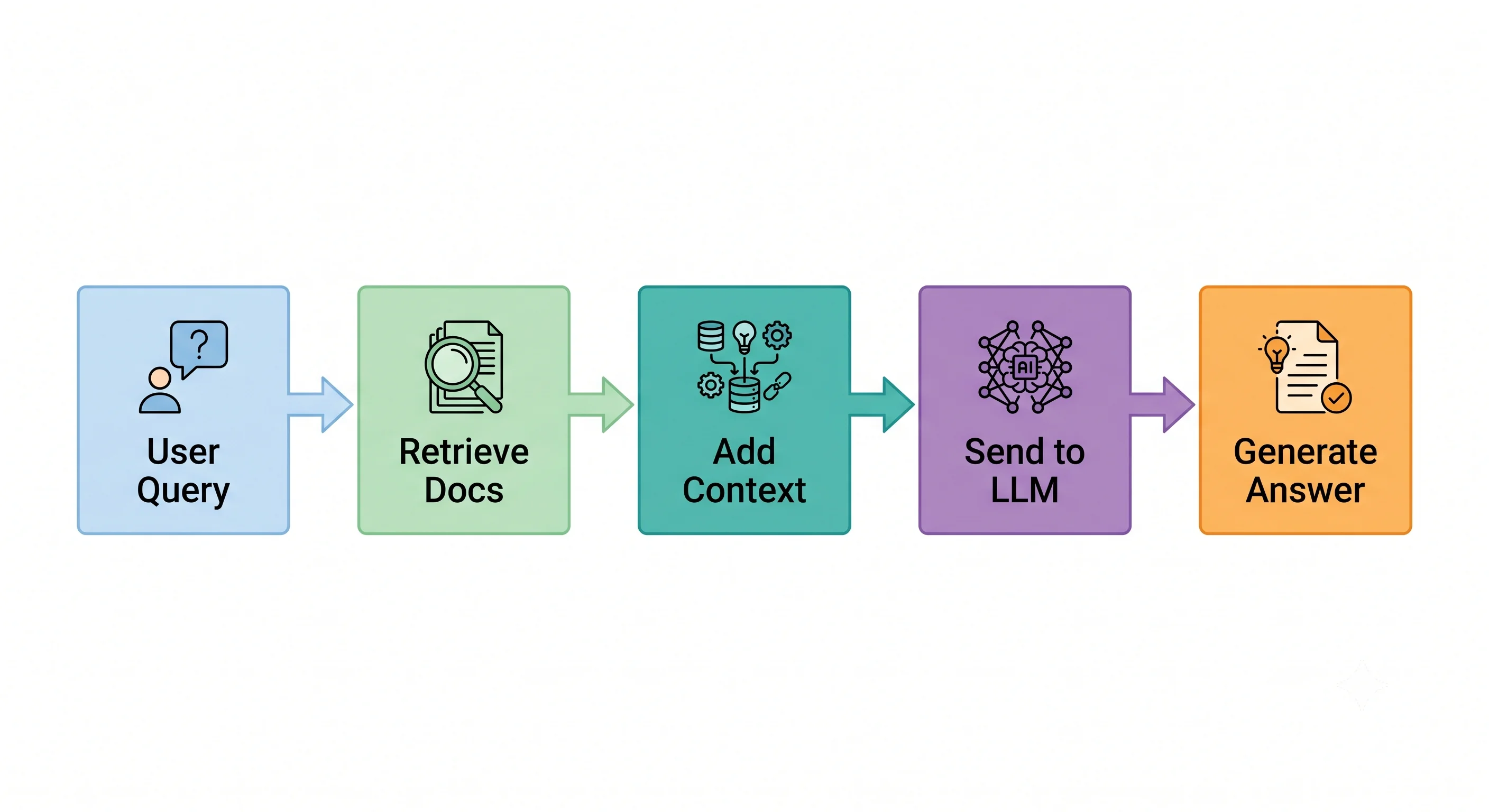
Table of Contents
- What is RAG?
- Why RAG?
- The RAG Pipeline
- RAG vs. Fine-tuning vs. Prompt Stuffing
- RAG Patterns
- Chunking Strategies
- Evaluation Metrics
- Code Example
- Key Takeaway
What is RAG?
Retrieval Augmented Generation (RAG) is an architectural pattern that enhances LLM responses by injecting relevant, retrieved context into the prompt at query time. Instead of relying on the model's static training knowledge, RAG dynamically pulls the most relevant information from an external knowledge base.
Without RAG:  User Query → LLM → Answer (from training data, may be stale/wrong)

With RAG:     User Query → Retrieve relevant docs → LLM + Context → Accurate Answer
Why RAG?
Large Language Models have real limitations:
| Problem | RAG Solution |
|---|---|
| Knowledge cutoff — training data is static | Retrieve fresh, real-time documents |
| Hallucinations — model makes up facts | Ground answers in retrieved evidence |
| Private data — model doesn't know your internal docs | Index your own knowledge base |
| Expensive fine-tuning — retraining costs millions | No retraining needed; just update the index |
| No citations — can't verify where answer came from | Return source documents alongside answer |
The RAG Pipeline
┌──────────────────────────────────────────────────────────┐
│                    INDEXING (Offline)                    │
│                                                          │
│  Documents → Chunking → Embedding → Vector Store         │
└──────────────────────────────────────────────────────────┘

┌──────────────────────────────────────────────────────────┐
│                   RETRIEVAL (Online)                     │
│                                                          │
│  User Query                                              │
│      │                                                   │
│      ▼                                                   │
│  Embed Query  ──→  Vector Search  ──→  Top-K Chunks      │
│                                                          │
│      ▼                                                   │
│  Build Prompt:                                           │
│  "Answer using this context: {chunks}\n\nQ: {query}"     │
│                                                          │
│      ▼                                                   │
│  LLM generates grounded answer with citations           │
└──────────────────────────────────────────────────────────┘
Step-by-Step
Indexing phase (run once / periodically):
- Load — Ingest documents (PDFs, web pages, databases, APIs)
- Chunk — Split documents into smaller passages (e.g., 512 tokens with overlap)
- Embed — Convert each chunk into a vector using an embedding model
- Store — Save vectors + metadata in a vector database
Retrieval phase (every query):
- Embed query — Convert the user's question into a vector
- Retrieve — Search the vector database for top-K semantically similar chunks
- Re-rank (optional) — Re-rank retrieved chunks for relevance using a cross-encoder
- Augment — Inject retrieved chunks into the LLM prompt as context
- Generate — LLM produces an answer grounded in the retrieved context
RAG vs. Fine-tuning vs. Prompt Stuffing
| Approach | When to Use | Pros | Cons |
|---|---|---|---|
| RAG | Dynamic, frequently changing knowledge | Fresh data, no retraining, citable | Retrieval quality critical |
| Fine-tuning | Stable domain knowledge, style/tone | Deep expertise, fast inference | Expensive, knowledge goes stale |
| Prompt Stuffing | Small, fixed context | Simple, no infrastructure | Context window limits, expensive |
| RAG + Fine-tuning | Best of both worlds | Most accurate | Most complex |
RAG Patterns
RAG has evolved through three generations. Each sub-page covers one pattern in depth:
| Pattern | Description | Sub-page |
|---|---|---|
| Naive RAG | Simple retrieve-and-generate. Fixed pipeline, good for prototyping. | (covered above) |
| Advanced RAG | Smarter queries, hybrid search, re-ranking, and contextual compression. | Advanced RAG → |
| Modular RAG | Fully composable pipeline with swappable, independent modules. | Modular RAG → |
| Agentic RAG | An AI agent controls retrieval — deciding when, where, and how many times to retrieve. | Agentic RAG → |
Chunking Strategies
How you split documents dramatically affects retrieval quality:
| Strategy | Description | Best For |
|---|---|---|
| Fixed-size | Split every N tokens | Quick setup, general use |
| Sentence splitting | Split at sentence boundaries | Conversational text |
| Recursive character | Tries paragraph → sentence → word | Most documents (LangChain default) |
| Semantic chunking | Split when topic changes (embedding-based) | Highest quality, slower |
| Document structure | Split by heading / section | Structured docs (Markdown, HTML) |
Overlap: Always add a small overlap (e.g., 50–100 tokens) between chunks to preserve context across boundaries.
Evaluation Metrics
| Metric | Measures | Tool |
|---|---|---|
| Faithfulness | Does the answer stick to retrieved context? | RAGAS, TruLens |
| Answer Relevancy | Is the answer relevant to the question? | RAGAS |
| Context Precision | Are retrieved chunks actually useful? | RAGAS |
| Context Recall | Did we retrieve all needed information? | RAGAS |
| Latency | End-to-end response time | Custom monitoring |
Code Example
A minimal RAG system using LangChain + Chroma + OpenAI:
from langchain_openai import OpenAIEmbeddings, ChatOpenAI
from langchain_chroma import Chroma
from langchain.text_splitter import RecursiveCharacterTextSplitter
from langchain.chains import RetrievalQA
from langchain_community.document_loaders import TextLoader

# 1. Load documents
loader = TextLoader("company_policy.txt")
documents = loader.load()

# 2. Chunk documents
splitter = RecursiveCharacterTextSplitter(
    chunk_size=500,
    chunk_overlap=50
)
chunks = splitter.split_documents(documents)

# 3. Embed and store in vector database
embeddings = OpenAIEmbeddings(model="text-embedding-3-small")
vectorstore = Chroma.from_documents(chunks, embeddings)

# 4. Create retriever
retriever = vectorstore.as_retriever(search_kwargs={"k": 3})

# 5. Build RAG chain
llm = ChatOpenAI(model="gpt-4o", temperature=0)
rag_chain = RetrievalQA.from_chain_type(
    llm=llm,
    retriever=retriever,
    return_source_documents=True
)

# 6. Query
result = rag_chain.invoke({"query": "What is our refund policy?"})
print(result["result"])
print("Sources:", [doc.metadata for doc in result["source_documents"]])
Key Takeaway
RAG enhances LLMs by grounding their answers in your own data — delivering accurate, relevant, and trustworthy responses with citations, while avoiding hallucinations and knowledge staleness.