
Agentic RAG
Agentic RAG gives the retrieval process to an AI agent — letting it decide when to retrieve, what to search for, how many times to retrieve, and whether the results are good enough before generating an answer.
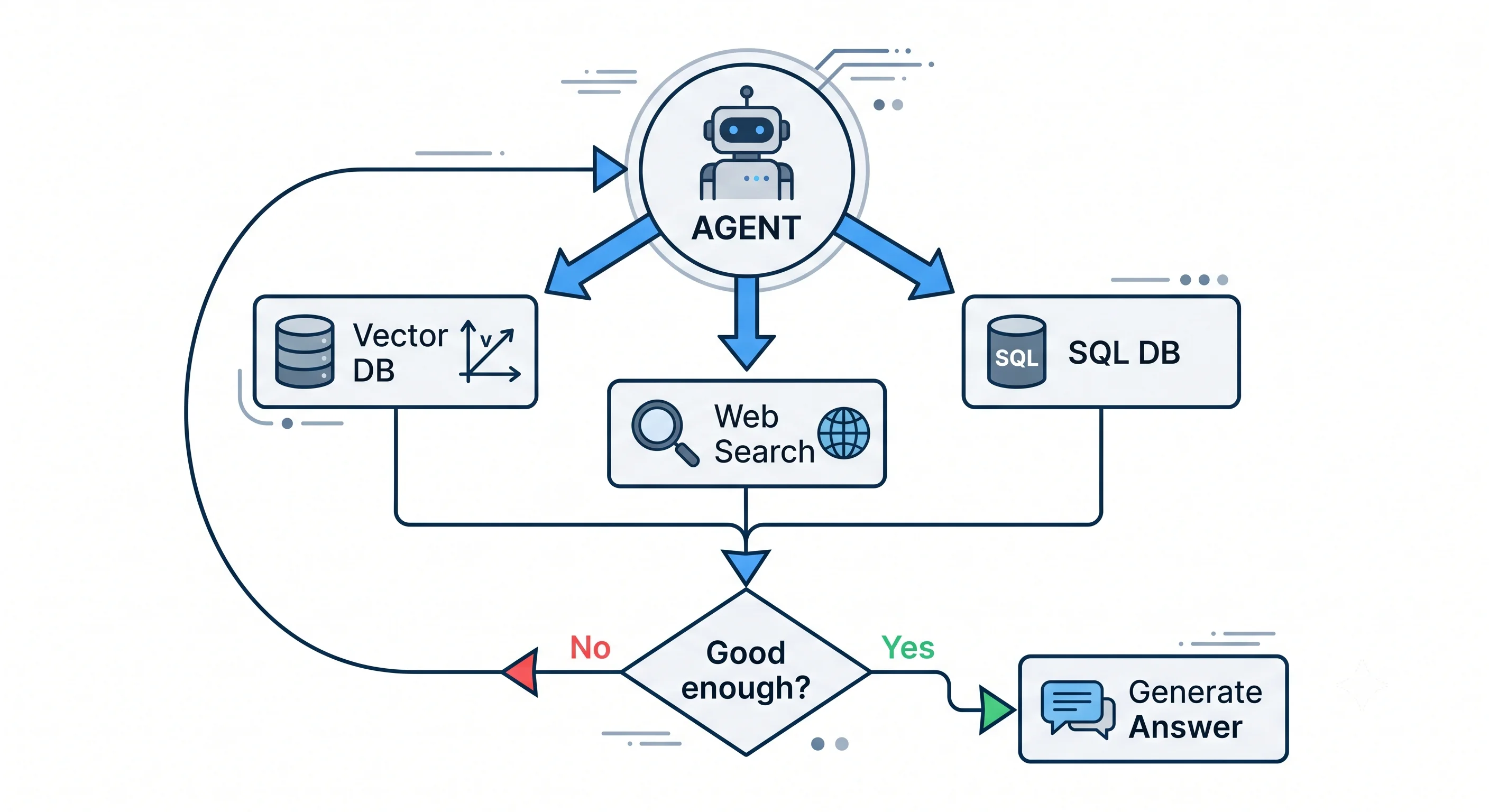
Table of Contents
- What is Agentic RAG?
- How It Differs from Standard RAG
- Core Agentic RAG Patterns
- The Agentic RAG Loop
- Multi-Agent RAG
- Tools an Agentic RAG System Uses
- Challenges & Trade-offs
- Nano Banana Image Prompt
- Key Takeaway
What is Agentic RAG?
In standard RAG, retrieval is passive — it always fires once, retrieves top-K chunks, and hands them to the LLM. There is no judgment about whether the retrieved content is good, whether more retrieval is needed, or whether the question requires multi-step reasoning.
Agentic RAG makes retrieval active. An LLM agent controls the entire process:
- Should I retrieve at all, or do I already know the answer?
- What is the best search query for this question?
- Are the retrieved documents actually useful?
- Do I need to search again with a different query?
- Should I search a different source?
Standard RAG:   Query → Retrieve (once) → Generate → Done

Agentic RAG:    Query → Agent decides →
                         ├─ Retrieve? (maybe not needed)
                         ├─ Which tool? (vector DB, web, SQL)
                         ├─ Good enough? (self-critique)
                         ├─ Retrieve again? (refine query)
                         └─ Generate → Done
How It Differs from Standard RAG
| Dimension | Standard RAG | Agentic RAG |
|---|---|---|
| Retrieval decision | Always retrieves | Agent decides if retrieval is needed |
| Number of retrievals | Fixed (1 round) | Dynamic (0, 1, or many rounds) |
| Query formulation | Direct from user input | Agent reformulates for best results |
| Result evaluation | None — uses whatever was retrieved | Agent critiques and rejects poor results |
| Tool selection | Single retriever | Chooses from multiple tools dynamically |
| Complexity | Low | High |
| Latency | Fast | Slower (multiple LLM calls) |
Core Agentic RAG Patterns
Self-RAG
The model generates a reflection token to decide whether retrieval is needed, then critiques the retrieved documents and its own output.
Steps:
1. [Retrieve?]    → YES / NO  (model decides)
2. [Retrieve]     → Fetch documents
3. [Is Relevant?] → YES / NO  (model grades each document)
4. [Is Supported?]→ Model checks if its answer is grounded in docs
5. [Is Useful?]   → Model rates its own response quality
6. Retry or return final answer
Corrective RAG (CRAG)
Evaluates retrieved documents with a grader. If quality is too low, falls back to web search.
Retrieve from vector store
      │
      ▼
Grade documents (LLM)
      │
  ┌───┴───────────────────────────┐
  │                               │
Relevant ✅                  Not Relevant ❌
      │                               │
Generate answer            Web Search fallback
                                   │
                           Grade web results
                                   │
                           Generate answer
Multi-hop RAG
For complex questions that require chaining multiple retrievals:
Q: "What technique did the team that won the 2023 ML competition use for retrieval?"

Hop 1: Search → "Who won the 2023 ML competition?" → "Team Hydra won"
Hop 2: Search → "What retrieval technique did Team Hydra use?" → "Hybrid BM25 + dense"
Answer: "Team Hydra used hybrid BM25 + dense retrieval"
Adaptive RAG
Classifies the query complexity first, then routes to the appropriate retrieval strategy:
Query → Classifier
              ├─ [Simple]   → No retrieval (model already knows)
              ├─ [Single-hop] → Standard RAG
              └─ [Multi-hop]  → Agentic multi-step RAG
The Agentic RAG Loop
┌─────────────────────────────────────────────────────┐
│                  AGENTIC RAG LOOP                   │
│                                                     │
│   User Query                                        │
│       │                                             │
│       ▼                                             │
│   ┌──────────────────────────────────────────────┐  │
│   │              AGENT (LLM)                     │  │
│   │                                              │  │
│   │  1. Analyse query                            │  │
│   │  2. Plan retrieval strategy                  │  │
│   │  3. Call retrieval tool(s)                   │  │
│   │  4. Evaluate retrieved docs                  │  │
│   │  5. Refine query if needed → loop back       │  │
│   │  6. Generate final answer                    │  │
│   └──────────────────────────────────────────────┘  │
│                          │                          │
│          ┌───────────────┼───────────────┐          │
│          ▼               ▼               ▼          │
│     Vector DB       Web Search       SQL DB         │
└─────────────────────────────────────────────────────┘
Multi-Agent RAG
For very complex tasks, you can distribute RAG across specialised agents:
Orchestrator Agent
├── Research Agent     → Searches multiple sources, grades results
├── Synthesis Agent    → Combines retrieved info into coherent context
├── Generation Agent   → Produces the final answer
└── Critique Agent     → Validates the answer against sources
This is used in advanced applications like autonomous research assistants, due diligence tools, and complex Q&A systems.
Tools an Agentic RAG System Uses
| Tool | Purpose |
|---|---|
vector_search |
Semantic search in private knowledge base |
web_search |
Live internet search fallback |
sql_query |
Query structured databases |
document_reader |
Parse and extract from raw files |
grade_documents |
LLM-based relevance scoring |
rewrite_query |
Reformulate query for better retrieval |
Challenges & Trade-offs
| Challenge | Detail |
|---|---|
| Latency | Multiple LLM calls per query → slower response |
| Cost | More token usage per query |
| Reliability | Agent can get stuck in loops if not managed |
| Debugging | Harder to trace why a specific retrieval decision was made |
| Mitigation | Set max iteration limits; add structured logging; use LangGraph for state management |
Nano Banana Image Prompt
A macro shot of a tiny nano banana sitting in a control room with multiple screens, actively choosing which screen (labelled "Vector DB", "Web Search", "SQL") to retrieve from, while holding a checklist to grade the results. Clean white background, flat illustration style.
Key Takeaway
Agentic RAG puts an intelligent agent in control of the retrieval process — dynamically deciding when to retrieve, from where, and whether the results are good enough — unlocking the ability to answer complex, multi-step questions that standard RAG cannot handle.