
1. Vector Database
A specialized database designed to store, index, and retrieve high-dimensional vectors (embeddings) efficiently. It is the backbone of semantic memory for modern AI systems.
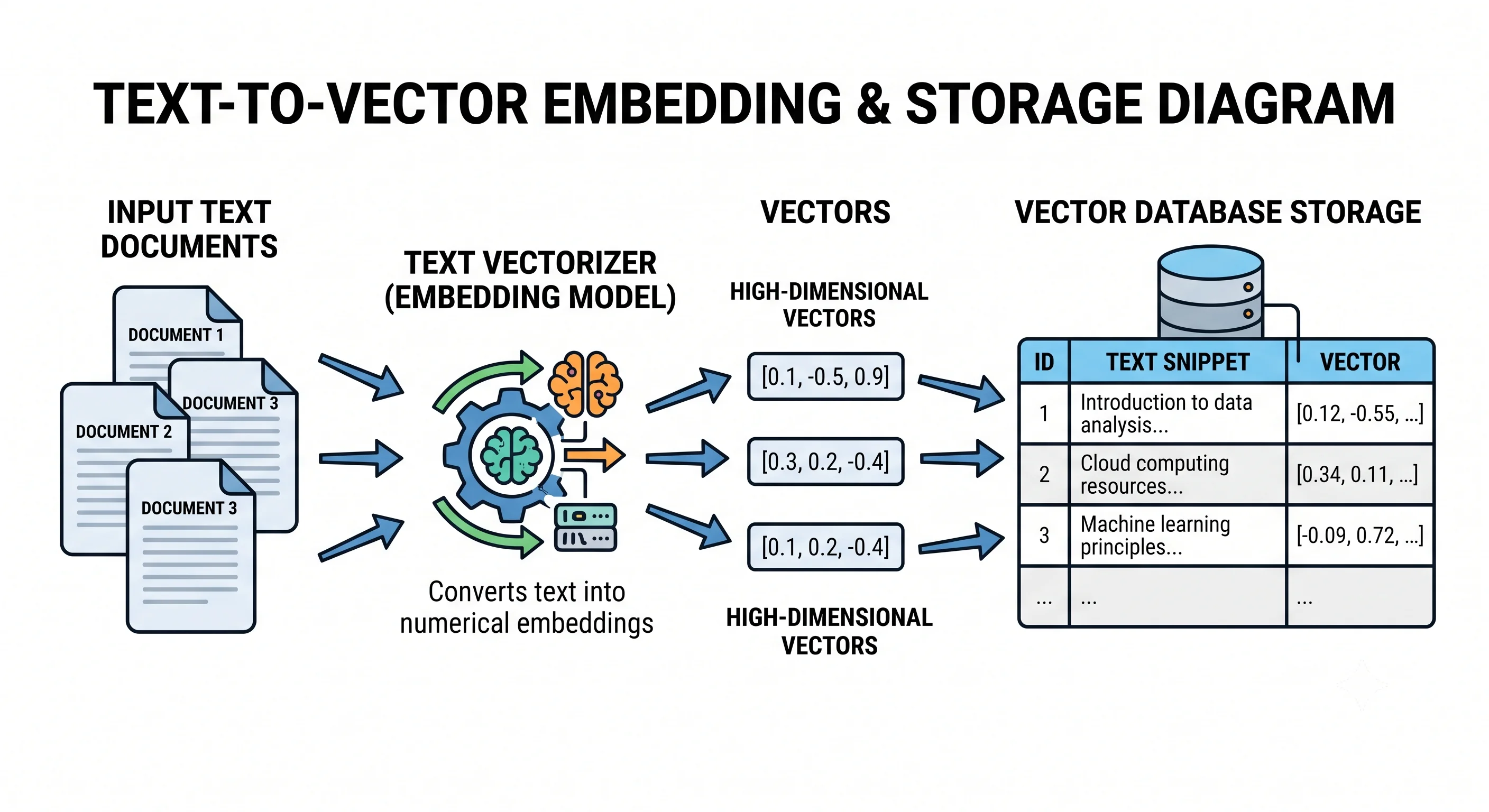
Table of Contents
- What is a Vector Database?
- How It Works
- Vector Representation & Similarity
- Indexing Algorithms
- Popular Vector Databases
- When to Use a Vector Database
- Code Example
- Key Takeaway
What is a Vector Database?
Traditional databases store structured data and query it using exact matches (e.g., WHERE name = 'Alice'). Vector databases are fundamentally different — they store data as high-dimensional numerical vectors and retrieve results based on semantic similarity rather than exact matches.
This makes them perfect for use cases where meaning matters more than keywords:
| Traditional DB | Vector DB |
|---|---|
| Exact keyword match | Semantic similarity search |
| Structured (rows & columns) | Unstructured (text, images, audio) |
| SQL queries | Nearest-neighbour queries |
| Fast for exact lookups | Fast for similarity lookups |
How It Works
Raw Data (Text / Image / Audio)
        │
        ▼
  Embedding Model
  (e.g., OpenAI, Cohere)
        │
        ▼
  High-Dimensional Vector
  e.g., [0.21, 0.83, -0.11, ..., 0.35]  (768 or 1536 dimensions)
        │
        ▼
  Stored in Vector Database
  with metadata { id, source, timestamp, ... }
        │
        ▼
  Similarity Search (ANN query)
        │
        ▼
  Top-K Most Relevant Results
Step-by-step:
- Data Ingestion — Raw data (text, image, audio, video) is fed into the pipeline.
- Embedding Generation — An embedding model converts the data into a numerical vector.
- Storage — The vector and its metadata are stored in the vector database.
- Query — At query time, the user's query is also embedded and compared against stored vectors.
- Retrieval — The database returns the top-K most similar vectors using an ANN (Approximate Nearest Neighbour) algorithm.
Vector Representation & Similarity
In a high-dimensional vector space, semantic meaning maps to geometric proximity:
        Vector Space (simplified 2D)

   [AI]  ●─────● [Machine Learning]
          \   /
           \ /
            ● [Deep Learning]


                        ● [Pizza Recipe]
Items with similar meaning cluster together. This allows queries like:
- "Find all documents similar to this one"
- "What products are most similar to what this user liked?"
Similarity metrics used:
- Cosine Similarity — measures the angle between vectors (most common for text)
- Euclidean Distance — measures straight-line distance
- Dot Product — efficient for normalized vectors
Indexing Algorithms
Brute-force comparison across millions of vectors is too slow. Vector databases use Approximate Nearest Neighbour (ANN) indexing:
| Algorithm | Description | Best For |
|---|---|---|
| HNSW (Hierarchical Navigable Small World) | Graph-based, high recall, fast query | General purpose, production |
| IVF (Inverted File Index) | Clusters vectors, searches relevant clusters | Large datasets |
| Flat | Brute-force exact search | Small datasets, max accuracy |
| PQ (Product Quantization) | Compresses vectors to save memory | Memory-constrained systems |
Popular Vector Databases
| Database | Type | Highlights |
|---|---|---|
| Pinecone | Managed cloud | Easy setup, auto-scaling, production-ready |
| Weaviate | Open-source / Cloud | GraphQL API, built-in ML models |
| Qdrant | Open-source / Cloud | High performance, Rust-based |
| Chroma | Open-source | Lightweight, great for local dev & RAG |
| Milvus | Open-source | Highly scalable, cloud-native |
| pgvector | PostgreSQL extension | Add vector search to existing Postgres DB |
| Redis VSS | In-memory | Ultra-fast, existing Redis infrastructure |
When to Use a Vector Database
✅ Semantic search — Search by meaning, not just keywords
✅ RAG (Retrieval Augmented Generation) — Ground LLMs in your private data
✅ Recommendation systems — "People who liked X also liked Y"
✅ Duplicate detection — Find near-duplicate documents or images
✅ Anomaly detection — Identify data points far from known clusters
✅ Chatbots with memory — Store and retrieve past conversation context
Code Example
A minimal example using Chroma (Python):
import chromadb
from chromadb.utils import embedding_functions

# Initialize client
client = chromadb.Client()

# Use OpenAI embeddings
openai_ef = embedding_functions.OpenAIEmbeddingFunction(
    api_key="YOUR_API_KEY",
    model_name="text-embedding-3-small"
)

# Create a collection
collection = client.create_collection(
    name="ai_docs",
    embedding_function=openai_ef
)

# Add documents (embeddings are auto-generated)
collection.add(
    documents=[
        "Vector databases store embeddings for semantic search.",
        "RAG combines retrieval with language model generation.",
        "Embeddings are numerical representations of meaning."
    ],
    ids=["doc1", "doc2", "doc3"]
)

# Query by semantic similarity
results = collection.query(
    query_texts=["How do I search by meaning?"],
    n_results=2
)

print(results["documents"])
# → Returns the 2 most semantically similar documents
Key Takeaway
Vector Databases store data as vectors (embeddings) in high-dimensional space, enabling machines to understand meaning and find the most relevant results — powering semantic search, RAG, recommendations, and modern AI memory systems.
← Back to Overview | Next: Embedding Model →