
Modular RAG
Modular RAG breaks the retrieval pipeline into independent, swappable components — giving you full control to mix, replace, or extend each stage without rebuilding the whole system.
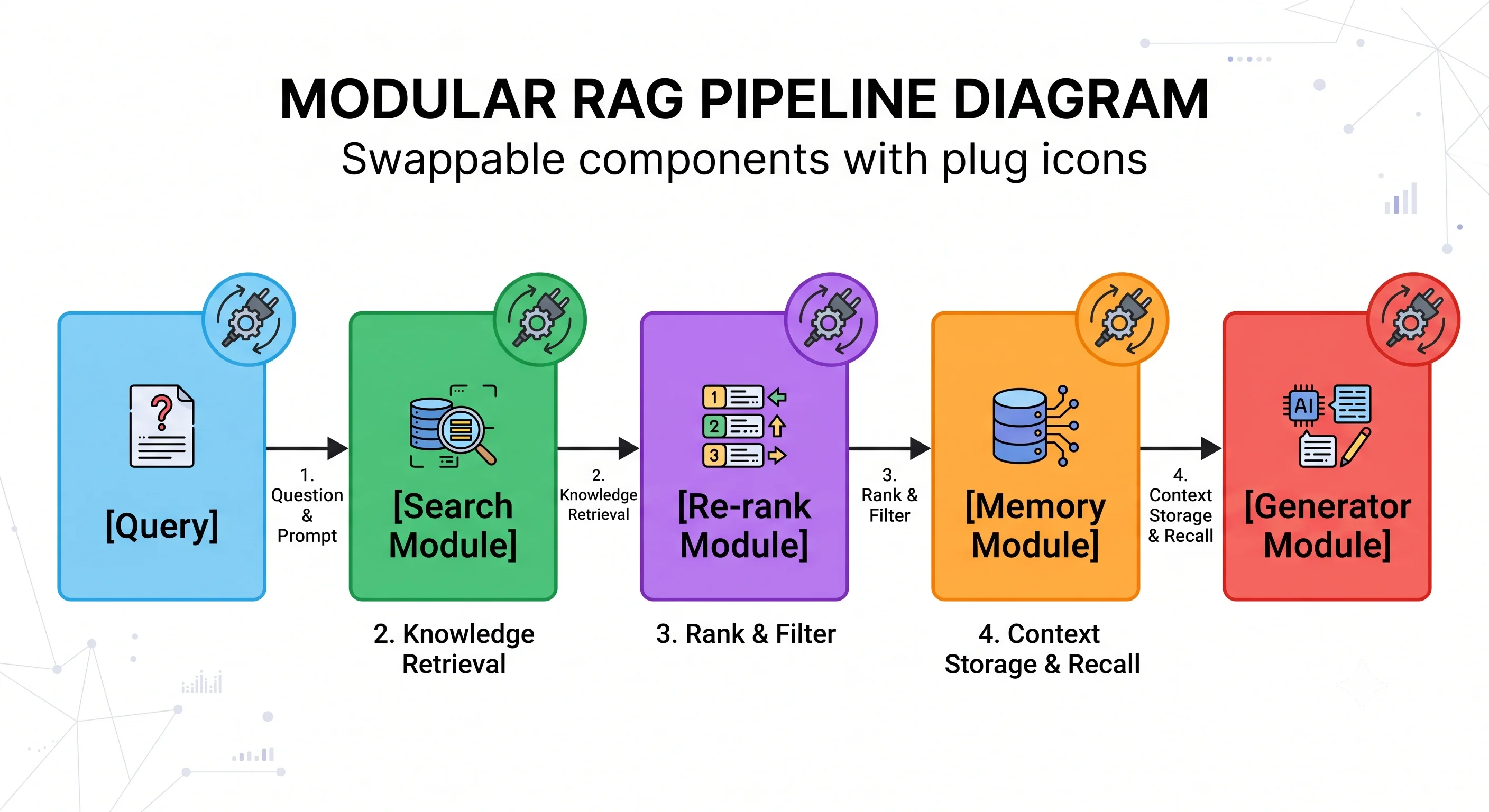
Table of Contents
- What is Modular RAG?
- The Module Library
- Common Modular Patterns
- Modular vs. Naive vs. Advanced RAG
- When to Use Modular RAG
- Nano Banana Image Prompt
- Key Takeaway
What is Modular RAG?
In Naive and Advanced RAG, the pipeline is mostly linear and tightly coupled. Modular RAG takes a different approach — it treats each stage of the pipeline as an independent, interchangeable module.
You can:
- Swap one retriever for another without touching the rest
- Add a new module (e.g., a memory module) between any two stages
- Run modules in parallel, sequence, or conditionally
- Compose entirely custom pipelines for your specific use case
Naive RAG:    [Query] → [Retriever] → [Generator]   (fixed, linear)

Modular RAG:  [Query] → [Search Module]
                               ↓
                      [Filter Module]
                               ↓
                      [Re-rank Module]
                               ↓
                      [Memory Module]
                               ↓
                      [Generator Module]   (composable, swappable)
The Module Library
Modular RAG defines a catalogue of reusable modules:
Search Modules
Handle how content is retrieved from the knowledge base.
| Module | Description |
|---|---|
| Dense Retriever | Semantic search using vector embeddings |
| Sparse Retriever | Keyword search using BM25/TF-IDF |
| Hybrid Retriever | Combines dense + sparse |
| Web Search | Live internet retrieval (Tavily, SerpAPI) |
| SQL Retriever | Queries structured databases |
| Graph Retriever | Traverses knowledge graphs |
Memory Modules
Manage what the system remembers across turns.
| Module | Description |
|---|---|
| Conversation Memory | Recent chat history in context window |
| Entity Memory | Tracks key entities mentioned by user |
| Summary Memory | Compresses old history into summaries |
| Long-term Memory | External vector store for persistent recall |
Processing Modules
Transform, filter, or enrich retrieved content.
| Module | Description |
|---|---|
| Query Rewriter | Improves the query before retrieval |
| Re-ranker | Scores retrieved chunks by relevance |
| Compressor | Extracts only relevant sentences |
| Fusion | Merges results from multiple retrievers |
Generation Modules
Control how the LLM produces its output.
| Module | Description |
|---|---|
| Standard Generator | Basic LLM call with context |
| Chain-of-Thought | Forces step-by-step reasoning |
| Citation Generator | Appends source references to output |
| Self-Critique | Model reviews and revises its own answer |
Common Modular Patterns
Pattern 1: Sequential (Standard)
Modules execute one after another in a fixed order.
Query → Rewriter → Hybrid Retriever → Re-ranker → Compressor → LLM → AnswerPattern 2: Conditional (Routing)
Route the query to different retrieval paths based on its type.
Query → Classifier
              ├─ [Factual]     → SQL Retriever → LLM
              ├─ [Semantic]    → Dense Retriever → Re-ranker → LLM
              └─ [Current]     → Web Search → LLM
Pattern 3: Parallel (Fusion)
Run multiple retrievers simultaneously, then merge results.
Query ──→ Dense Retriever ──→ ┐
       ──→ Sparse Retriever ──→ Fusion Module → Re-ranker → LLM
       ──→ Web Search ────────→ ┘
Pattern 4: Iterative (Multi-hop)
Loop through retrieval multiple times, using each result to refine the next query.
Query → Retrieve → Partial Answer → New Query → Retrieve → Final AnswerModular vs. Naive vs. Advanced RAG
| Dimension | Naive RAG | Advanced RAG | Modular RAG |
|---|---|---|---|
| Pipeline structure | Linear, fixed | Linear + enhancements | Composable, graph-like |
| Flexibility | Low | Medium | High |
| Complexity | Low | Medium | High |
| Custom routing | ❌ | ❌ | ✅ |
| Parallel retrieval | ❌ | ❌ | ✅ |
| Swappable components | ❌ | ⚠️ Partial | ✅ |
| Best for | Prototyping | Production quality | Complex enterprise systems |
When to Use Modular RAG
✅ You need to handle multiple query types differently (factual vs. conversational vs. real-time)
✅ You want to A/B test different retrievers or re-rankers
✅ Your use case requires parallel retrieval from multiple sources
✅ You need enterprise-grade flexibility without rewriting the whole pipeline
✅ You're building a platform where different teams plug in their own modules
Nano Banana Image Prompt
A macro shot of a tiny nano banana standing at a LEGO-like assembly table, snapping together colourful modular pipeline blocks labelled "Retriever", "Re-ranker", "Memory", and "Generator" into a custom chain. Clean white background, flat illustration style.
Key Takeaway
Modular RAG gives you maximum flexibility by treating every step of the RAG pipeline as a swappable, composable module — enabling conditional routing, parallel retrieval, and enterprise-grade customisation without coupling.