
Regions and Availability
Goal: understand the geography every AWS design sits on. By the end you should know which boundary
is the failure domain and which is the isolation domain, why your us-east-1a isn't the same place
as someone else's, and what multi-region actually costs before you promise it to anyone.
1. Regions
The analogy: a region is a city. AWS operates in many of them, and by default what happens in one city stays there.
The technical version: a region is a named, geographically separate cluster of data centres —
us-east-1 (N. Virginia), eu-west-1 (Ireland), ap-southeast-2 (Sydney). Each has its own service
endpoints, its own resource namespace, and its own quotas.
Regions are isolated from each other by design. This is the property that matters most and the one people accidentally rely on without noticing:
- Resources do not replicate between regions unless you configure replication explicitly.
- Most resource identifiers are region-scoped. An AMI ID, a subnet ID, a security group ID mean nothing in another region.
- A region-wide event does not, by design, cascade into other regions.
- Quotas are per region — a new region starts you at defaults, however much headroom you arranged elsewhere. See ARNs, Tagging & Quotas.
That isolation is deliberate. It's also why "just fail over to another region" is a much bigger project than it sounds: nothing is there unless you put it there.
AWS has no equivalent of Azure's paired regions. There is no automatic partner region, no platform-managed replication between a designated pair, and no guaranteed sequential update ordering. If you want a second region, you choose it, you replicate to it, and you keep it current. Anyone arriving from Azure should unlearn this expectation early.
2. Availability Zones
The analogy: if a region is a city, an AZ is a building — or a small campus of them — far enough from its siblings that one flooding doesn't flood the others, close enough that walking between them takes moments.
The technical version: an Availability Zone is one or more discrete data centres within a region, with independent power, cooling, and physical security, connected to sibling AZs by high-bandwidth, low-latency private links.
| Property | Detail |
|---|---|
| Separation | Meaningfully distant — far enough to avoid correlated physical failure |
| Inter-AZ latency | Low single-digit milliseconds — synchronous replication is practical |
| Inter-AZ traffic | Charged per GB, in both directions |
| Count per region | Most regions have three or more; some older ones have two. ⚠️ verify per region |
| Purpose | The unit of correlated failure you design around |
AZ names are shuffled per account
This one catches nearly everyone. us-east-1a in your account and us-east-1a in mine are probably
different physical zones. AWS randomises the name-to-zone mapping per account, specifically so that
customers don't all pile into "a" and leave the others idle.
The consequence: AZ names are not comparable across accounts. When it genuinely matters — a shared VPC, a cross-account latency-sensitive placement, comparing capacity notes with another team — use the AZ ID, which is consistent:
aws ec2 describe-availability-zones \
  --query 'AvailabilityZones[].[ZoneName,ZoneId,State]' --output table
# eu-west-1a   euw1-az2   available     ← ZoneId is the stable identifier
# eu-west-1b   euw1-az1   available
# eu-west-1c   euw1-az3   available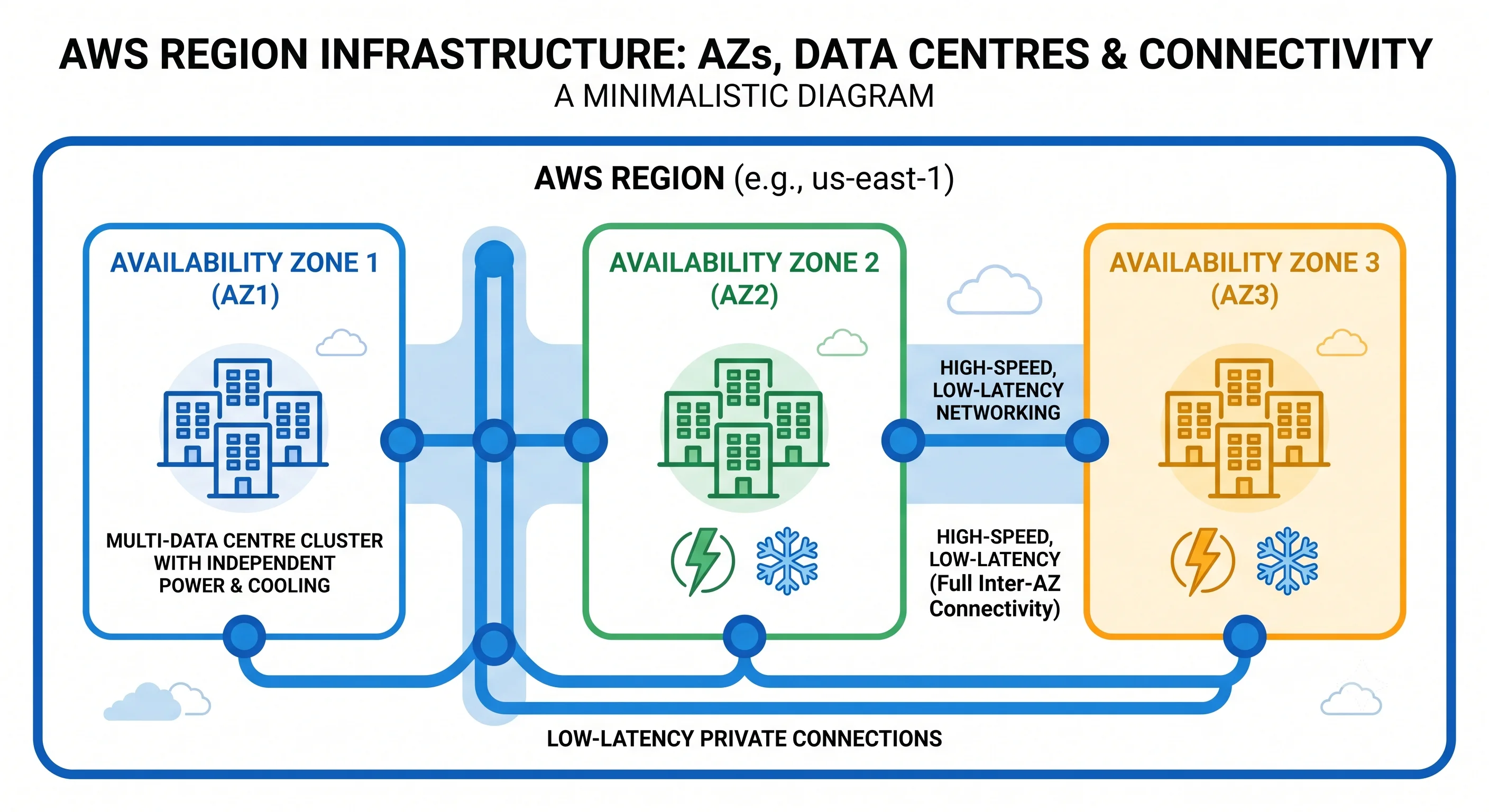
3. Global, regional, zonal
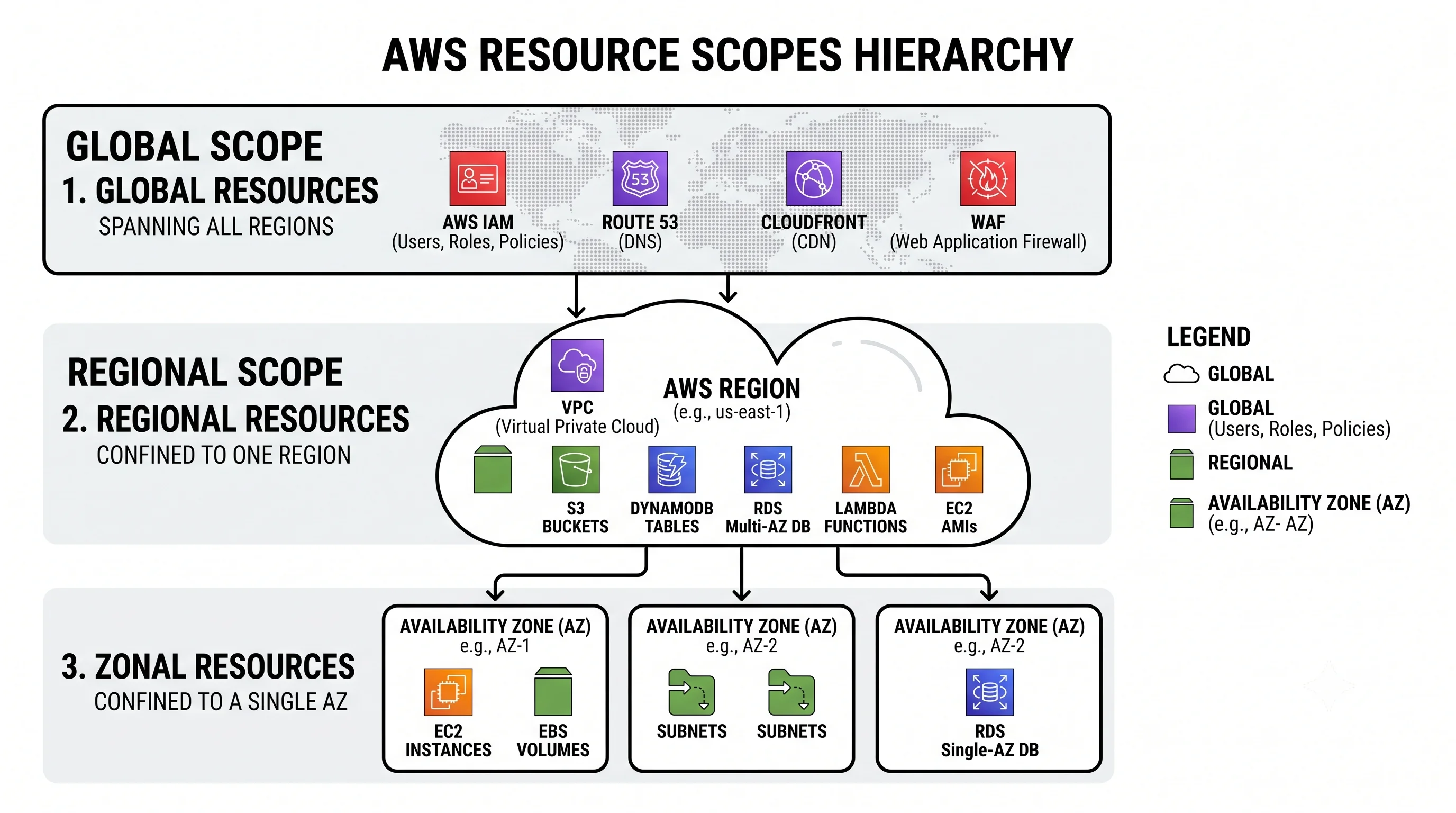
Every AWS resource has a scope, and knowing which is which prevents a specific class of design error.
| Scope | Meaning | Examples |
|---|---|---|
| Global | One instance for the whole account; no region in the ARN | IAM users and roles, Organizations, Route 53 hosted zones, CloudFront distributions, WAF (global scope) |
| Regional | Exists in one region; survives the loss of any single AZ | S3 buckets, DynamoDB tables, SQS queues, Lambda functions, VPCs, ELBs, ECR repositories |
| Zonal | Lives in exactly one AZ; dies with it | EC2 instances, EBS volumes, subnets, RDS instances (a single instance), ElastiCache nodes |
The design rule falls straight out of the table: zonal resources need a sibling in another AZ. Regional resources already survive AZ loss. Global resources survive regional loss but are, for that same reason, a shared dependency worth respecting.
Two nuances that cause arguments:
- S3 bucket names are globally unique; buckets are regional. The namespace is global, the data is not. Nobody else can take your bucket name in another region, but your data lives in one region until you replicate it.
- A VPC is regional; its subnets are zonal. This is why a subnet belongs to exactly one AZ and why "spread across AZs" concretely means "use several subnets".
4. Failure domain vs. isolation domain
The single most useful framing on this page.
| Availability Zone | Region | |
|---|---|---|
| Role | Failure domain | Isolation domain |
| Design question | "What breaks together?" | "What contains a disaster?" |
| Typical answer | Spread across 3 AZs behind a load balancer | Usually one region; a second only with a real requirement |
| Cost of using it | Cross-AZ data transfer, modest latency | Duplicated infrastructure, replication, operational complexity |
| Recovery | Automatic, in seconds, if designed for | Deliberate, minutes to hours, and rehearsed |
Multi-AZ is the default and is close to non-negotiable. Three AZs, a load balancer, an Auto Scaling group, no instance-local state. It costs cross-AZ transfer and a little latency, and it converts an AZ event from an outage into a capacity reduction.
Multi-region is a decision, not a default. It is dramatically more expensive — in money, in engineering time, and in the ongoing tax of keeping the second region genuinely current. Do it when there's a real requirement: a regulatory one, a latency one, or an availability target that genuinely cannot be met inside a single region. "For resilience" without a stated RTO and RPO is not a requirement; it's an aspiration that will decay into an untested standby nobody trusts.
5. Opt-in regions
Not every region is enabled by default. Older regions are on automatically; newer ones — and several regional additions since roughly 2019 — must be explicitly enabled per account.
This has consequences beyond a checkbox:
- Resources can't be created there until enabled, which surprises expansion projects on day one.
- STS session tokens have historically differed in whether they're valid in opt-in regions,
depending on account settings and endpoint used.
⚠️ verify current STS token version behaviour and defaults against AWS docs - Enabling is an organisation-level action you can control via SCPs — and disabling unused regions is a genuinely useful security control. An attacker with credentials commonly spins up mining capacity in a region nobody watches.
Practical guidance: enable only the regions you use, deny the rest via SCP, and delete default VPCs in regions you don't intend to use. It reduces both the attack surface and the number of places you have to look when auditing.
6. Data residency
Your data stays in the region you put it in. AWS does not move customer data between regions on its own. That's the foundation of most compliance answers.
The honest caveats:
- Global services are global. IAM, Organizations, and Route 53 hold configuration outside any single region. That's metadata — user names, role definitions, DNS records — not your workload data, but a compliance reviewer may still ask.
- CloudFront caches at edge locations worldwide, by design. If you serve regulated content through it, that's a deliberate decision requiring geo-restriction or a different design.
- You can move data across regions accidentally. Cross-region replication, a snapshot copy, a backup plan with a cross-region rule, or a global table are all things you configure — but a colleague configuring them is enough.
- Sovereign and isolated partitions exist — AWS GovCloud and the China regions operate as separate
partitions with distinct ARNs (
aws-us-gov,aws-cn) and separate credentials. AWS has also been building a European Sovereign Cloud.⚠️ verify current availability, partition names, and scope against AWS docs
To enforce residency, use the aws:RequestedRegion condition key in SCPs — remembering the
global-service exemptions covered in
Accounts & Organizations.
7. Choosing a region
Five factors, roughly in order of how often they decide it:
| Factor | Notes |
|---|---|
| Latency to users | Usually dominant for user-facing workloads. Measure; don't assume the nearest map pin wins |
| Compliance / residency | Often decides it outright, and isn't negotiable |
| Service availability | New services launch in a subset of regions first. Check before committing |
| Price | Prices differ per region, sometimes substantially for the same instance type. ⚠️ verify current pricing |
| Carbon intensity | Some regions run on markedly cleaner grids; AWS publishes guidance |
The us-east-1 question deserves its own paragraph. It's the oldest and largest region, it's often
cheapest, and it gets new services first. It's also where the control planes for several global
services live — IAM, Organizations, CloudFront, Route 53 — which means a significant us-east-1 event
can have effects felt by customers who don't run anything there. Two practical consequences: an ACM
certificate used by CloudFront must be issued in us-east-1, and billing and global-service
CloudTrail events land there. Choose it deliberately, not by accepting the console default.
8. Multi-region, honestly
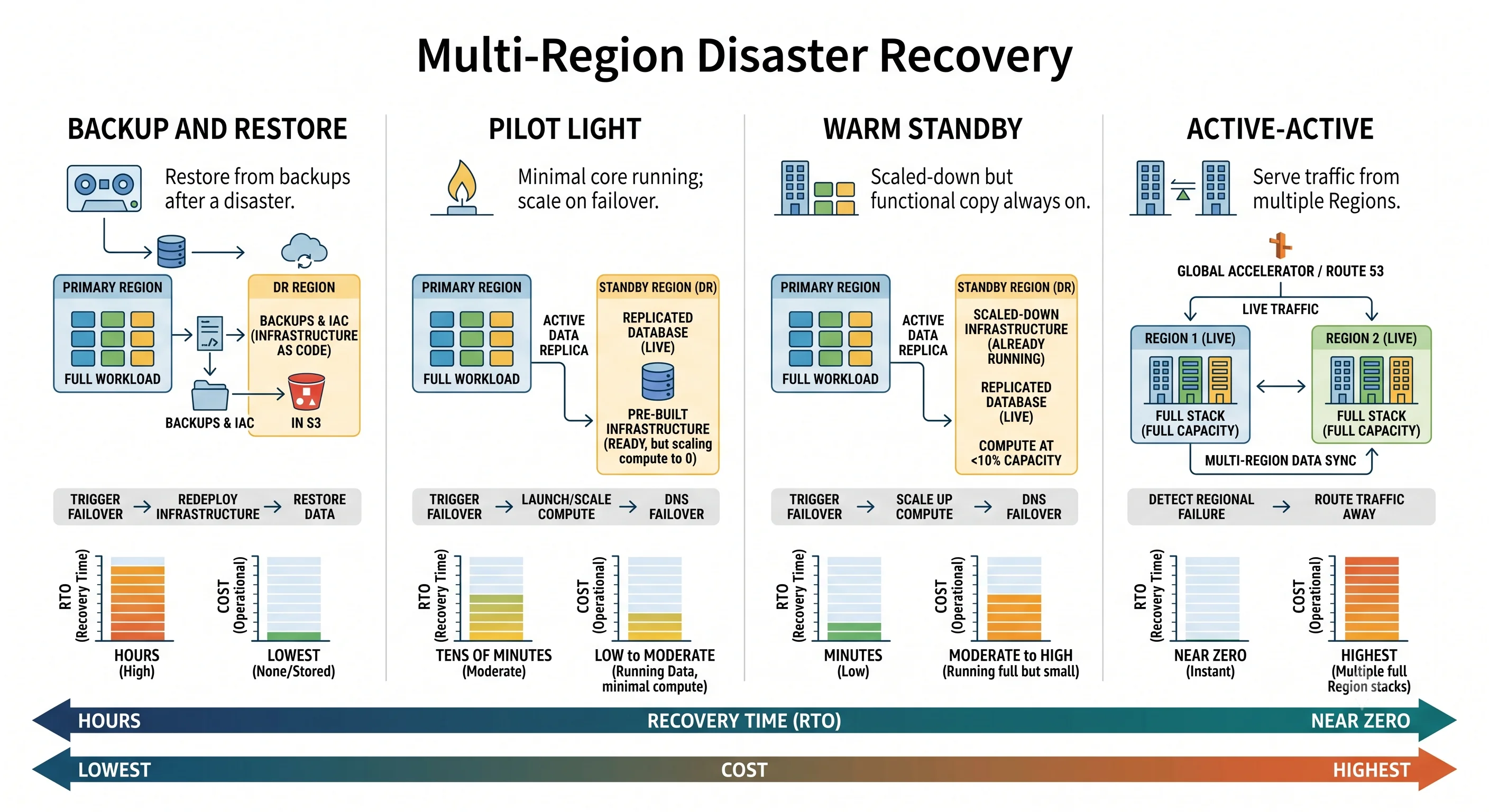
If you do need a second region, these are the recognised strategies, cheapest and slowest first:
| Strategy | What runs in region 2 | RTO | RPO | Cost |
|---|---|---|---|---|
| Backup & restore | Nothing — backups only | Hours | Hours | Lowest |
| Pilot light | Data replicated; core services off | Tens of minutes | Minutes | Low |
| Warm standby | A scaled-down but running copy | Minutes | Seconds–minutes | Medium |
| Active/active | Full capacity, serving traffic | Near zero | Near zero | Highest |
The hard part is never the compute — it's the data. Stateless application tiers are easy to duplicate. Getting a consistent, current copy of state in two places forces a genuine choice between consistency and availability, and no amount of AWS service selection makes that choice go away. Services that help — Aurora Global Database, DynamoDB global tables, S3 Cross-Region Replication — each embed a specific answer to that trade-off, and you should know which answer you've bought.
Things that reliably get forgotten when standing up a second region: service quotas (at defaults there), AMIs and container images (region-scoped — must be copied), KMS keys (region-scoped — data must be re-encrypted), ACM certificates, Secrets Manager entries, IAM roles referenced by ARN with a region in them, and the deploy pipeline itself.
A standby you have never failed over to does not work. Whichever strategy you choose, schedule a real failover exercise. The first attempt always surfaces something — a missing quota, a hard-coded region, a DNS TTL nobody lowered.
9. Beyond regions and AZs
| Thing | What it is | Use when |
|---|---|---|
| Local Zones | A small AWS deployment in a metro area, attached to a parent region | Single-digit-millisecond latency to a specific city |
| Wavelength Zones | AWS infrastructure inside telecom operators' 5G networks | Mobile-edge applications |
| Outposts | AWS-managed racks in your data centre | Data must stay on premises, or latency to on-prem systems is critical |
| Edge locations | CloudFront's global cache points of presence | Content delivery — not general compute |
Edge locations are not Local Zones. Edge locations cache and terminate connections for CloudFront and a few edge services; you can't run an EC2 instance in one. Confusing the two leads to architectures that assume compute where there is only cache.
10. Anti-patterns
| Anti-pattern | Why it hurts | Instead |
|---|---|---|
| Everything in one AZ | An AZ event is a full outage | Three AZs, load balanced |
| Comparing AZ names across accounts | The mapping is randomised per account | Use AZ IDs |
| Hard-coded AMI or subnet IDs in shared modules | They're region-scoped and break on expansion | Look them up by name or tag |
| "We'll fail over to another region" with no replication | Nothing is there to fail over to | Choose a strategy, replicate, and rehearse |
| Chatty services spread across AZs on the hot path | Cross-AZ charges both ways, plus latency | Keep hot paths intra-AZ where correctness allows |
| Assuming quota headroom carries to a new region | Quotas are per region | Request increases before launch day |
| Leaving unused regions enabled | Somewhere nobody watches for crypto-mining | Disable them; deny by SCP |
A CloudFront certificate outside us-east-1 |
It simply won't attach | Issue CloudFront certs in us-east-1 |
| A standby region never tested | Discovering the gaps during a real incident | Scheduled failover exercises |
| Multi-region "for resilience" with no RTO/RPO | Enormous cost, untested benefit | State the target first, then pick the cheapest strategy that meets it |
Check yourself
- Which is the failure domain and which is the isolation domain — the AZ or the region?
- Why is
eu-west-1anot a meaningful thing to compare between two accounts, and what is? - Classify these: an EBS volume, an S3 bucket, an IAM role, a subnet, a Route 53 hosted zone.
- You've replicated your database to a second region. Name four other things that must exist there before a failover works.
- Why does disabling unused regions improve your security posture?
- What's the difference between an edge location and a Local Zone?
- Why must a CloudFront certificate be issued in
us-east-1?
Next: ARNs, Tagging & Quotas — the identifier every policy consumes, the metadata that makes cost attributable, and the limits that bite on launch day.
← Back to the Foundations overview · ← Previous: IAM & Identity