
Functional vs Non-Functional Requirements
In a Nutshell
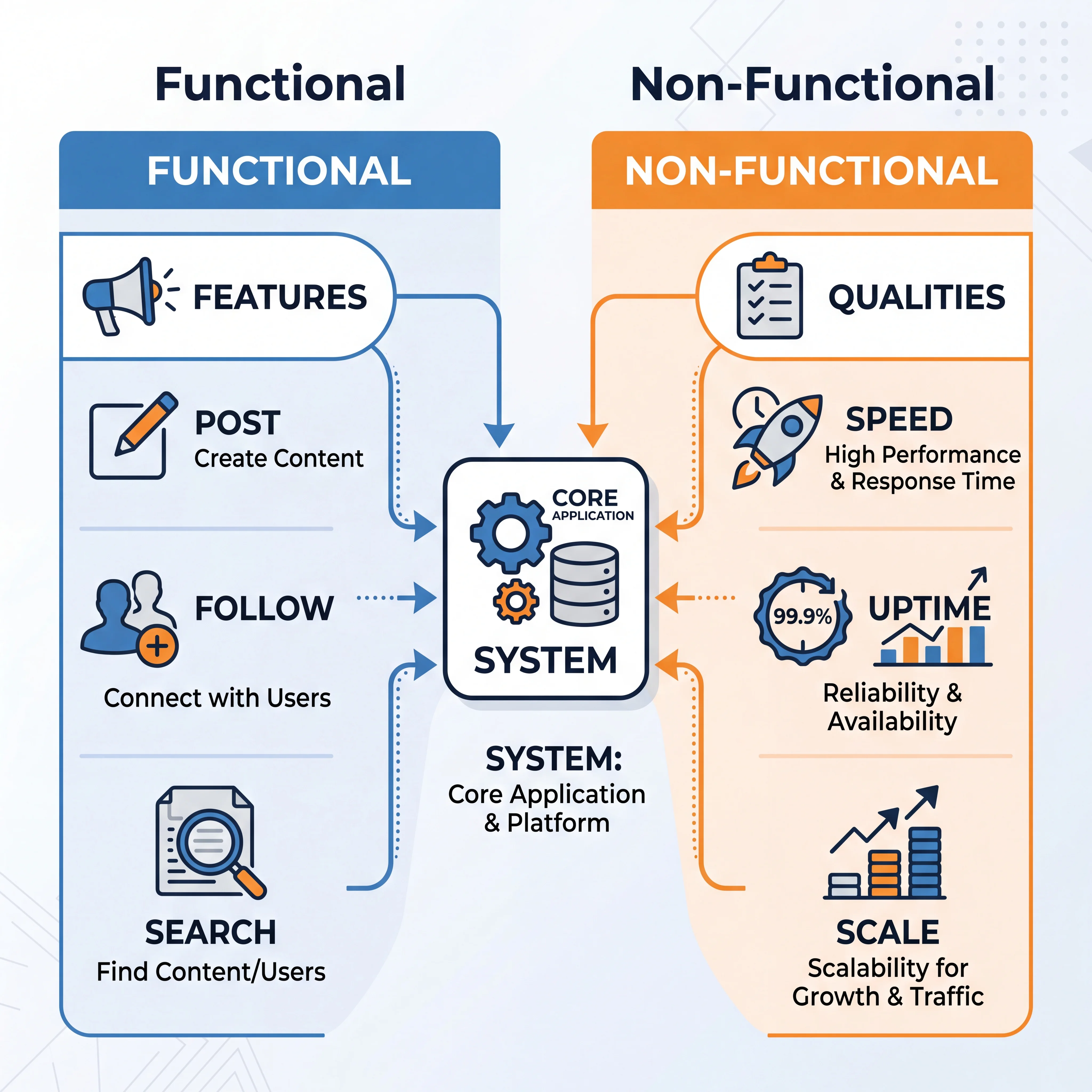
When someone says "design Twitter," there are really two questions hiding inside that prompt. Functional requirements answer "what does the system do?" — things like posting tweets, following users, and viewing a timeline. Non-functional requirements answer "how well does it do it?" — things like 99.99% uptime, page loads under 200ms, and supporting 500 million daily users.
Functional requirements shape your API and data model. Non-functional requirements shape your architecture. A system serving 100 requests per second and one serving 100,000 are fundamentally different systems — even if they do the exact same thing.
How It Actually Works
Functional Requirements
These describe the user-visible capabilities of the system. Think of them as the features list — what a user can do.
To identify them, ask:
- Who are the users? (end users, admins, other services)
- What actions can each user perform?
- What data goes in and what comes out?
Examples for a social media platform:
- A user can create a post with text and images
- A user can follow/unfollow other users
- A user can view a chronological feed of posts from people they follow
- A user can search for other users by name
Each functional requirement typically maps to one or more API endpoints and database tables. They are the skeleton of your system.
Non-Functional Requirements
These describe the quality attributes — how the system behaves under real-world conditions.
| Category | Question It Answers | Example |
|---|---|---|
| Availability | How much downtime is acceptable? | 99.99% uptime (~52 min/year downtime) |
| Latency | How fast must responses be? | p99 under 200ms for feed loads |
| Scalability | How much growth must it handle? | 500M daily active users |
| Durability | Can we afford to lose data? | Zero data loss for messages |
| Consistency | Must reads reflect the latest write? | Eventual consistency OK for likes |
| Security | What protection is needed? | End-to-end encryption for DMs |
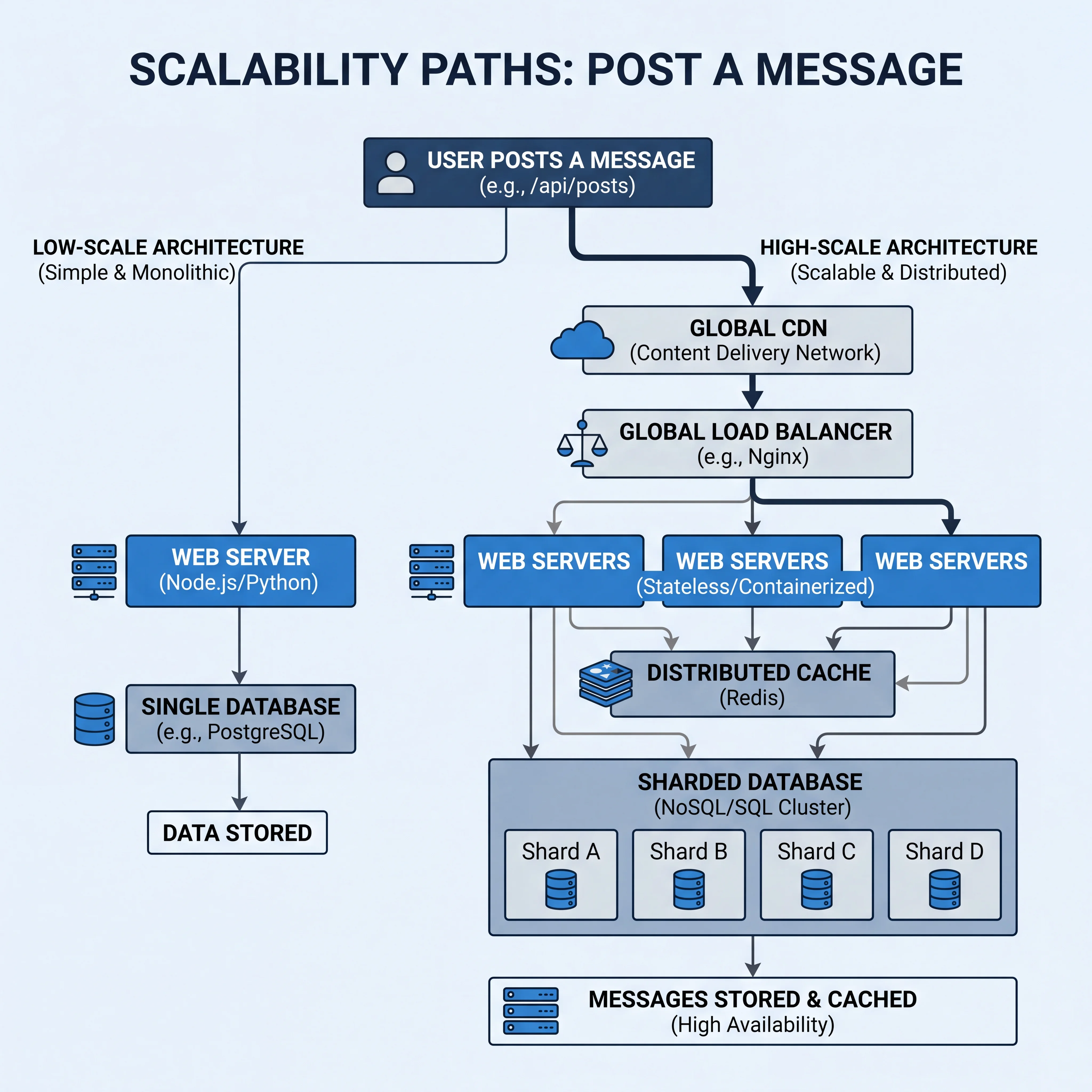
Non-functional requirements are what actually drive architecture decisions. They determine whether you need caching, replication, sharding, CDNs, or multi-region deployment.
Why the Distinction Matters
Consider this: if your functional requirement is "users can post messages" and your non-functional requirement is "support 10 QPS," a single PostgreSQL instance behind a web server handles it fine. Change the non-functional requirement to "support 100,000 QPS," and now you need load balancers, caching layers, database sharding, and a CDN — even though the feature hasn't changed at all.
Common Mistakes
- Jumping to architecture before gathering requirements — drawing boxes in the first minute instead of spending 5–8 minutes understanding the problem
- Treating non-functional requirements as afterthoughts — availability, latency, and scale are architectural drivers, not nice-to-haves
- Being vague — "the system should be fast" is not a requirement; "p99 latency under 200ms for timeline loads" is
Seeing It in Action
Scenario: You're asked to design a URL shortener.
Step 1 — Functional Requirements:
- User can submit a long URL and receive a short URL
- User (or anyone) can visit the short URL and get redirected to the original
- User can optionally set a custom short alias
- User can view click analytics for their links
Step 2 — Non-Functional Requirements:
- Read-heavy: Read-to-write ratio is ~100:1 (most traffic is redirects, not creation)
- Low latency: Redirects must happen in < 50ms (any delay and users notice)
- High availability: 99.99% uptime — a broken shortener breaks every link using it
- Scale: 100M new URLs/month, 10B redirects/month
- Durability: Once a short link is created, it must work forever (or until explicitly deleted)
Notice how the non-functional requirements immediately tell you: you need heavy caching (read-heavy), you probably don't need strong consistency (a few seconds of delay for a new link to propagate is fine), and you need a database that handles high read throughput.
Interview Questions
Q: You're designing a messaging app. What functional and non-functional requirements would you gather first? Hint: Functional: send/receive messages, group chats, media sharing, read receipts. Non-functional: message delivery latency (< 500ms), durability (zero message loss), availability (99.99%), end-to-end encryption, scale (concurrent users).
Q: How do non-functional requirements influence your choice of database? Hint: High consistency needs → SQL/ACID (e.g., payments). High write throughput → wide-column store (e.g., Cassandra). Low latency reads → in-memory cache (e.g., Redis). The feature doesn't change — the quality attributes do.
Q: A system has 99.9% availability as a requirement. What does that actually mean in terms of downtime, and how does it change your architecture compared to 99.99%? Hint: 99.9% ≈ 8.7 hours/year downtime; 99.99% ≈ 52 minutes/year. The jump from 3 to 4 nines typically requires multi-AZ deployment, automated failover, and redundancy at every layer — roughly an order of magnitude more effort.
Q: What's the risk of not stating non-functional requirements explicitly in a system design interview? Hint: Without them, you can't justify any architecture decision. You might over-engineer (build for 1M QPS when 1K suffices) or under-engineer (single server for a global-scale product). The interviewer wants to see you drive the conversation by asking about scale, latency, and consistency.
Q: Can the same system have different consistency requirements for different features? Give an example. Hint: Yes — this is common. An e-commerce platform might use strong consistency for inventory/payment (you can't sell what you don't have) but eventual consistency for product reviews and recommendations (a few seconds of delay is invisible to users).
References
- System Design Interview – An Insider's Guide by Alex Xu — Chapter 1: Scale from Zero to Millions of Users
- Designing Data-Intensive Applications by Martin Kleppmann — Chapter 1: Reliable, Scalable, and Maintainable Applications
- Google SRE Book — Service Level Objectives — how Google thinks about non-functional requirements
Dive Deeper
- Non-Functional Requirements in Software Architecture — arc42's structured approach to quality requirements
- Software Architecture in Practice by Bass, Clements & Kazman — the definitive treatment of quality attributes and architectural tactics
- Martin Fowler — Is High Quality Software Worth the Cost? — why non-functional requirements pay for themselves