
Sharding & Partitioning
In a Nutshell
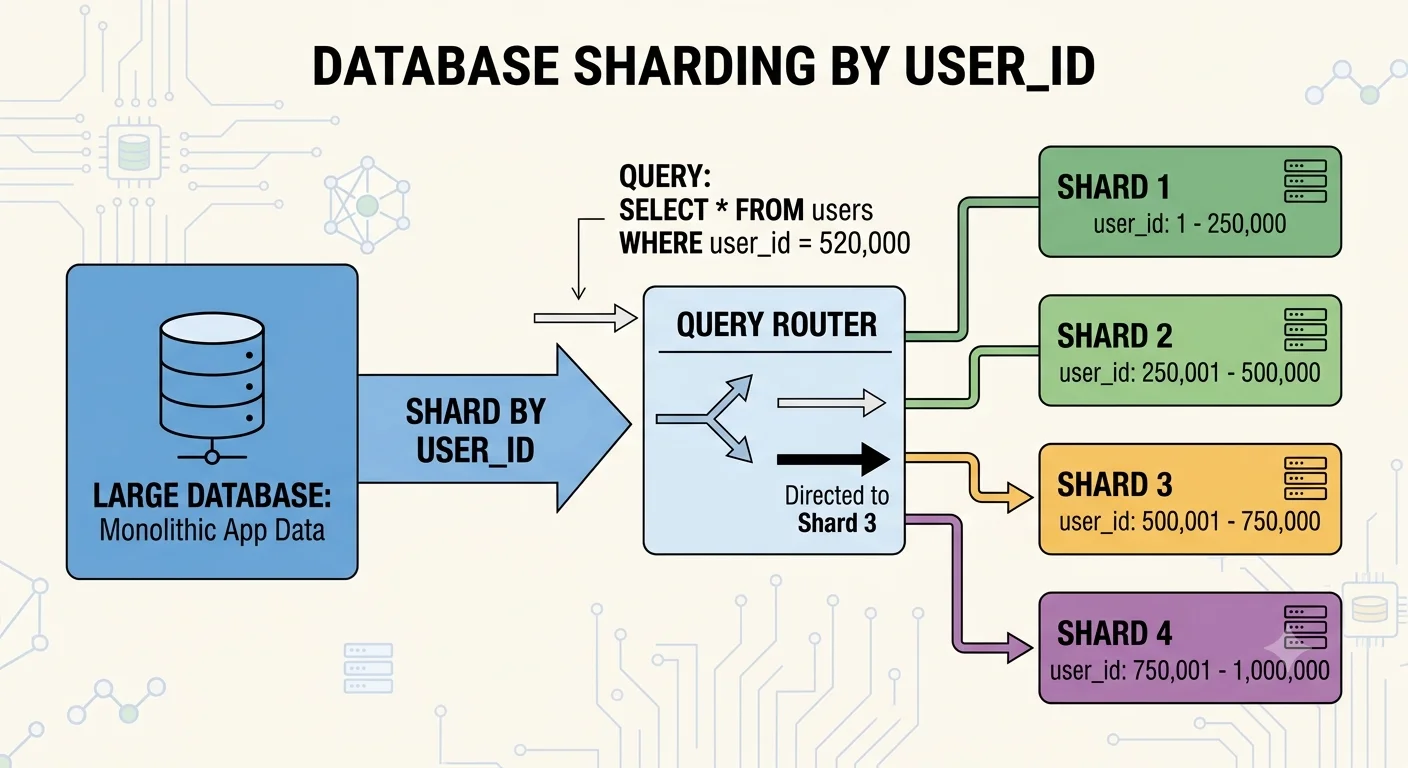
When a single database machine can't hold your data or handle your traffic, you split the data across multiple machines. Partitioning is the general concept of dividing a dataset into smaller pieces. Sharding is horizontal partitioning across separate database instances — each shard holds a subset of the rows and runs on its own server. The shard key determines which shard holds which data. Choose well (high cardinality, even distribution, matches query patterns) and your system scales linearly. Choose poorly (low cardinality, skewed distribution) and you get hot shards, cross-shard queries, and uneven growth. Sharding is the most impactful and most painful scaling decision you'll make.
How It Actually Works
Partitioning vs Sharding
| Term | What It Means | Example |
|---|---|---|
| Vertical Partitioning | Split columns across tables (each table has different columns for the same entity) | Move user_bio and user_avatar to a user_profiles table |
| Horizontal Partitioning | Split rows across partitions within the same database | PostgreSQL table partitioned by created_at month |
| Sharding | Split rows across separate database instances | Users 1–25M on Shard 1, 25M–50M on Shard 2 |
Sharding Strategies
Range-Based Sharding
Assign rows to shards based on a range of the shard key.
Shard 1: user_id    1 — 25,000,000
Shard 2: user_id    25,000,001 — 50,000,000
Shard 3: user_id    50,000,001 — 75,000,000
Shard 4: user_id 75,000,001 — 100,000,000| Pros | Cons |
|---|---|
| Simple to understand and implement | Uneven distribution if ranges are skewed |
| Range queries on the shard key are efficient | New users always hit the latest shard (hot shard) |
| Easy to split/merge ranges | Time-based keys create write hotspots |
Hash-Based Sharding
Hash the shard key, mod by the number of shards.
shard = hash(user_id) % num_shards| Pros | Cons |
|---|---|
| Even distribution regardless of key pattern | Range queries require hitting all shards |
| No hot shard from sequential inserts | Adding/removing shards requires rehashing (mitigated by consistent hashing) |
| Simple computation |
Directory-Based Sharding
A lookup service maintains the mapping from key to shard.
| Pros | Cons |
|---|---|
| Maximum flexibility (any key → any shard) | Lookup service is a single point of failure |
| Easy to move individual keys between shards | Extra network hop for every query |
| Can handle uneven data sizes by rebalancing | Directory must be highly available |
Consistent Hashing
Standard hash-based sharding breaks when you add or remove shards — every key gets reassigned. Consistent hashing minimizes redistribution: only ~1/n of the keys move when a shard is added or removed.
Hash ring (0 to 2^32):

    Shard A       Shard B       Shard C
      ↓             ↓             ↓
  ────●─────────────●─────────────●────
  0   ^             ^             ^    2^32
      Keys in       Keys in       Keys in
      [A, B)        [B, C)        [C, A)

Adding Shard D between B and C:
  ────●──────●──────●──────●──────────
      A      D      B      C
  Only keys in [B, D) move to D — everything else stays
What Breaks When You Shard
| Challenge | Why It's Hard |
|---|---|
| Cross-shard joins | Joining data across shards requires reading from multiple databases and assembling in application code |
| Cross-shard transactions | ACID across shards requires distributed transactions (2PC) — slow and complex |
| Auto-increment IDs | Each shard has its own sequence — IDs collide. Use UUIDs, Snowflake IDs, or a central ID service |
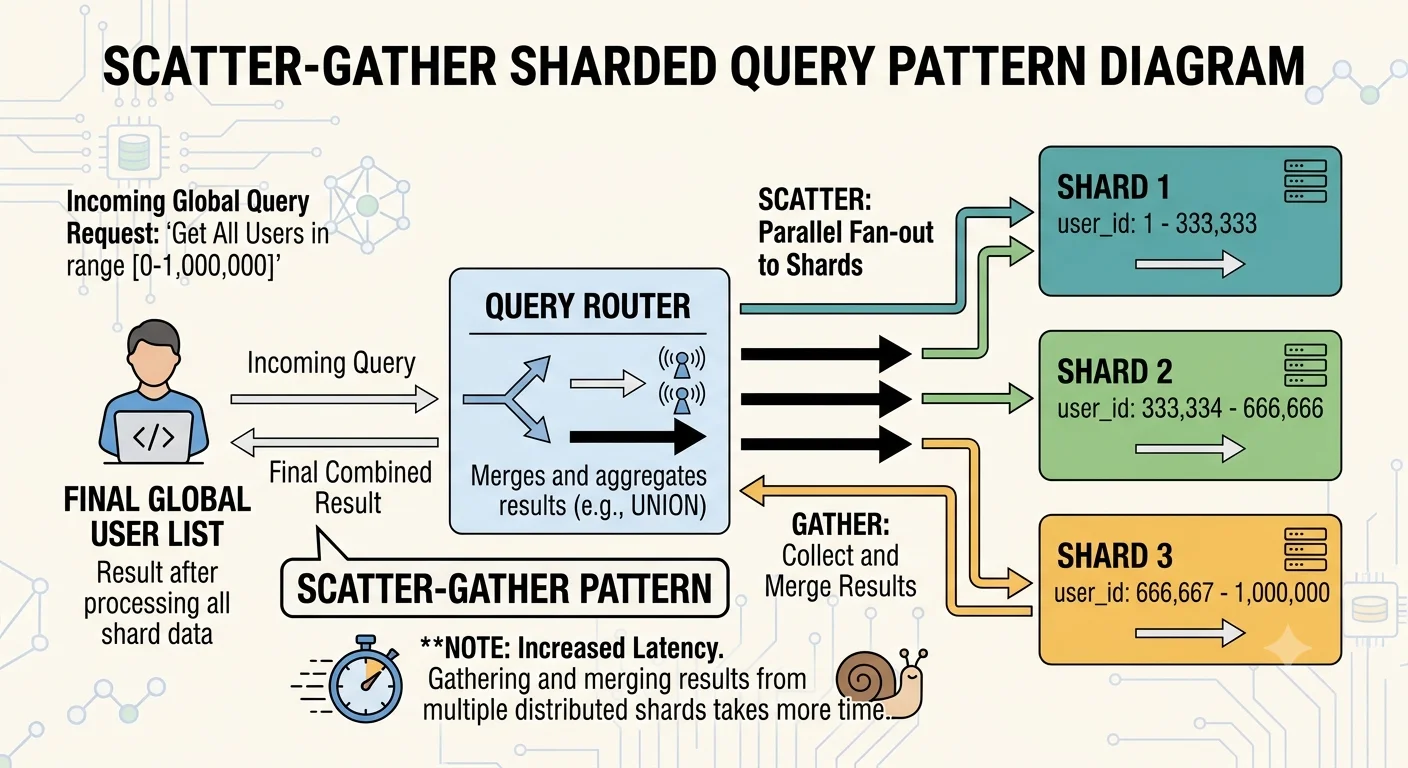
| Aggregations | COUNT(*), AVG(), ORDER BY across all data requires scatter-gather from all shards |
| Schema changes | Every shard needs the migration — coordinate or face inconsistency |
| Rebalancing | When one shard grows too large, moving data is operationally complex |
| Operational overhead | N shards = N database instances to monitor, backup, upgrade |
Seeing It in Action
Scenario: Sharding a messaging platform (1B users, 50B messages/day)
Shard key: conversation_id (hash-based)

Why conversation_id:
  ✅ All messages in a conversation are on the same shard
     → "get messages for conversation X" is a single-shard query
  ✅ Conversations are roughly equal size → even distribution
  ✅ No cross-shard joins for the primary query pattern

Why NOT user_id:
  ❌ A user participates in many conversations across different shards
     → "get all conversations for user X" requires scatter-gather
  ❌ Celebrity users with millions of messages create hot shards

Architecture:
┌──────────┐
│  Client   │
└─────┬────┘
      │
┌─────▼──────┐     ┌───────────┐
│   Router    │────▶│ Shard Map │ (conversation_id → shard_id)
│ (Shard-Aware)│    │  (Redis)  │
└──┬──┬──┬───┘     └───────────┘
   │  │  │
   │  │  └──▶ Shard 3: conversations C
   │  └─────▶ Shard 2: conversations B
   └────────▶ Shard 1: conversations A
Handling the "user's conversations" query:
- Maintain a separate lookup table:
user_conversations(user_id, conversation_id, shard_id) - This table can live in a non-sharded database or be sharded by
user_id - Trade-off: denormalization (write amplification on conversation creation)
Interview Questions
Q: How do you choose a shard key? What criteria matter? Hint: High cardinality (many distinct values), even distribution (no hot shards), aligns with primary query pattern (queries hit one shard, not scatter-gather). For a messaging app:
conversation_id. For an e-commerce app:user_id. For a multi-tenant SaaS:tenant_id. Avoid time-based keys (all writes hit latest shard).Q: What is consistent hashing, and why is it important for sharding? Hint: Standard modular hashing (
hash(key) % N) reassigns nearly all keys when N changes. Consistent hashing places shards on a ring — adding/removing a shard only moves ~1/N of keys. This minimizes data migration when scaling. Used by DynamoDB, Cassandra, and many in-house sharding systems.Q: How do you handle cross-shard queries in a sharded database? Hint: Scatter-gather: send the query to all shards, merge results in application code. For aggregations (
COUNT,SUM), each shard returns its partial result and the coordinator combines them. ForORDER BY ... LIMIT, each shard returns its top-K and the coordinator re-sorts. Cross-shard queries are inherently slower — design the shard key to minimize them.Q: Your sharded database has one shard that's 3× larger than the others. What do you do? Hint: This is a hot shard / skewed distribution. Options: 1) Split the large shard into two (range split). 2) Reshard with a better key. 3) Use consistent hashing with virtual nodes for more even distribution. 4) For hash-based, check if the hash function is distributing well. Prevention: monitor shard sizes proactively and set alerts.
Q: When should you NOT shard your database? Hint: When a single instance handles the load (vertical scaling, read replicas, and caching haven't been exhausted). Sharding adds enormous complexity — cross-shard joins, distributed transactions, operational overhead. Many applications with millions of users run fine on a single PostgreSQL with read replicas. Only shard when you've genuinely hit the limits of a single instance.
References
- Designing Data-Intensive Applications by Martin Kleppmann — Chapter 6: Partitioning
- Consistent Hashing — Tom White — clear explanation with implementation
- Vitess — YouTube's MySQL sharding layer, now open source
Dive Deeper
- Instagram's Sharding Strategy — how Instagram generates IDs and shards PostgreSQL
- Stripe's Approach to Online Migration — migrating data between shards without downtime
- PlanetScale (Vitess) — managed MySQL with built-in horizontal sharding