
High Availability
In a Nutshell
High availability (HA) is designing a system so it keeps serving requests even when individual components fail. It's measured in "nines": 99.9% ("three nines") allows ~8.7 hours of downtime a year, while 99.999% ("five nines") allows only ~5 minutes. You achieve HA by eliminating single points of failure — every critical component gets redundancy, and traffic automatically routes away from anything unhealthy. The core idea is simple but demanding: assume every piece will fail, and make sure no single failure can take down the whole system.
How It Actually Works
The Nines and What They Cost
| Availability | Downtime/Year | Downtime/Month | Typical Use |
|---|---|---|---|
| 99% (two nines) | 3.65 days | 7.2 hours | Internal tools |
| 99.9% (three nines) | 8.77 hours | 43.8 min | Standard SaaS |
| 99.99% (four nines) | 52.6 min | 4.4 min | E-commerce, business-critical |
| 99.999% (five nines) | 5.26 min | 26 sec | Telecom, payments, core infra |
Each additional nine is dramatically more expensive — it demands more redundancy, faster failover, multi-region deployment, and rigorous operational discipline. Don't promise five nines when your business needs three.
Availability Math: Series vs Parallel
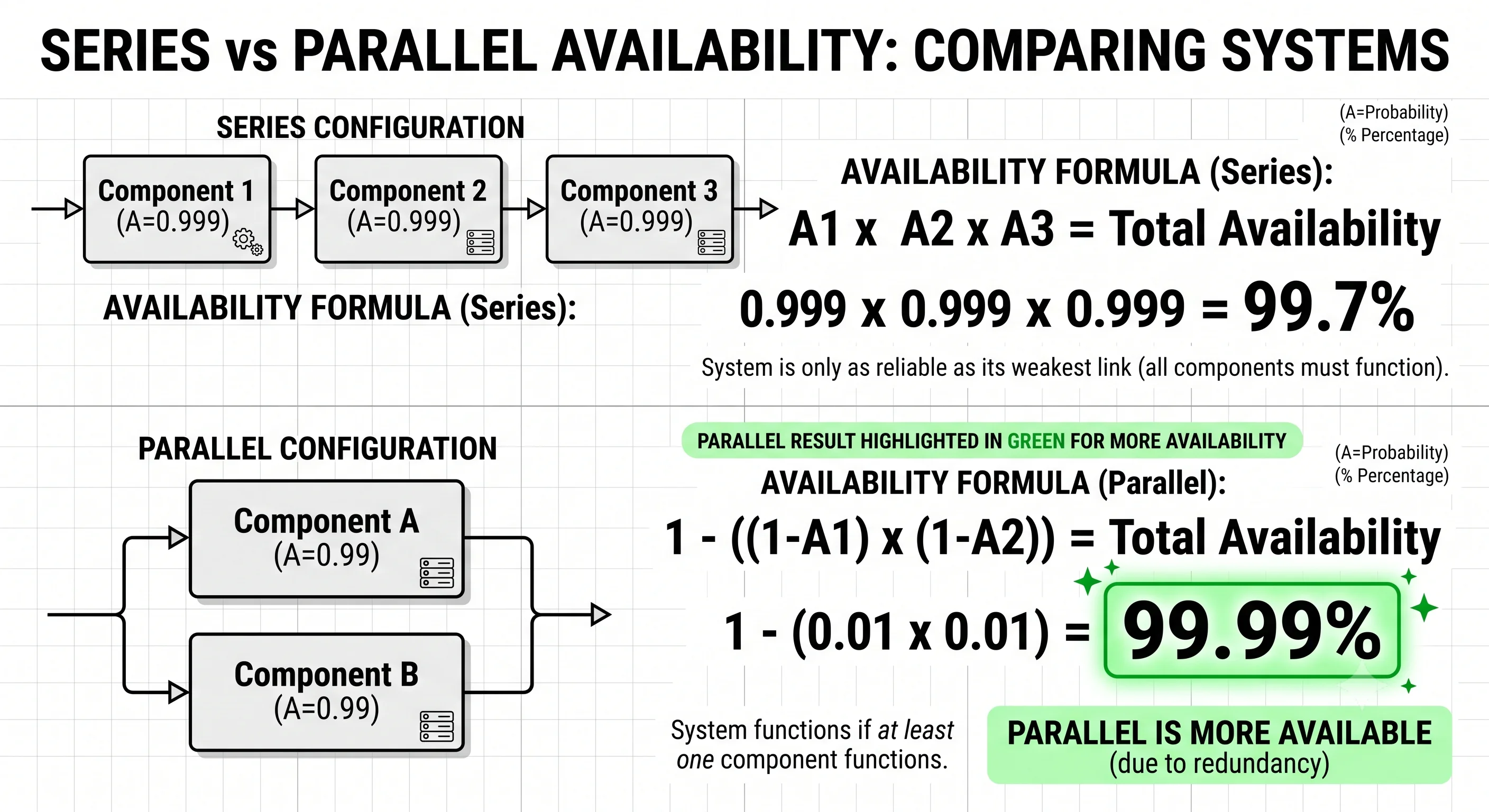
Components in series (all must work) multiply their availabilities, making the whole less available than any part:
Series (dependency chain):  A_total = A1 × A2 × A3
  LB(99.9%) → App(99.9%) → DB(99.9%) = 0.999³ ≈ 99.7%   (worse!)
Redundant components in parallel (any one suffices) make the whole more available:
Parallel (redundancy):  A_total = 1 − (1−A1)(1−A2)
  Two app servers at 99% each = 1 − (0.01 × 0.01) = 99.99%   (better!)
This is the mathematical case for redundancy: adding a parallel copy of a 99% component yields 99.99%.
Eliminating Single Points of Failure (SPOFs)
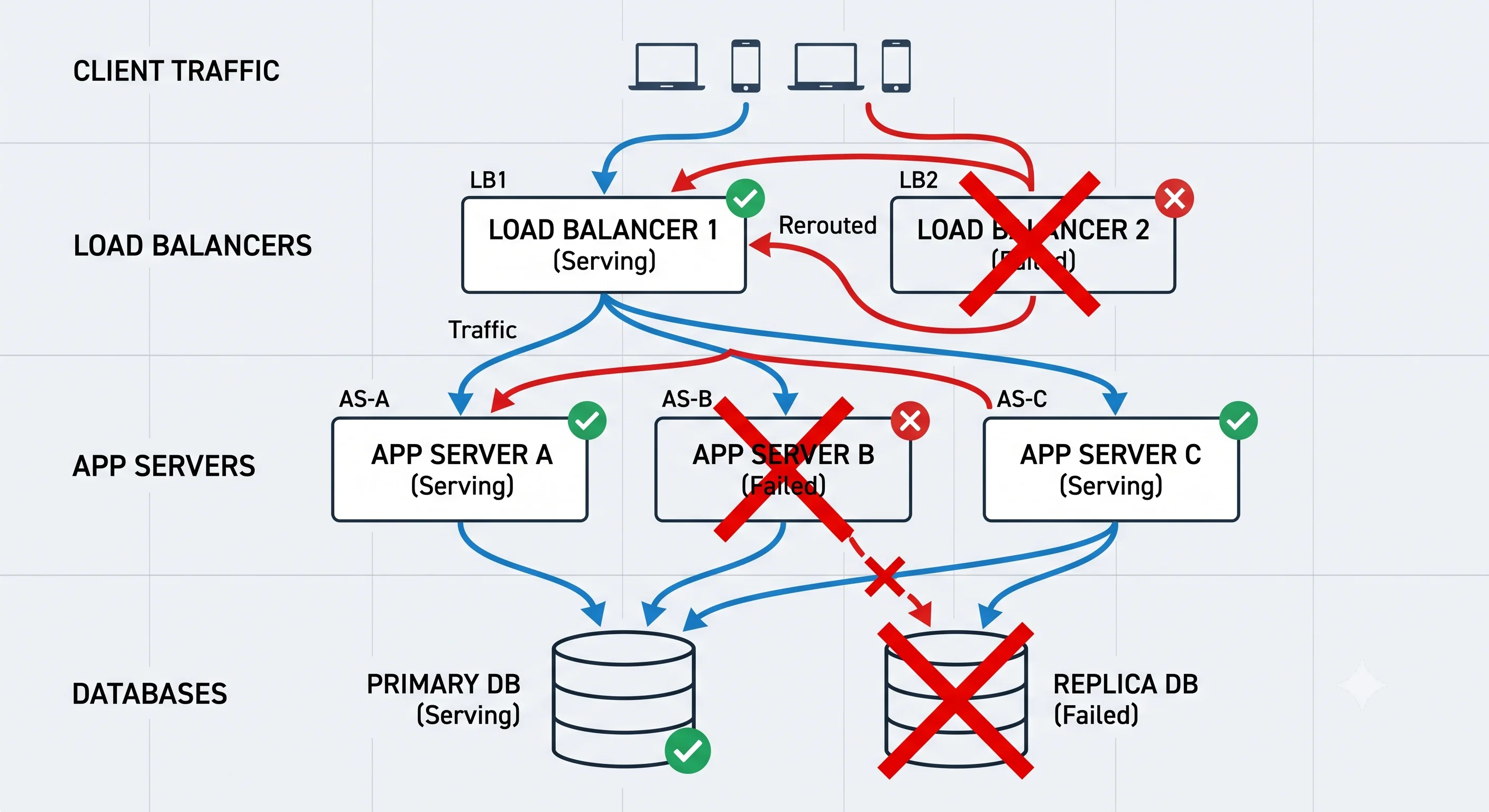
A SPOF is any component whose failure takes down the system. The HA method is to find every SPOF and add redundancy:
| Layer | SPOF | HA Fix |
|---|---|---|
| DNS | Single provider | Multiple DNS providers |
| Load balancer | One LB | Redundant LBs + virtual IP (VRRP) |
| App tier | One server | N stateless servers behind LB |
| Database | Single primary | Primary + replicas with auto-failover |
| Zone | Single data center | Multi-AZ deployment |
| Region | Single region | Multi-region (active-active or active-passive) |
Redundancy Models
| Model | Standby Behavior | Failover Time | Cost |
|---|---|---|---|
| Active-Passive | Standby idle until primary fails | Seconds–minutes | Lower (idle capacity) |
| Active-Active | All nodes serve traffic | Near-instant | Higher (but no wasted capacity) |
| N+1 / N+M | M spare units for N active | Fast | Moderate |
Redundancy Isn't Enough — You Need Automatic Detection & Recovery
Redundancy only helps if the system notices a failure and reacts without a human:
Detect  →  Isolate  →  Reroute  →  Recover
  │           │           │           │
health    remove bad   send traffic  rebuild/replace
checks    node from    to healthy    the failed
+heartbeat  pool       redundant     component
                       node
If failover requires paging an engineer, your real availability is bounded by human response time — not by your redundancy.
Seeing It in Action
Scenario: Making a typical web service highly available.
Before (SPOFs everywhere):
  Client → 1 LB → 1 app server → 1 database
  Any single failure = full outage.  Effective ~99% at best.

After (HA architecture):
  Client
    │
    ├─ DNS (2 providers, health-checked)
    │
  [ LB-A ]═══[ LB-B ]        active-active, shared virtual IP
    │            │
  ┌─┴────┬───────┴─┐
  App-1  App-2  App-3        stateless, behind LB, autoscaled
  └──┬───┴───┬────┘
     │       │
  [Primary DB]──replicates──[Replica DB]   auto-failover on primary loss
     (AZ-1)                    (AZ-2)        spread across availability zones

  Result: no single component failure causes an outage.
  Combined with multi-AZ, tolerates a full data-center loss.
The availability budget in practice: if you target 99.99% (52 min/year), you must account for planned work too — deployments, patching, migrations. This is why HA architectures use rolling deployments and can drain/replace nodes without downtime; otherwise routine maintenance eats your entire error budget.
Interview Questions
Q: What does "five nines" mean, and why isn't it always the right target? Hint: 99.999% availability ≈ 5.26 minutes of downtime per year. Each added nine costs dramatically more (more redundancy, faster failover, multi-region, operational rigor). Over-provisioning availability wastes money; match the target to business need — payments/telecom need five nines, an internal dashboard is fine at three.
Q: How does adding a redundant component improve availability mathematically? Hint: Series components multiply availabilities (chain is less available than any link). Parallel/redundant components combine as 1−∏(1−Aᵢ), so two 99% components in parallel give 99.99%. Redundancy converts "any one must survive" into much higher combined availability.
Q: What's the difference between active-active and active-passive redundancy? Hint: Active-active: all nodes serve traffic, near-instant failover, no wasted capacity, but requires the system to handle concurrent multi-node operation (and conflicts for stateful tiers). Active-passive: standby is idle until the primary fails, cheaper in operational complexity but wastes capacity and has slower failover.
Q: Why is redundancy alone insufficient for high availability? Hint: You also need automatic failure detection (health checks, heartbeats) and recovery (isolate the bad node, reroute traffic, rebuild). If failover depends on a human noticing and reacting, availability is capped by human response time regardless of how much redundant hardware you have.
Q: Your architecture is fully redundant within one data center. Are you highly available? What's still a SPOF? Hint: No — the data center (availability zone) itself is a SPOF: power, cooling, network, or a natural disaster can take the whole facility down. Deploy across multiple AZs, and for regional resilience, multiple regions. Also check for hidden SPOFs: shared DNS, a single config service, or a single deployment pipeline.
References
- Google SRE Book — Availability — the nines table and error budgets
- AWS Well-Architected: Reliability Pillar — HA design patterns
- Designing Data-Intensive Applications by Martin Kleppmann — Chapter 1: Reliability
Dive Deeper
- Calculating availability of multi-tier architectures — AWS deep dive on availability math
- Netflix: Chaos Engineering — proving availability by deliberately breaking things
- Site Reliability Engineering by Google — error budgets and the economics of availability