
Service Mesh
In a Nutshell
As microservices multiply, so do the network problems between them: every service needs retries, timeouts, circuit breakers, mutual TLS, load balancing, and observability for its calls to every other service. Building all this into each service (and in each language) is repetitive and error-prone. A service mesh moves that logic out of the application and into a dedicated infrastructure layer — a network of lightweight sidecar proxies deployed alongside each service that transparently handle all service-to-service communication. Your application code just makes a normal network call; the mesh handles the mTLS, retries, routing, and telemetry underneath. It's the "networking dial tone" for microservices.
How It Actually Works
The Problem: Cross-Cutting Network Concerns Everywhere
Every service-to-service call needs the same reliability + security logic:
  • mutual TLS (encrypt + authenticate between services)
  • retries with backoff, timeouts, circuit breakers
  • load balancing across instances
  • traffic routing (canary, A/B, blue-green)
  • metrics, tracing, logging for every call

Without a mesh: each service implements ALL of this, in its own language,
  → duplicated, inconsistent, and a nightmare to update across 50 services. 💥
The Sidecar Pattern
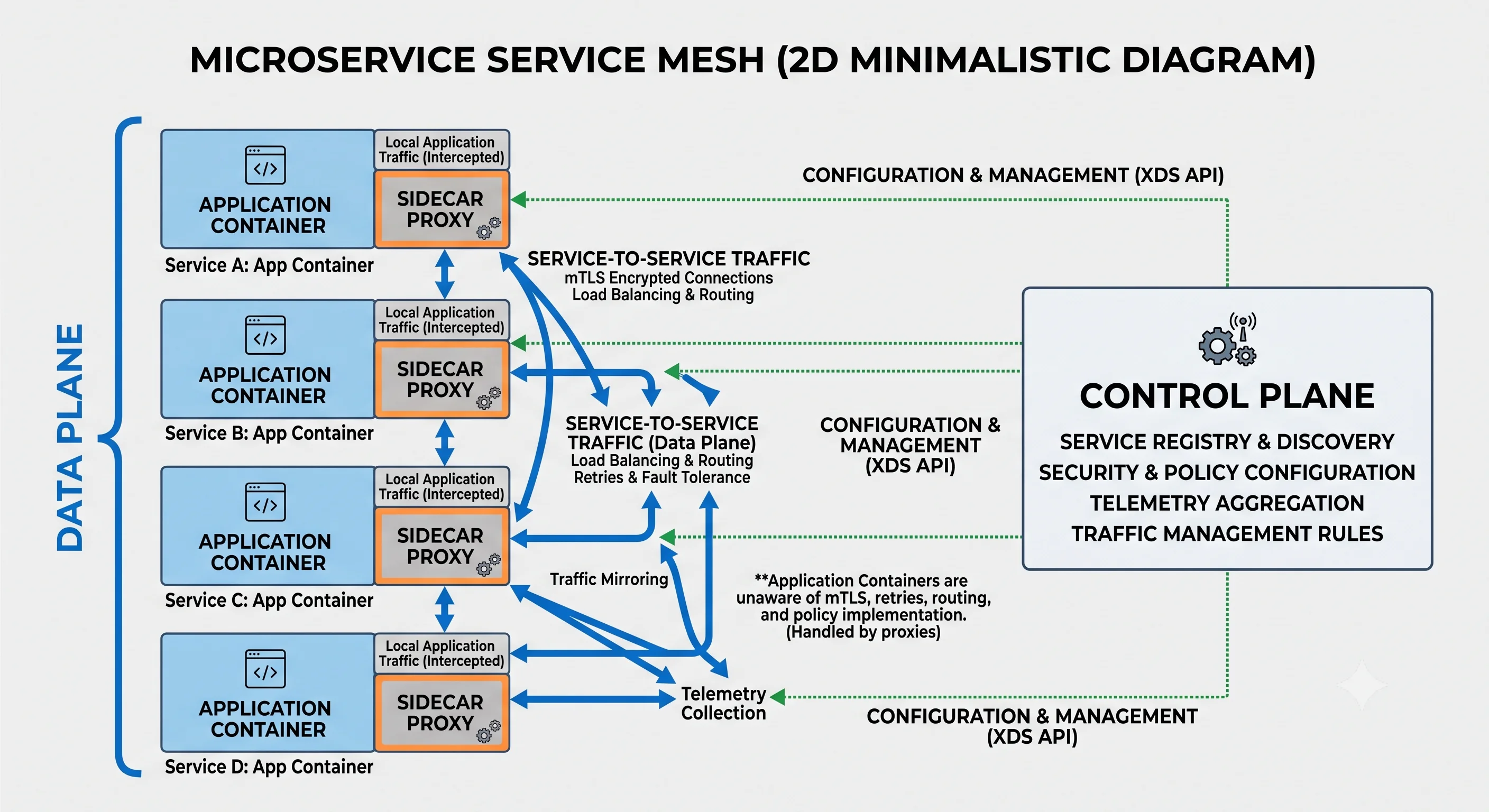
The mesh's core mechanism: deploy a proxy (e.g., Envoy) as a sidecar next to every service instance. All inbound and outbound traffic is transparently routed through the local sidecar.
Service A calls Service B:
  A's app → A's sidecar → (network, mTLS) → B's sidecar → B's app
            └── the sidecars handle mTLS, retries, LB, metrics ──┘
  A and B's application code just see a plain localhost call.
The application is unaware — it makes an ordinary call to localhost, and the sidecar intercepts and handles everything. This is how the mesh adds capabilities without changing app code.
Data Plane vs Control Plane
| Plane | Role | Made Of |
|---|---|---|
| Data plane | Actually moves the traffic — the sidecars that intercept, secure, route, and observe every request | The fleet of proxies (Envoy) |
| Control plane | Configures and coordinates the sidecars — policies, certificates, routing rules, telemetry collection | Central controller (Istio istiod, Linkerd control plane) |
Control plane: "here are the routing rules, certs, and policies" → pushes config
Data plane:    sidecars enforce that config on live traffic
You configure the control plane declaratively; it programs all the sidecars.
What a Service Mesh Provides
| Capability | What the Mesh Handles |
|---|---|
| mTLS everywhere | Automatic encryption + identity between all services (zero-trust) |
| Traffic management | Canary/blue-green/A-B routing, traffic splitting, mirroring |
| Resilience | Retries, timeouts, circuit breaking, outlier detection |
| Load balancing | Advanced algorithms across instances |
| Observability | Uniform metrics, distributed traces, and logs for every call |
| Policy | Access control, rate limits, quotas between services |
Crucially, these are added uniformly and language-agnostically — a Python service and a Go service get identical mTLS and retry behavior because the sidecar, not the app, provides it.
Mesh vs API Gateway
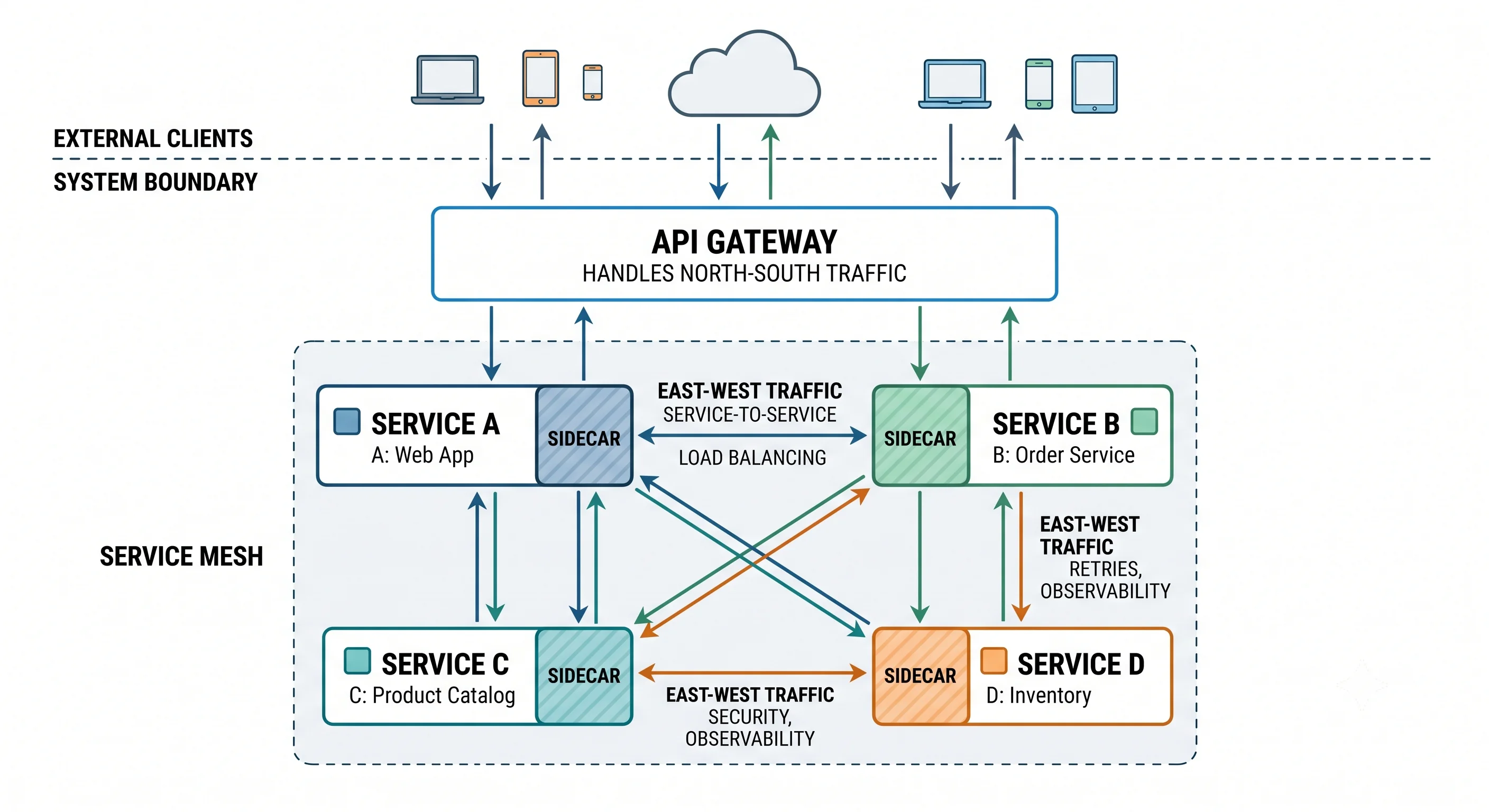
They're complementary, operating on different traffic (see API Gateway):
| API Gateway | Service Mesh | |
|---|---|---|
| Traffic | North-south (client ↔ system, at the edge) | East-west (service ↔ service, internal) |
| Focus | External API management (auth, rate limit, aggregation) | Internal comms (mTLS, retries, routing, observability) |
| Location | Edge/front door | Between every internal service |
A typical architecture uses both: a gateway at the edge and a mesh internally.
The Trade-off: Is It Worth It?
A service mesh is powerful but not free:
- Adds: operational complexity (another distributed system to run), latency (an extra proxy hop each way), and resource overhead (a sidecar per pod).
- Worth it when: you have many services, need uniform mTLS/zero-trust, want consistent observability and traffic control, and are already on Kubernetes.
- Overkill when: you have a handful of services — the complexity outweighs the benefit. Start without one; adopt when the cross-cutting pain is real.
Seeing It in Action
Scenario: Adding progressive delivery and zero-trust to a Kubernetes microservices platform with Istio.
# Canary rollout: send 10% of traffic to v2, 90% to v1 — no app code changes.
apiVersion: networking.istio.io/v1beta1
kind: VirtualService
metadata: { name: checkout }
spec:
  hosts: [ checkout ]
  http:
  - route:
    - destination: { host: checkout, subset: v1 }
      weight: 90
    - destination: { host: checkout, subset: v2 }
      weight: 10          # canary: 10% to the new version
    retries:
      attempts: 3
      perTryTimeout: 2s   # mesh handles retries + timeouts uniformly
---
# Enforce mTLS for ALL service-to-service traffic (zero-trust), cluster-wide.
apiVersion: security.istio.io/v1beta1
kind: PeerAuthentication
metadata: { name: default, namespace: istio-system }
spec:
  mtls: { mode: STRICT }  # every call is encrypted + mutually authenticated
What the mesh delivers here without touching a single service's code:
- Progressive delivery: the canary sends 10% of checkout traffic to v2; if error rates rise, shift back to 0% instantly — all by editing mesh config, not redeploying apps.
- Uniform resilience: every checkout call gets 3 retries with a 2s per-try timeout, applied identically regardless of the caller's language.
- Zero-trust security:
STRICTmTLS means all internal traffic is automatically encrypted and services mutually authenticate — even though no application implemented TLS. A compromised service can't sniff or spoof traffic. - Free observability: the sidecars emit consistent metrics and traces for every call, so you see latency, error rates, and dependencies across the whole mesh without instrumenting each service.
The payoff and the caveat: the mesh turns traffic management, security, and observability into declarative infrastructure config rather than per-service code — a huge win at scale. But it's a serious operational commitment (another control plane, sidecar overhead, added latency), so it's justified once you have enough services that the uniformity and centralized control outweigh the complexity — not for a three-service app.
Interview Questions
Q: What is a service mesh and what problem does it solve? Hint: It's an infrastructure layer that handles service-to-service communication via sidecar proxies, moving cross-cutting network concerns (mTLS, retries, timeouts, circuit breaking, load balancing, traffic routing, observability) out of application code. It solves the duplication and inconsistency of each service (in each language) reimplementing this logic, providing it uniformly and transparently.
Q: Explain the sidecar pattern and how it makes the mesh transparent. Hint: A proxy (e.g., Envoy) is deployed alongside every service instance; all inbound/outbound traffic is routed through the local sidecar. The application just makes an ordinary localhost call, and the sidecar intercepts it to handle mTLS, retries, load balancing, and telemetry. Because the proxy (not the app) provides these, capabilities are added without changing or being visible to application code.
Q: What's the difference between the data plane and control plane in a mesh? Hint: The data plane is the fleet of sidecar proxies that actually move traffic — intercepting, securing (mTLS), routing, retrying, and observing every request. The control plane (e.g., Istio's istiod) configures and coordinates those proxies — distributing routing rules, certificates, and policies, and collecting telemetry. You declaratively configure the control plane; it programs all the sidecars.
Q: How does a service mesh differ from (and complement) an API gateway? Hint: An API gateway handles north-south traffic (external clients ↔ system) at the edge, focused on API management (auth, rate limiting, aggregation). A service mesh handles east-west traffic (internal service ↔ service), focused on inter-service comms (mTLS, retries, routing, observability). They're complementary — a typical architecture uses a gateway at the edge and a mesh internally.
Q: When is a service mesh worth the complexity, and when is it overkill? Hint: Worth it with many services needing uniform mTLS/zero-trust, consistent observability, and advanced traffic control (canary, A/B), especially on Kubernetes. Overkill for a handful of services — it adds an entire distributed control plane to operate, per-pod sidecar resource overhead, and extra latency (a proxy hop each way). Start without one; adopt when the cross-cutting pain and scale justify it.
References
- Istio documentation — the leading service mesh
- Linkerd documentation — a lightweight service mesh
- Envoy Proxy — the data-plane proxy behind many meshes
Dive Deeper
- The Service Mesh: What Every Software Engineer Needs to Know (Buoyant) — a clear conceptual manifesto
- Istio traffic management deep dive — canary, mirroring, fault injection
- Do you need a service mesh? (Thoughtworks) — when adoption is (and isn't) justified