
Message Queues
In a Nutshell
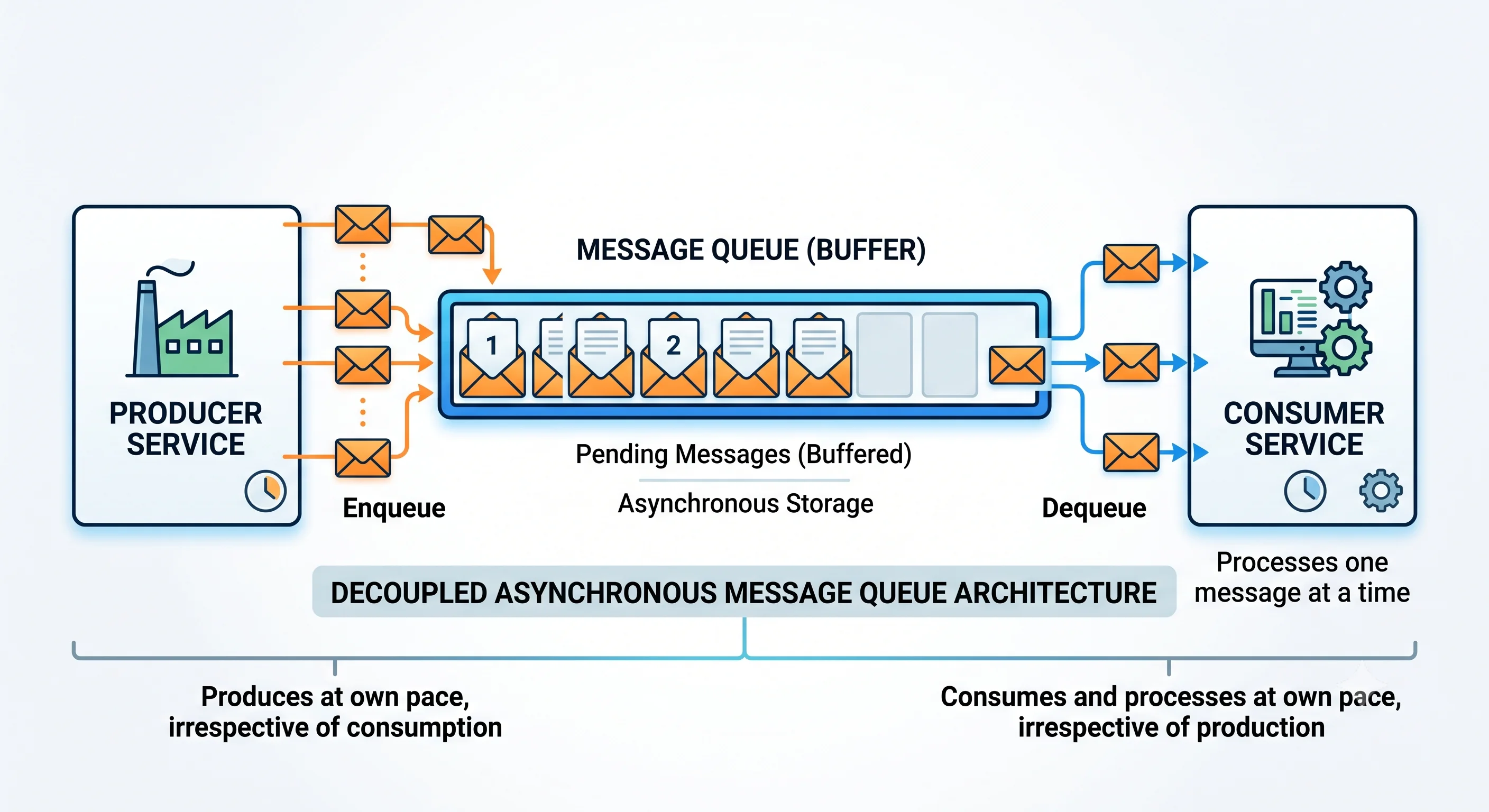
A message queue is a buffer that sits between services, letting one service (the producer) hand off work to another (the consumer) without waiting for it to finish — or even for it to be online. The producer drops a message into the queue and moves on; the consumer picks it up when it's ready and processes it. This decouples the two sides in time and load, which is the foundation of asynchronous, event-driven architecture. Message queues turn brittle synchronous chains ("A calls B calls C, and if C is slow everything hangs") into resilient pipelines that absorb spikes, survive downstream outages, and scale each stage independently.
How It Actually Works
Synchronous vs Asynchronous
Synchronous (tightly coupled):
  Client → Service A → Service B → Service C → back up the chain
  If C is slow/down, A is stuck waiting, and the client hangs. 💥

Asynchronous (queue-decoupled):
  Client → Service A → [Queue] → (later) Service B processes
  A responds immediately; B works when ready; C outage doesn't block A. ✅
The producer's job finishes when the message is safely enqueued — not when the work is done. This is the core shift.
What Queues Buy You
| Benefit | How |
|---|---|
| Decoupling | Producer and consumer don't need to know about or wait for each other |
| Load leveling (buffering) | A traffic spike fills the queue; consumers drain it at a steady rate |
| Resilience | If a consumer is down, messages wait safely instead of being lost |
| Independent scaling | Add more consumers to drain faster; scale producers separately |
| Retry & error handling | Failed messages can be redelivered or sent to a dead-letter queue |
Load Leveling: The Killer Feature
Spike: 10,000 orders arrive in 1 second.

Without a queue:  the order service must handle 10,000 concurrent
                  requests NOW → overload, timeouts, dropped orders.

With a queue:     10,000 messages land in the queue instantly (cheap).
                  Consumers process at a sustainable 500/sec.
                  The queue absorbs the burst; nothing is lost;
                  users got an instant "order received" ack.
The queue acts as a shock absorber, converting a spiky, bursty load into a smooth, sustainable one — protecting downstream systems from overload.
Delivery Guarantees
A crucial design axis: how hard does the system try to deliver each message exactly once?
| Guarantee | Meaning | Trade-off |
|---|---|---|
| At-most-once | Deliver 0 or 1 time (may drop) | Simple, fast; can lose messages |
| At-least-once | Deliver 1+ times (may duplicate) | No loss, but consumers must handle duplicates |
| Exactly-once | Deliver precisely once | Hardest/most expensive; often approximated |
At-least-once is the common default — it never loses messages, at the cost of possible duplicates. This is why consumers must be idempotent (see Idempotency): processing the same message twice must be safe.
Acknowledgments and Visibility
The mechanism that makes at-least-once work:
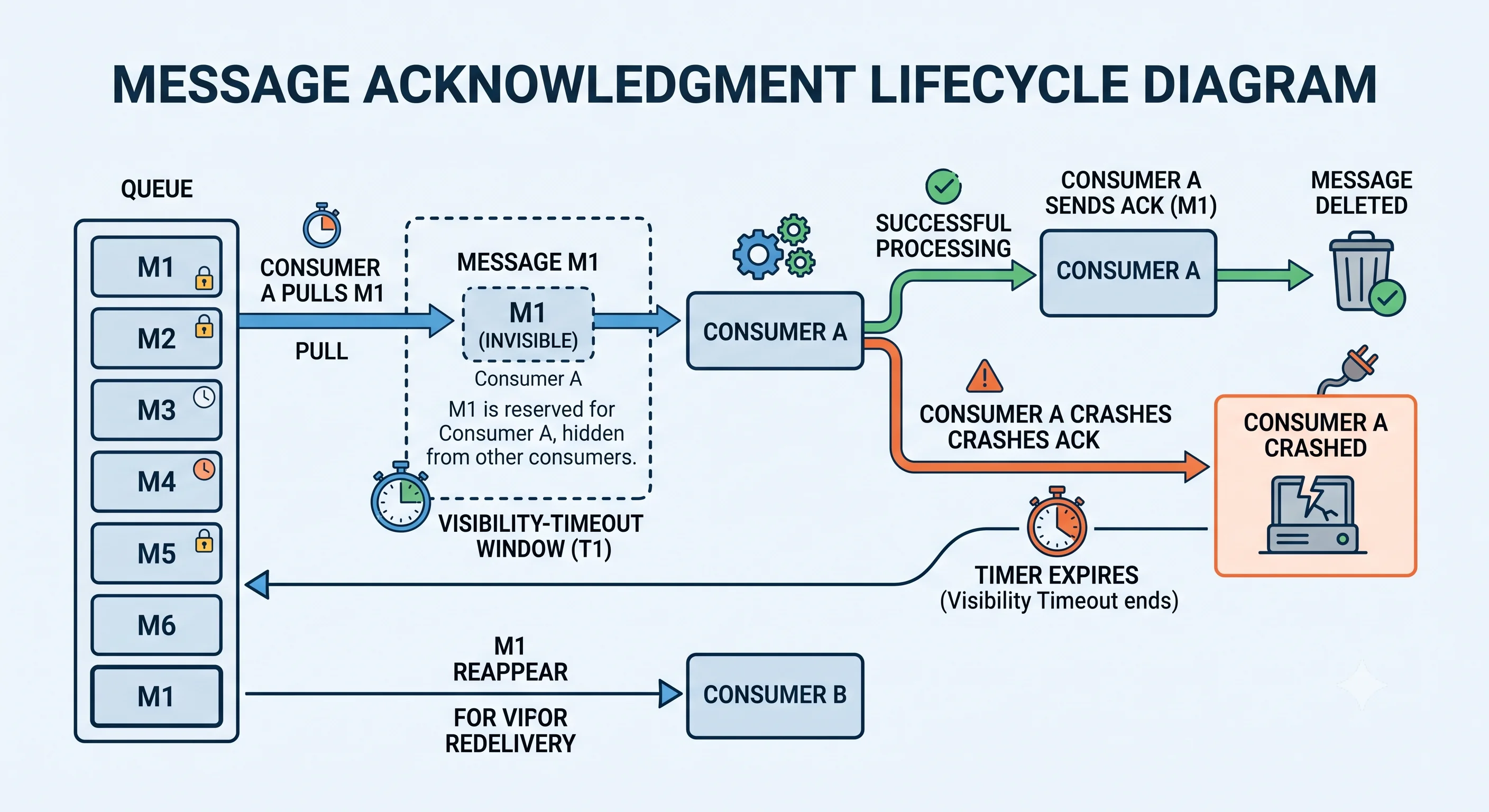
1. Consumer receives a message → it becomes "invisible" to others
   (visibility timeout) but is NOT yet deleted.
2. Consumer processes the message.
3. Consumer sends an ACK → the queue deletes it permanently.
   If the consumer crashes before ACK, the visibility timeout expires
   and the message reappears for another consumer to retry.
This guarantees no message is lost to a consumer crash — but is exactly why a message can be delivered more than once (the crash happened after processing but before ACK).
Point-to-Point vs Pub/Sub
A message queue is typically point-to-point: each message is consumed by exactly one consumer (competing consumers share the load). This differs from pub/sub, where each message is delivered to every subscriber (see Pub/Sub).
Seeing It in Action
Scenario: Order processing decoupled with a queue.
Synchronous nightmare (before):
  POST /order → validate → charge card → reserve inventory →
                send email → update analytics → RETURN
  Every step blocks the user. Email service slow? User waits.
  Analytics down? Order fails. Fragile and slow.

Queue-based (after):
  POST /order → validate → charge card → enqueue "order.created"
              → RETURN "order received" instantly (fast, reliable)

  Independent consumers drain the queue asynchronously:
    ┌─ inventory-worker   → reserve stock
    ├─ email-worker       → send confirmation (retries if slow)
    ├─ analytics-worker   → record event
    └─ fulfillment-worker → notify warehouse

  Benefits realized:
    • User gets an instant response (only the critical path is sync)
    • Email service being slow doesn't affect checkout
    • Analytics outage doesn't lose orders (messages wait in queue)
    • Black Friday spike? Queue buffers it; workers drain steadily
    • Scale each worker independently based on its own backlog
Why this is transformative: the synchronous version couples the user's checkout latency and success to the slowest, least-reliable downstream system. The queue-based version makes the user-facing path fast and reliable, isolates each downstream concern, and turns a fragile chain into a resilient pipeline that degrades gracefully and scales per-stage. This decoupling is the single most important pattern in scalable backend design.
Interview Questions
Q: What problems does a message queue solve? Hint: Decoupling (producer and consumer don't wait for or depend on each other), load leveling (buffer spikes so downstream processes at a steady rate), resilience (messages wait safely if a consumer is down instead of being lost), independent scaling (add consumers to drain faster), and built-in retry/error handling. It converts fragile synchronous chains into resilient asynchronous pipelines.
Q: Explain at-most-once, at-least-once, and exactly-once delivery. Hint: At-most-once may drop messages (deliver 0–1 times) — simple but lossy. At-least-once never loses but may duplicate (deliver 1+ times) — the common default. Exactly-once delivers precisely once — hardest and most expensive, often approximated via at-least-once + idempotent consumers or dedup. The practical answer is usually "at-least-once with idempotent processing."
Q: How does message acknowledgment prevent loss, and why does it cause duplicates? Hint: A consumed message becomes invisible (visibility timeout) but isn't deleted until the consumer ACKs after processing. If the consumer crashes before ACK, the timeout expires and the message reappears for retry — no loss. But if the crash happens after processing but before ACK, the message is processed again → duplicate. Hence consumers must be idempotent.
Q: What is load leveling and why is it valuable? Hint: The queue absorbs bursts: a spike of messages lands in the queue instantly (cheap), while consumers drain them at a sustainable rate. This shields downstream systems from overload — instead of forcing them to handle peak concurrency, they process a smooth stream. Users get an instant ack while work happens asynchronously. It's the queue acting as a shock absorber.
Q: What's the difference between a point-to-point queue and pub/sub? Hint: Point-to-point (a message queue): each message is delivered to exactly one consumer; multiple competing consumers share the load. Pub/sub: each message is broadcast to every subscriber, so N subscribers each get their own copy. Queues distribute work; pub/sub distributes events/notifications. Some systems (Kafka) blend both via consumer groups.
References
- AWS SQS documentation — queues, visibility timeout, delivery
- Enterprise Integration Patterns by Hohpe & Woolf — the messaging pattern bible
- Designing Data-Intensive Applications by Martin Kleppmann — Chapter 11: Stream Processing
Dive Deeper
- The Log: What every software engineer should know (Jay Kreps) — logs as the foundation of messaging
- AWS Builders' Library: Avoiding insurmountable queue backlogs — operating queues at scale
- RabbitMQ tutorials — hands-on queue mechanics