
NoSQL Databases
In a Nutshell
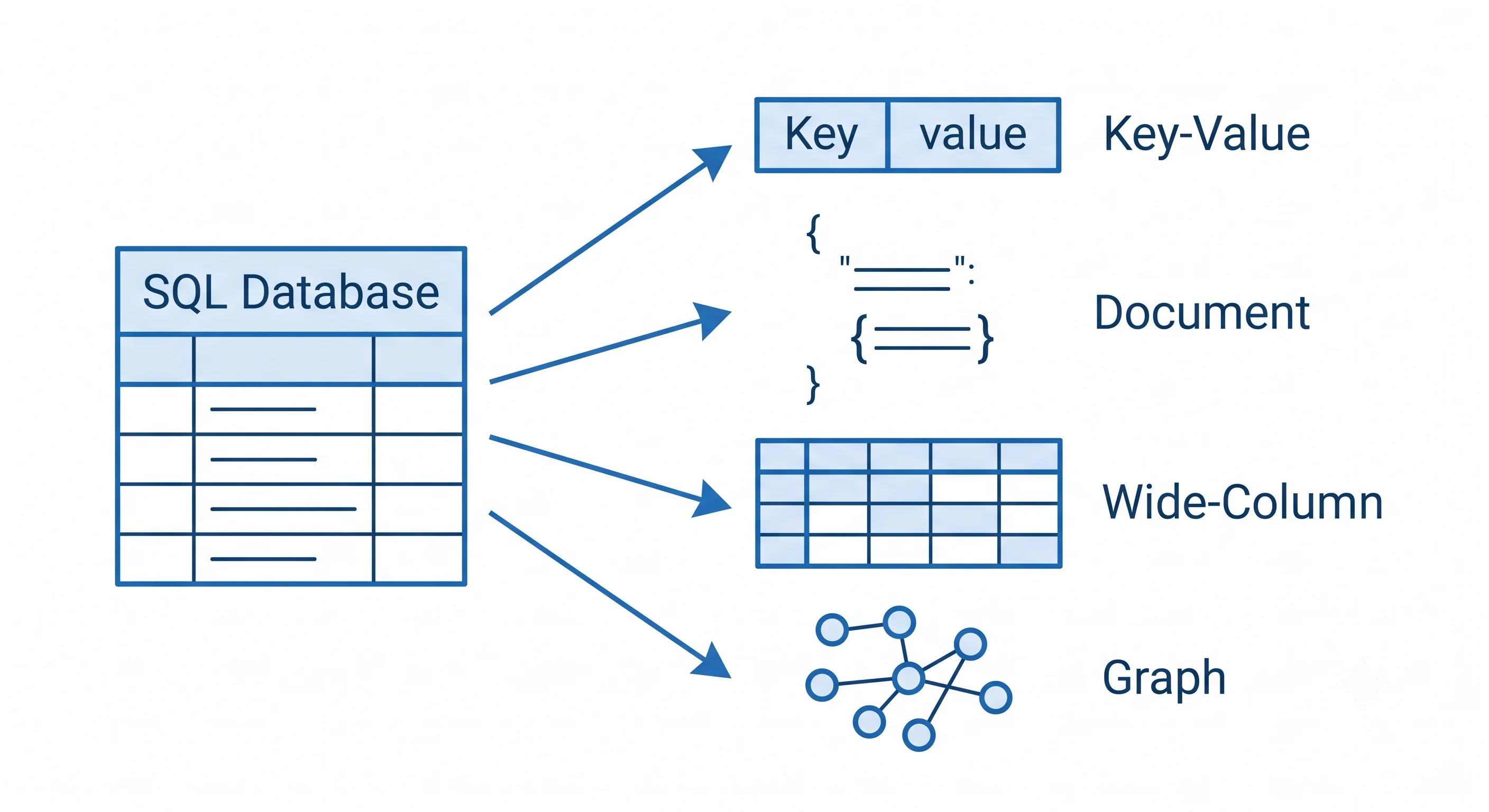
NoSQL is not one thing — it's an umbrella term for databases that trade parts of the SQL contract (rigid schemas, joins, full ACID) for scale, flexibility, or specialized performance. The name is misleading; a better name would be "Not Only SQL." NoSQL databases exist because relational databases, despite being excellent, have real limitations at extreme scale: a single primary bottleneck for writes, expensive cross-shard joins, and rigid schemas that make frequent changes painful. NoSQL solves specific problems — but it creates new ones.
How It Actually Works
The Four NoSQL Families
| Family | Data Model | Access Pattern | Examples |
|---|---|---|---|
| Key-Value | Key → opaque value | Get/set by exact key | Redis, DynamoDB, Riak |
| Document | Key → structured JSON/BSON document | Query by any field in the document | MongoDB, CouchDB, Firestore |
| Wide-Column | Row key → sparse, dynamic columns | Range scans on row key, high write throughput | Cassandra, HBase, ScyllaDB |
| Graph | Nodes + edges with properties | Traverse relationships | Neo4j, Amazon Neptune, JanusGraph |
What They All Share
Despite their differences, all NoSQL databases share some common traits:
- Schema flexibility — No predefined schema (or a very flexible one). Fields can be added without migrations.
- Horizontal scaling — Designed to shard data across many machines from the start.
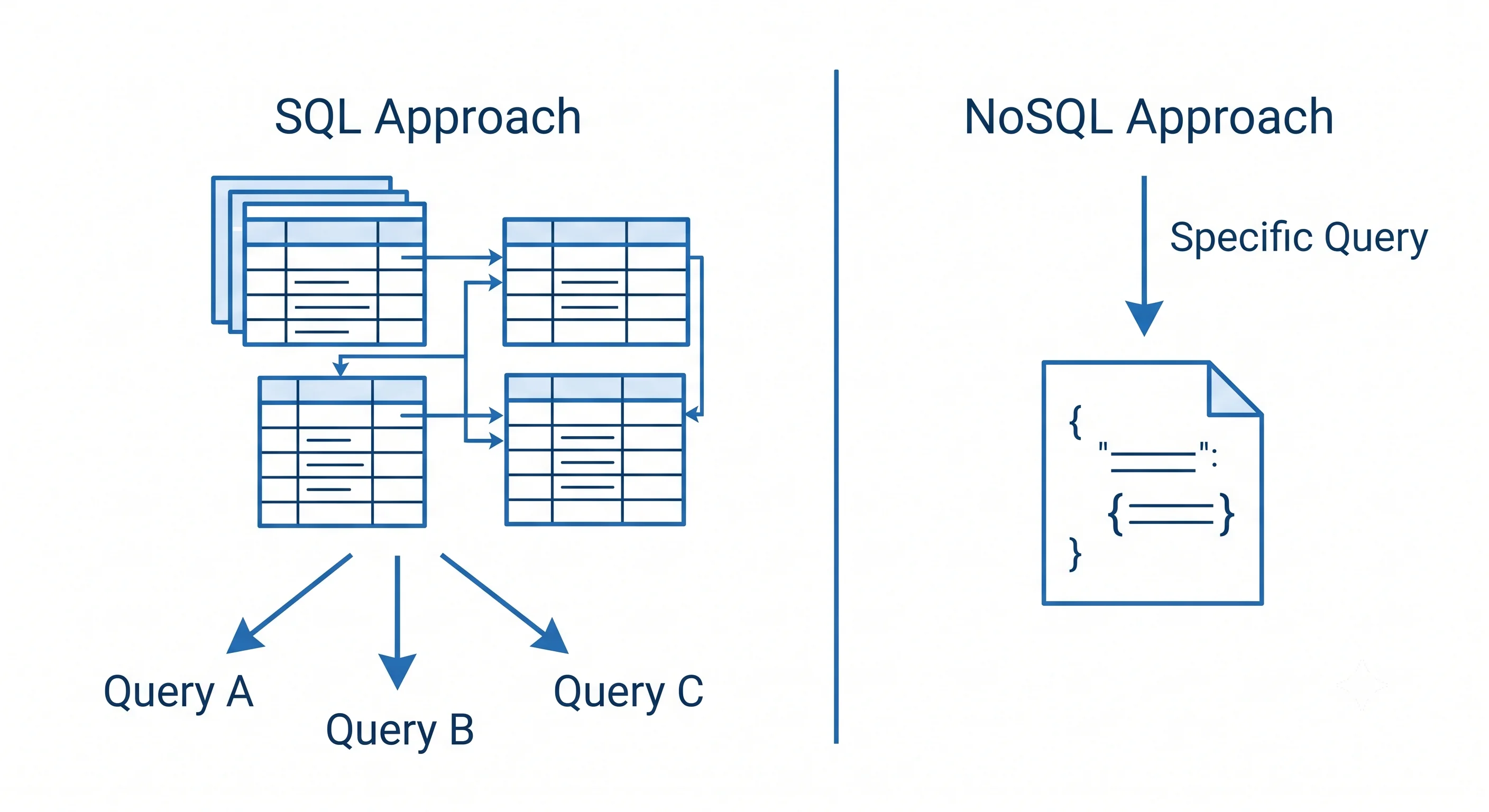
- Denormalized data — Data is typically stored in the shape it will be queried, not normalized.
- Weaker consistency — Most offer tunable consistency rather than strict ACID (eventual consistency is the default).
- No joins — Relationships between records must be handled in application code or by denormalization.
SQL vs NoSQL Decision Framework
| Question | If Yes → SQL | If Yes → NoSQL |
|---|---|---|
| Does data have many relationships? | ✅ | |
| Do you need joins in queries? | ✅ | |
| Is ACID required (money, inventory)? | ✅ | |
| Will query patterns change frequently? | ✅ | |
| Is write throughput the bottleneck? | ✅ | |
| Is each record self-contained? | ✅ | |
| Do you need horizontal scaling from day one? | ✅ | |
| Is schema evolving rapidly (prototyping)? | ✅ | |
| Is the access pattern very specific (key lookup, graph traversal)? | ✅ |
The Trade-Offs You Accept
When you choose NoSQL, you're accepting specific trade-offs:
| What You Gain | What You Lose |
|---|---|
| Horizontal write scaling | Cross-record transactions |
| Schema flexibility | Data integrity enforcement |
| Optimized access patterns | Ad-hoc query flexibility |
| High throughput for specific operations | Joins (must denormalize or do in app code) |
| Simpler read path (data shaped for query) | Harder write path (must maintain denormalized copies) |
The fundamental shift: in SQL, you model the data and let the query language handle access. In NoSQL, you model the query and shape the data to serve it.
Common Mistakes
- Using NoSQL because it's "modern" — If your data has relationships and you need transactions, SQL is the right choice. NoSQL for a banking system is a mistake.
- Treating all NoSQL as the same — Key-value and graph databases solve completely different problems. "We'll use NoSQL" is not a design decision.
- Ignoring the join problem — Without joins, you either denormalize (write amplification) or join in application code (latency). Neither is free.
- Assuming NoSQL = no schema — The schema moves to application code, which is worse because it's not enforced. Schema-on-read means bugs are discovered at read time instead of write time.
Seeing It in Action
Scenario: Choosing the right NoSQL family for different use cases
| Use Case | Best NoSQL Family | Why |
|---|---|---|
| Session storage for a web app | Key-Value (Redis) | Simple get/set by session ID, TTL expiry, microsecond access |
| User profiles for a social platform | Document (MongoDB) | Each profile is self-contained, schema varies by user type, no joins needed |
| IoT sensor readings (billions/day) | Wide-Column (Cassandra) | Massive write throughput, time-range queries, data partitioned by device ID |
| Social network "friends of friends" | Graph (Neo4j) | Traversal queries (3 hops deep) that would require 6 self-joins in SQL |
| Shopping cart | Document or Key-Value | Cart is self-contained, temporary, per-user — no relationships to other entities |
| Financial transactions ledger | SQL ❌ Not NoSQL | ACID transactions, double-entry consistency — NoSQL is wrong here |
Interview Questions
Q: When would you choose NoSQL over SQL for a new project? Give specific criteria. Hint: When records are self-contained (no joins needed), write throughput exceeds what a single SQL primary handles, schema is evolving rapidly, or the access pattern is very specific (key lookup, time-range scans, graph traversal). Never choose NoSQL just because "it's more scalable" — that's a myth at most scales.
Q: Explain the difference between schema-on-write (SQL) and schema-on-read (NoSQL). What are the implications? Hint: Schema-on-write: the database enforces structure at write time — invalid data is rejected. Schema-on-read: anything can be written, and the application interprets structure at read time — invalid data is discovered later. Schema-on-write catches errors earlier but makes changes harder. Schema-on-read is flexible but pushes validation into application code.
Q: You're designing a system that needs both strong consistency (payments) and high write throughput (activity logs). How do you handle this? Hint: Polyglot persistence — use SQL (PostgreSQL) for payments where ACID is required, and NoSQL (Cassandra or DynamoDB) for activity logs where eventual consistency is fine and write volume is high. This is the standard pattern: different databases for different access patterns within the same system.
Q: What does "model the query, not the data" mean in NoSQL? Give an example. Hint: In SQL, you normalize data and write any query you want. In NoSQL (e.g., Cassandra), you design each table around a specific query. If you need "get orders by user" AND "get orders by date," you create two tables with the same data partitioned differently. Write amplification is the cost of read optimization.
Q: What problems does denormalization create in a NoSQL database, and how do you handle them? Hint: Data can become inconsistent across copies (user changes name — do all denormalized copies update?). Solutions: accept eventual consistency, use change data capture (CDC) to propagate updates, or batch reconciliation jobs. The key trade-off: faster reads at the cost of more complex writes.
References
- Designing Data-Intensive Applications by Martin Kleppmann — Chapter 2: Data Models and Query Languages
- MongoDB vs PostgreSQL — official comparison from MongoDB
- AWS Database Selection Guide — decision framework for AWS database services
Dive Deeper
- NoSQL Distilled by Pramod Sadalage & Martin Fowler — concise guide to NoSQL families and when to use each
- Rick Houlihan — DynamoDB Deep Dive (re:Invent) — masterclass on NoSQL data modeling
- Martin Fowler — NoSQL Databases Introduction — conceptual overview from a thought leader