
Vertical vs Horizontal Scaling
In a Nutshell
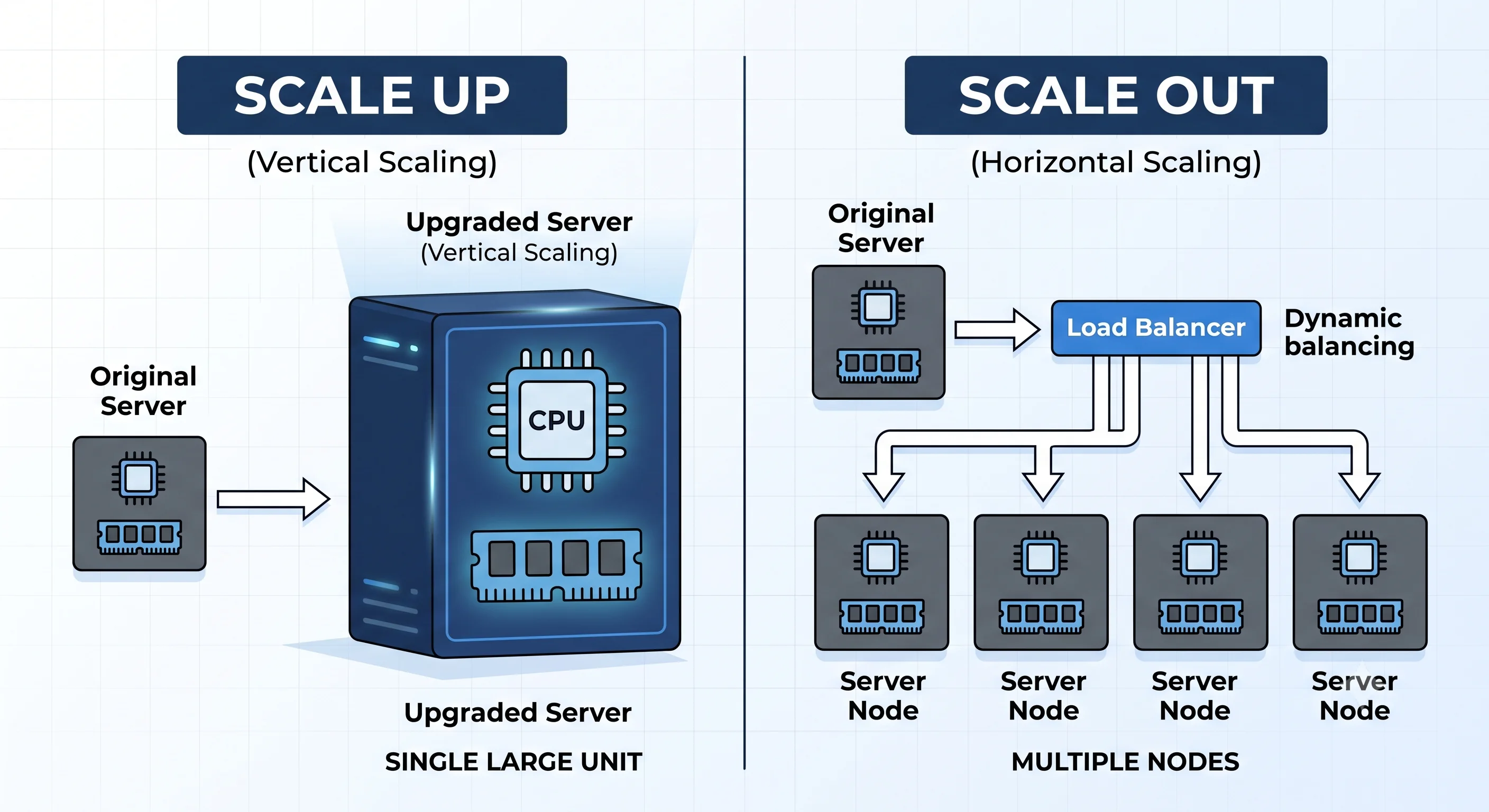
When your system can't keep up with load, you have two fundamental moves. Vertical scaling (scale up) means making one machine more powerful — more CPU, more RAM, faster disks. Horizontal scaling (scale out) means adding more machines and spreading the work across them. Scaling up is simple but hits a hard ceiling (the biggest server money can buy) and gives you a single point of failure. Scaling out is theoretically unlimited and fault-tolerant, but forces you to solve hard distributed-systems problems: load balancing, data partitioning, and keeping state consistent across nodes. Almost every large system is a mix — scale up until it's painful, then scale out.
How It Actually Works
The Two Axes of Scaling
| Dimension | Vertical (Scale Up) | Horizontal (Scale Out) |
|---|---|---|
| What changes | One node gets bigger | More nodes get added |
| Upper limit | Hardware ceiling (largest available instance) | Practically unbounded |
| Fault tolerance | Single point of failure | Survives individual node loss |
| Complexity | Low — no app changes | High — needs LB, partitioning, coordination |
| Cost curve | Superlinear (top-tier hardware is disproportionately expensive) | Roughly linear (commodity hardware) |
| Downtime to scale | Often requires a reboot/migration | Add nodes with zero downtime |
| Data consistency | Trivial (single machine) | Hard (distributed state) |
Why Vertical Scaling Hits a Wall
Scaling up is the path of least resistance: resize the VM, restart, done. No code changes, no distributed-systems headaches. But the ceiling is real. As of the mid-2020s, the largest cloud instances top out around 128–224 vCPUs and 24+ TB of RAM — and the price per unit of compute climbs steeply at the top end. Worse, a single big box means a single point of failure: when it goes down, everything goes down. There's also a maintenance problem — you can't patch or reboot without downtime unless you already have redundancy, which itself requires more than one machine.
Why Horizontal Scaling Is Harder
Adding machines sounds easy until you ask: how does a request find the right machine, and how do the machines agree on state? Scaling out forces you to confront:
- Load distribution — you need a load balancer to spread requests (see Load Balancing).
- State management — if a server holds session state in memory, the next request might hit a different server. This pushes you toward stateless services with shared state in Redis or a database.
- Data partitioning — one database can't hold everything, so you shard (see Sharding & Partitioning).
- Coordination — nodes must agree on who's the leader, who owns which data, and what the current config is (see Consensus & Leader Election).
Stateless Is the Enabler
The single most important design decision for horizontal scaling is making your application tier stateless. A stateless service keeps no client-specific data between requests — any node can handle any request. Session data, uploaded files, and caches all move to shared backing stores.
Stateful (hard to scale out):
  Client → Server A (holds session in local memory)
  Next request MUST return to Server A ("sticky sessions")

Stateless (easy to scale out):
  Client → [Any Server] → reads session from Redis
  Any node can serve any request → add nodes freely
Amdahl's & Universal Scalability Law
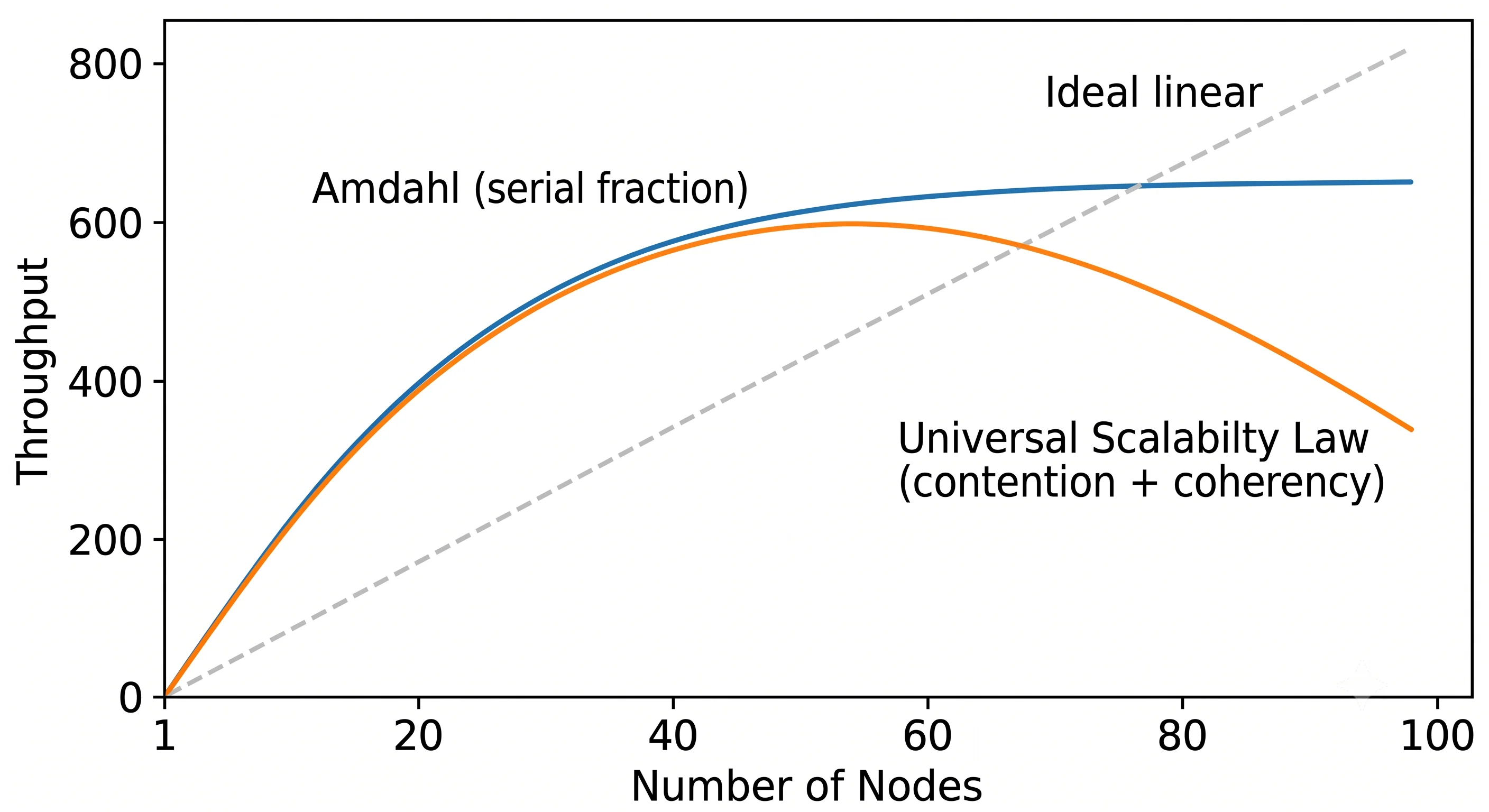
Scaling out never gives perfect linear returns. Amdahl's Law says the serial (non-parallelizable) fraction of your workload caps your maximum speedup. The Universal Scalability Law adds a second penalty: coordination and contention between nodes eventually make adding nodes hurt throughput. This is why doubling servers rarely doubles capacity — and why reducing shared state and cross-node chatter matters so much.
Seeing It in Action
Scenario: A startup's API is at 80% CPU during peak hours.
Stage 1 — Scale up (buy time):
  Resize instance:  4 vCPU / 16 GB  →  16 vCPU / 64 GB
  Effort: minutes. Buys ~4x headroom. No code changes.
  ✅ Good first move while you re-architect.

Stage 2 — Make the app stateless:
  Move sessions from in-process memory → Redis
  Move uploaded files from local disk → S3/object storage
  Now any instance can serve any request.

Stage 3 — Scale out:
  Put 6 instances behind a load balancer.
  Autoscale between 3 and 20 based on CPU.
  ✅ Fault tolerant, near-linear cost, no ceiling.

Stage 4 — Scale the data tier:
  Add read replicas (see replication-and-read-replicas.md)
  Shard when a single primary can't hold writes.
Rule of thumb: Scale up first because it's cheap in engineering effort; invest in scaling out before you hit the vertical ceiling, because that migration takes time you won't have during an outage.
Interview Questions
Q: What's the difference between vertical and horizontal scaling, and when would you choose each? Hint: Vertical = bigger machine (simple, has a ceiling, single point of failure). Horizontal = more machines (unbounded, fault-tolerant, complex). Choose vertical for quick wins, simple stateful systems (e.g., a single relational primary), or when you haven't hit the ceiling. Choose horizontal when you need fault tolerance, elasticity, or capacity beyond one machine.
Q: Why is making a service stateless so important for horizontal scaling? Hint: If a server holds client state (sessions, in-memory caches) locally, requests must be routed back to the same server (sticky sessions), which defeats even load distribution and breaks when that server dies. Stateless services push state to shared stores (Redis, DB, S3), so any node can serve any request — enabling free addition/removal of nodes.
Q: Doubling the number of servers rarely doubles throughput. Why? Hint: Amdahl's Law (the serial fraction of work can't be parallelized and caps speedup) and the Universal Scalability Law (coordination/contention overhead between nodes grows and can even reduce throughput past a point). Shared resources (a single database, locks) become bottlenecks. Reducing shared state and cross-node coordination improves scaling efficiency.
Q: What are the operational downsides of relying purely on vertical scaling? Hint: Hard hardware ceiling; superlinear cost at the top end; single point of failure; scaling and patching often require downtime (reboot/migration); no elasticity for spiky traffic. You also can't easily do rolling deployments without a second machine.
Q: You have a legacy monolith that stores sessions in local memory. Traffic is spiking. What's your migration path to horizontal scaling? Hint: First scale up to buy time. Then externalize state: move sessions to Redis, files to object storage, and make the app tier stateless. Add a load balancer, run multiple instances, then introduce autoscaling. Scale the data tier separately (read replicas, then sharding).
References
- Designing Data-Intensive Applications by Martin Kleppmann — Chapter 1: Scalability
- The Art of Scalability by Abbott & Fisher — the "AKF Scale Cube"
- AWS: Scaling vertically vs horizontally — cloud-specific guidance
Dive Deeper
- Universal Scalability Law — Neil Gunther — the math behind why scaling out has diminishing (then negative) returns
- Google SRE Book — Handling Overload — what happens when scaling can't keep up
- Systems Performance by Brendan Gregg — deep treatment of resource ceilings and capacity