
Consistency Models
In a Nutshell
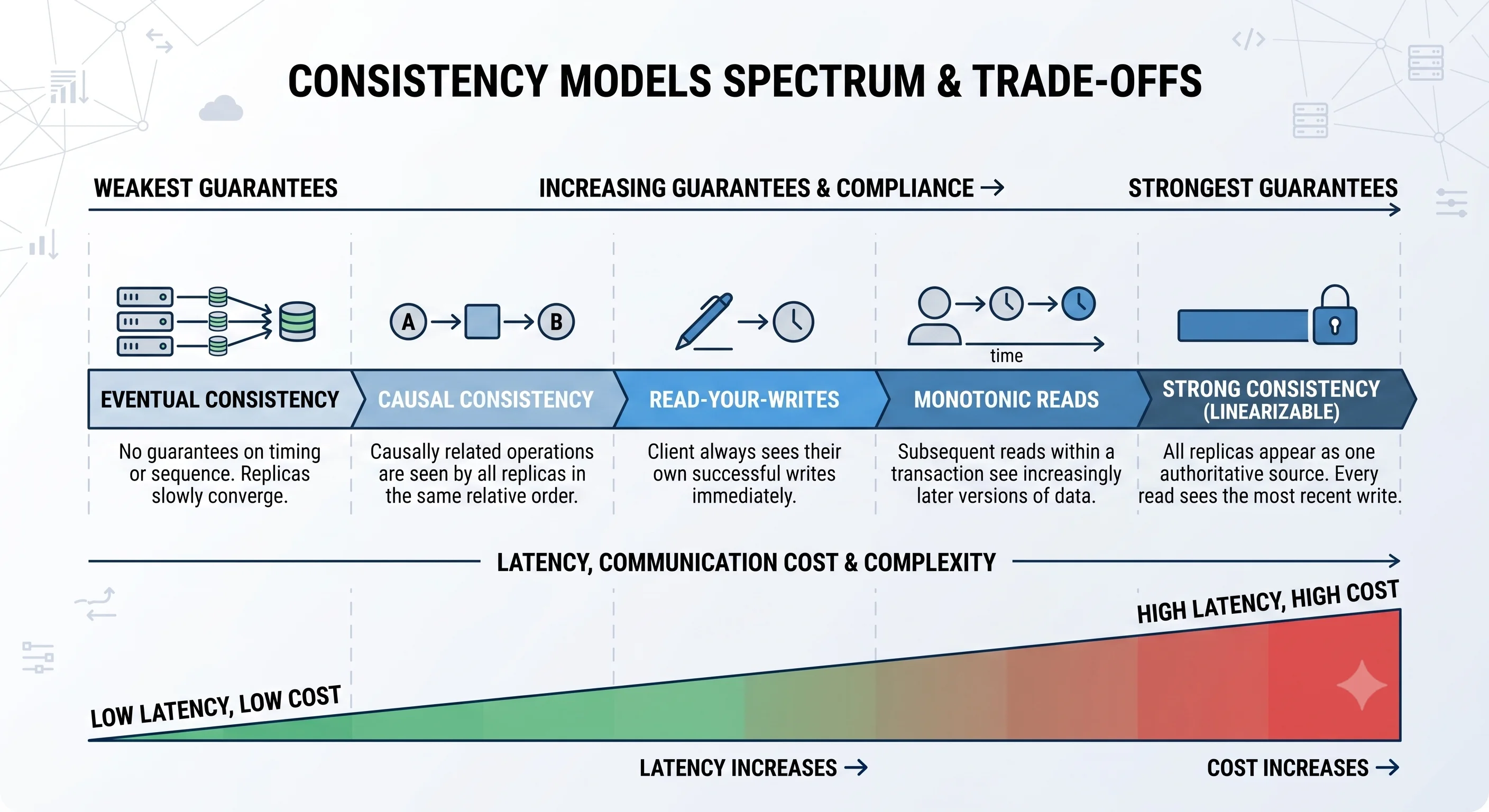
CAP gives you a binary choice (CP or AP), but reality is a spectrum. Consistency models describe exactly how fresh a read is relative to the latest write — from strong consistency (every read sees the latest write — simple to reason about, expensive to provide) to eventual consistency (reads might be stale, but the system will eventually converge — cheap, fast, but application must handle staleness). Between these extremes lie several practically useful models that offer specific, weaker guarantees. Choosing the right model is about matching the consistency guarantee to the business requirement, not always picking the strongest one.
How It Actually Works
The Consistency Spectrum
| Model | Guarantee | Example | Use Case |
|---|---|---|---|
| Strong (Linearizable) | Every read sees the latest write, globally ordered | After writing balance = $50, any reader anywhere immediately sees $50 |
Payments, inventory, leader election |
| Sequential | All operations appear in some total order consistent with each client's order | Writes appear in the same order to all observers | Distributed logs, event sourcing |
| Causal | If operation A caused operation B, everyone sees A before B | If Alice posts and Bob replies, everyone sees Alice's post before Bob's reply | Social media, messaging |
| Read-Your-Writes | A client always sees its own writes | After updating your profile, you immediately see the change | User-facing write-then-read flows |
| Monotonic Reads | A client never sees data move backward | If you read version 5, you'll never see version 4 on a subsequent read | Dashboards, feeds |
| Eventual | If no new writes occur, all replicas will eventually converge | DNS propagation — a new record takes minutes/hours to reach all servers | DNS, CDN caches, analytics |
Strong Consistency (Linearizability)
The strongest guarantee: operations appear to happen instantaneously at some point between their start and end time. Every client sees the same, totally ordered sequence of operations.
Timeline:
Writer: SET x = 1  ─────────▶ (commit at T1)
Reader A:                          GET x → 1 ✓ (always sees latest)
Reader B:                          GET x → 1 ✓ (even from different node)
How to achieve: Consensus protocols (Raft, Paxos) or single-leader with synchronous replication. Expensive — every write requires a majority acknowledgment.
Used by: Google Spanner, CockroachDB, etcd, ZooKeeper.
Eventual Consistency
The weakest useful guarantee: if you stop writing, all replicas will eventually converge to the same value. But "eventually" is undefined — it could be milliseconds or minutes.
Timeline:
Writer: SET x = 1  ─────────▶ (commit at T1)
Reader (same region):              GET x → 1 ✓ (fast — local replica)
Reader (different region):         GET x → 0 ✗ (stale! not yet replicated)
    ... time passes ...            GET x → 1 ✓ (converged)
The problem: What happens between the write and convergence? The application sees stale data. For a social media like count, this is fine. For a bank balance, it's catastrophic.
Used by: Cassandra (default), DynamoDB (default), DNS, CDN caches.
Causal Consistency
Stronger than eventual, weaker than strong. Guarantees that causally related operations are seen in order by all observers, but concurrent (unrelated) operations may be seen in different orders.
Alice posts: "Anyone free for lunch?"       (operation A)
Bob replies: "I am!"                         (operation B, caused by A)

Causal guarantee: Everyone sees A before B.
Without causality: Some users might see B before A ("I am!" without context).
Used by: MongoDB (since 3.6 with causal sessions), some collaborative editing systems.
Read-Your-Writes
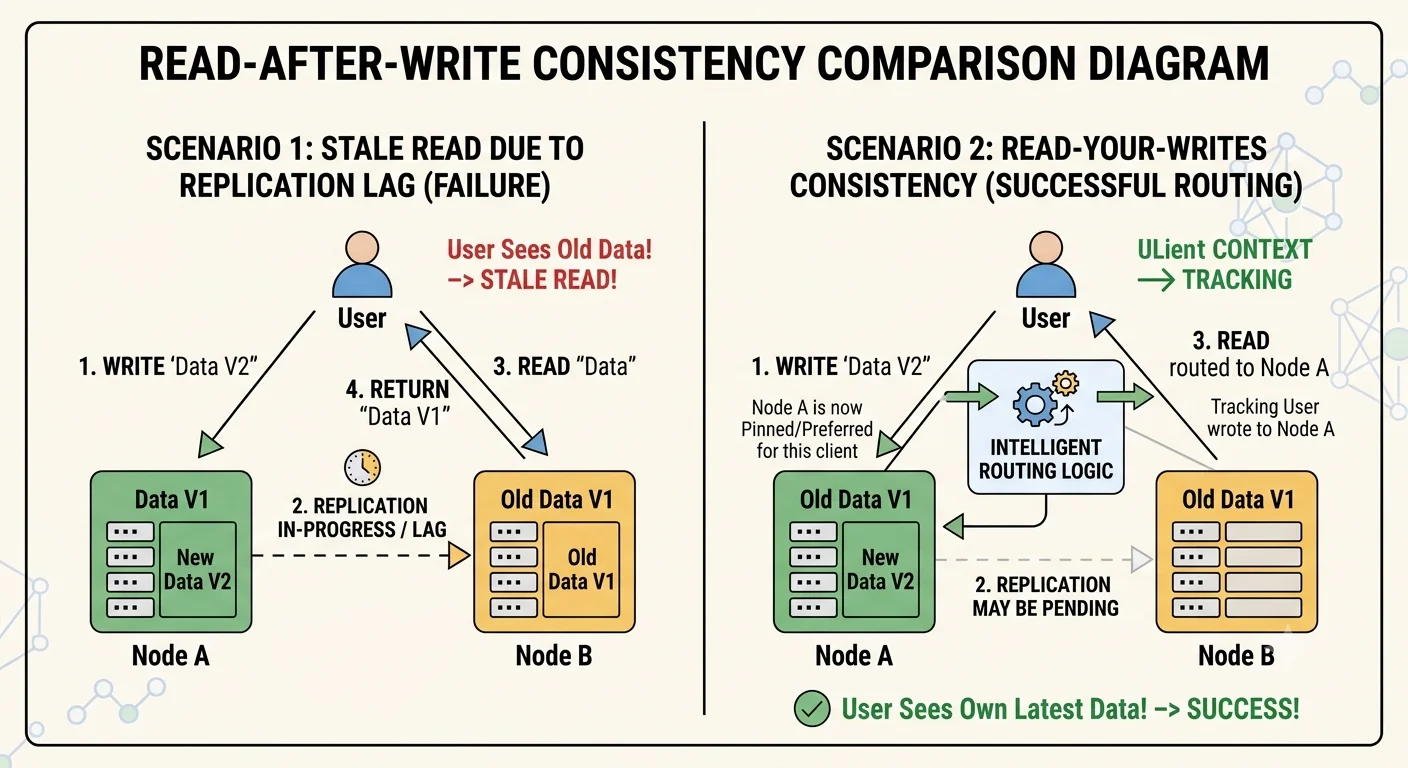
After a client writes data, that same client is guaranteed to see its own write on subsequent reads — even if the write hasn't replicated everywhere yet.
User updates profile name → immediately sees the new name
Other users might see the old name for a few seconds → eventually converges
How to implement: Route reads after a write to the same replica that handled the write, or use sticky sessions. Alternatively, track a "last write timestamp" and wait for the replica to catch up.
Seeing It in Action
Scenario: Consistency model choices for different parts of a social media platform
| Feature | Consistency Model | Why |
|---|---|---|
| Account balance (ad credits) | Strong (Linearizable) | Money cannot be double-spent; every read must reflect the latest debit |
| Post creation | Read-Your-Writes | After posting, the author must see their post immediately; others can see it eventually |
| News feed | Eventual | A 5-second delay in seeing a friend's post is unnoticeable; availability matters more |
| Comment threads | Causal | Replies must appear after the comment they respond to; ordering within a thread matters |
| Like count | Eventual | Off-by-a-few is imperceptible; high write throughput matters more than precision |
| DM read receipts | Monotonic Reads | Once you see "read," it should never go back to "delivered" |
Interview Questions
Q: What's the difference between strong consistency and eventual consistency? When would you choose each? Hint: Strong: every read sees the latest write — use for payments, inventory, authentication. Eventual: reads might be stale but will converge — use for social feeds, analytics, caching. The trade-off is latency and availability: strong consistency requires coordination (consensus), which adds latency and reduces availability during partitions.
Q: A user updates their profile but sees the old name on refresh. What's happening and how do you fix it? Hint: The write went to the primary, but the read hit a replica that hasn't received the update yet (replication lag). Fix with read-your-writes consistency: route the user's reads to the primary after a write, or use a session-level read preference that ensures the replica has caught up (e.g.,
readPreference: "primaryPreferred"withafterClusterTime).Q: Explain causal consistency with a messaging example. Hint: Alice sends "Want to grab lunch?" (msg A). Bob replies "Sure, where?" (msg B, causally dependent on A). Causal consistency guarantees every user sees A before B. Without it, a user might see Bob's reply before Alice's question — confusing. Causal consistency tracks dependencies (vector clocks or Lamport timestamps) without the full cost of linearizability.
Q: How does DynamoDB let you choose between eventual and strong consistency? Hint: Per-read setting.
ConsistentRead: false(default) reads from any replica — fast but potentially stale.ConsistentRead: truereads from the leader — always current but slower and uses more capacity. Choose per-query based on the operation: strong for account balance, eventual for product listing.Q: Can you have strong consistency in a multi-region deployment without high latency? Hint: Not easily. Strong consistency requires consensus (majority of replicas agree), and cross-region round trips are 50–200ms. Google Spanner mitigates this with TrueTime (atomic clocks reduce coordination overhead). CockroachDB uses follower reads (read from the closest replica if the data is recent enough). The honest answer: strong consistency across regions always costs latency; the question is how much.
References
- Designing Data-Intensive Applications by Martin Kleppmann — Chapter 9: Consistency and Consensus
- Consistency Models — Jepsen — visual map of consistency models and their relationships
- AWS DynamoDB Consistency — practical tunable consistency
Dive Deeper
- Linearizability vs Serializability — Peter Bailis — the most common consistency confusion, clarified
- Vector Clocks and Causal Consistency — how systems track causality
- Google Spanner TrueTime — how Spanner achieves external consistency globally