
Load Balancer & Reverse Proxy
In a Nutshell
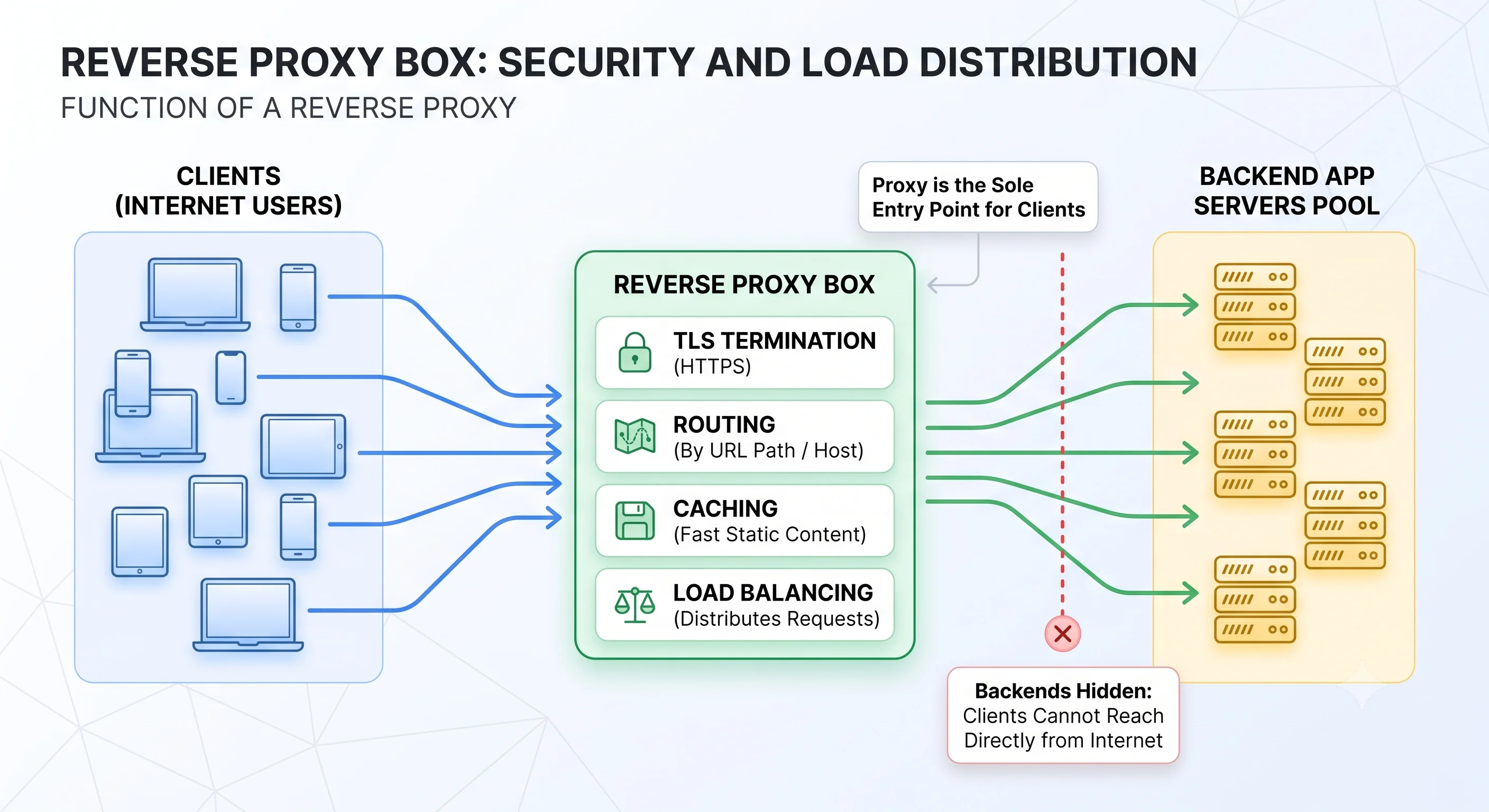
A reverse proxy is a server that sits in front of your application servers and forwards client requests to them, then relays the responses back — the client only ever talks to the proxy, never directly to the backends. A load balancer is a specialized reverse proxy whose primary job is distributing traffic across a pool of backends. The two concepts overlap heavily: most reverse proxies can load-balance, and most load balancers are reverse proxies. The distinction is one of emphasis — a reverse proxy is about what happens at the boundary (TLS, caching, routing, security), while a load balancer is about how traffic is spread across many servers.
How It Actually Works
Forward Proxy vs Reverse Proxy
These are mirror images — know the difference:
| Forward Proxy | Reverse Proxy | |
|---|---|---|
| Sits in front of | Clients | Servers |
| Acts on behalf of | The client | The server |
| Client knows the real server? | Yes (proxy hides the client) | No (proxy hides the servers) |
| Typical use | Corporate egress, privacy, filtering | LB, TLS, caching, security, routing |
Forward proxy:  [Clients] → (proxy) → Internet     (hides who's asking)
Reverse proxy:  Internet → (proxy) → [Servers]     (hides what's answering)
What a Reverse Proxy Does at the Boundary
Putting a reverse proxy in front of your app centralizes cross-cutting concerns so your backends don't each have to reimplement them:
| Function | Benefit |
|---|---|
| Load balancing | Spread traffic across backends (see Load Balancing) |
| TLS termination | Decrypt once at the edge; backends speak plain HTTP internally |
| Caching | Serve cached responses without hitting backends |
| Compression | gzip/brotli responses centrally |
| Routing | Path/host-based routing (/api → service A, /img → service B) |
| Security | WAF, rate limiting, IP allow/deny, hide backend topology |
| Request buffering | Absorb slow clients so backends aren't tied up |
| Observability | One place for access logs, metrics, tracing headers |
Load Balancer vs Reverse Proxy vs API Gateway
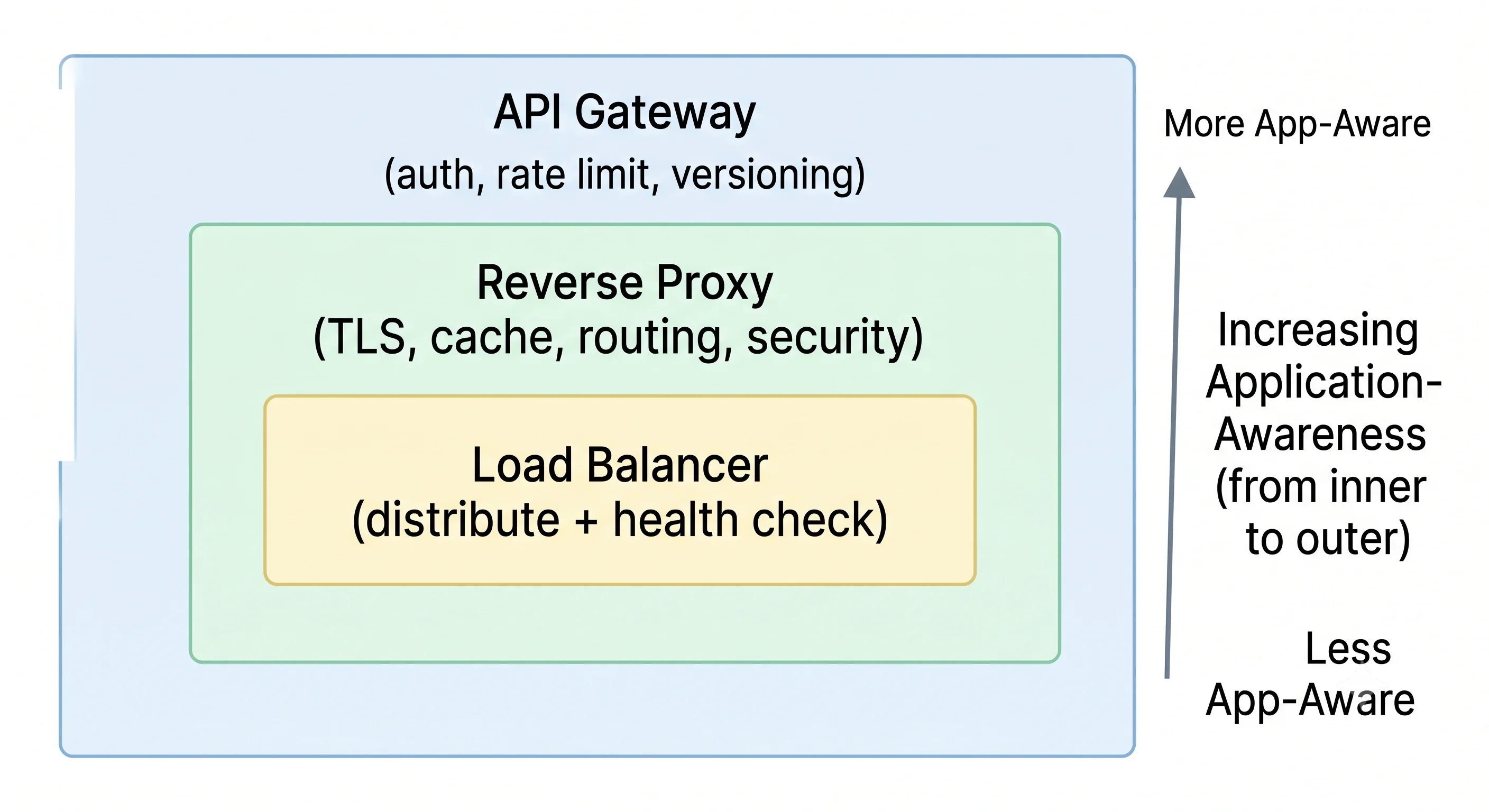
A frequent point of confusion. They form a spectrum of increasing application-awareness:
| Load Balancer | Reverse Proxy | API Gateway | |
|---|---|---|---|
| Primary job | Distribute traffic | Boundary functions + LB | API-specific control plane |
| Awareness | L4 or L7 | L7 (HTTP) | Deep app/API awareness |
| Adds | Health checks, distribution | TLS, cache, routing, security | Auth, rate limits, versioning, aggregation, transformation |
| Example | AWS NLB, HAProxy | NGINX, Envoy | Kong, AWS API Gateway |
Rule of thumb: a load balancer spreads load, a reverse proxy also handles edge concerns, and an API gateway (see API Gateway) adds API management on top. In practice one component (e.g., Envoy or NGINX) can play all three roles.
TLS Termination vs Passthrough
Termination (common):
  Client ──HTTPS──▶ [Reverse Proxy decrypts] ──HTTP──▶ Backend
  ✅ Backends simpler, central cert management, can inspect/cache
  ⚠️ Internal hop is plaintext (mitigate with mTLS / private network)

Passthrough / re-encryption (high security):
  Client ──HTTPS──▶ [Proxy] ──HTTPS/mTLS──▶ Backend
  ✅ Encrypted end-to-end
  ⚠️ Proxy can't inspect/cache; more overhead
Why It Matters for System Design
The reverse proxy is where you enforce policy once: it's the single chokepoint for TLS, auth pre-checks, rate limiting, and routing — so backends stay simple and stateless. It also hides your topology (clients can't tell how many backends exist or where they are), which improves both security and operational flexibility (add/remove/relocate backends transparently).
Seeing It in Action
Scenario: NGINX as a reverse proxy doing TLS termination, routing, and load balancing.
# Upstream backend pools
upstream web_app  { server 10.0.1.10:8080; server 10.0.1.11:8080; }
upstream img_svc  { server 10.0.2.10:9090; server 10.0.2.11:9090; }

server {
    listen 443 ssl http2;
    server_name example.com;

    ssl_certificate     /etc/ssl/example.crt;   # TLS terminated here
    ssl_certificate_key /etc/ssl/example.key;

    gzip on;                                     # central compression

    # Path-based routing to different backend services
    location /images/ {
        proxy_pass http://img_svc;
        proxy_cache img_cache;                   # cache images at the proxy
        proxy_cache_valid 200 1h;
    }

    location / {
        proxy_pass http://web_app;               # everything else → web app
        proxy_set_header X-Forwarded-For $remote_addr;   # preserve client IP
        proxy_set_header X-Forwarded-Proto https;
        limit_req zone=perip burst=20 nodelay;   # rate limit per client IP
    }
}
What this single config centralizes: TLS is terminated once (backends speak plain HTTP), traffic is routed by path to the right service pool and load-balanced within each, images are cached at the edge, responses are compressed, the real client IP is forwarded, and per-IP rate limiting protects the backends — none of which the application servers have to implement themselves. This is the reverse proxy as the system's front door and policy enforcement point.
Interview Questions
Q: What's the difference between a forward proxy and a reverse proxy? Hint: A forward proxy sits in front of clients and acts on their behalf (corporate egress, privacy, filtering) — it hides the client. A reverse proxy sits in front of servers and acts on their behalf (LB, TLS, caching, security) — it hides the backends. Clients knowingly use a forward proxy; they're usually unaware of a reverse proxy.
Q: How do a load balancer, reverse proxy, and API gateway differ? Hint: Increasing app-awareness: a load balancer distributes traffic (L4/L7) with health checks; a reverse proxy adds edge functions (TLS termination, caching, routing, security) plus LB; an API gateway adds API-management (auth, rate limiting, versioning, request aggregation/transformation). They overlap heavily and one product can play all three roles.
Q: What is TLS termination, and what are the trade-offs vs passthrough? Hint: Termination decrypts HTTPS at the proxy, so backends speak plain HTTP — simpler backends, central cert management, and the proxy can inspect/cache/route. Downside: the internal hop is plaintext (mitigate with mTLS/private networking). Passthrough/re-encryption keeps traffic encrypted end-to-end (higher security) but the proxy can't inspect or cache and incurs more overhead.
Q: Why put a reverse proxy in front of your application servers at all? Hint: It centralizes cross-cutting concerns (TLS, caching, compression, routing, rate limiting, WAF, logging) so backends stay simple and stateless, provides a single policy-enforcement chokepoint, hides backend topology (security + flexibility to add/remove/relocate servers transparently), and buffers slow clients to protect backends.
Q: A reverse proxy terminates TLS and forwards to backends. How do backends still see the real client IP and protocol? Hint: The proxy injects forwarding headers —
X-Forwarded-For(original client IP),X-Forwarded-Proto(original scheme, e.g., https), andX-Forwarded-Host. Backends read these instead of the proxy's own connection info. The proxy must be trusted and should strip/overwrite these headers from untrusted clients to prevent spoofing.
References
- NGINX: What is a reverse proxy? — definitions and functions
- Cloudflare: Reverse proxy vs forward proxy — the distinction clearly explained
- Envoy Proxy documentation — a modern L7 proxy powering many gateways/meshes
Dive Deeper
- HAProxy Configuration Manual — a battle-tested L4/L7 proxy in depth
- Google Maglev — network load balancing at scale
- The AWS Builders' Library: reverse proxies and dependency isolation — proxies in resilient architectures