
Replication
In a Nutshell
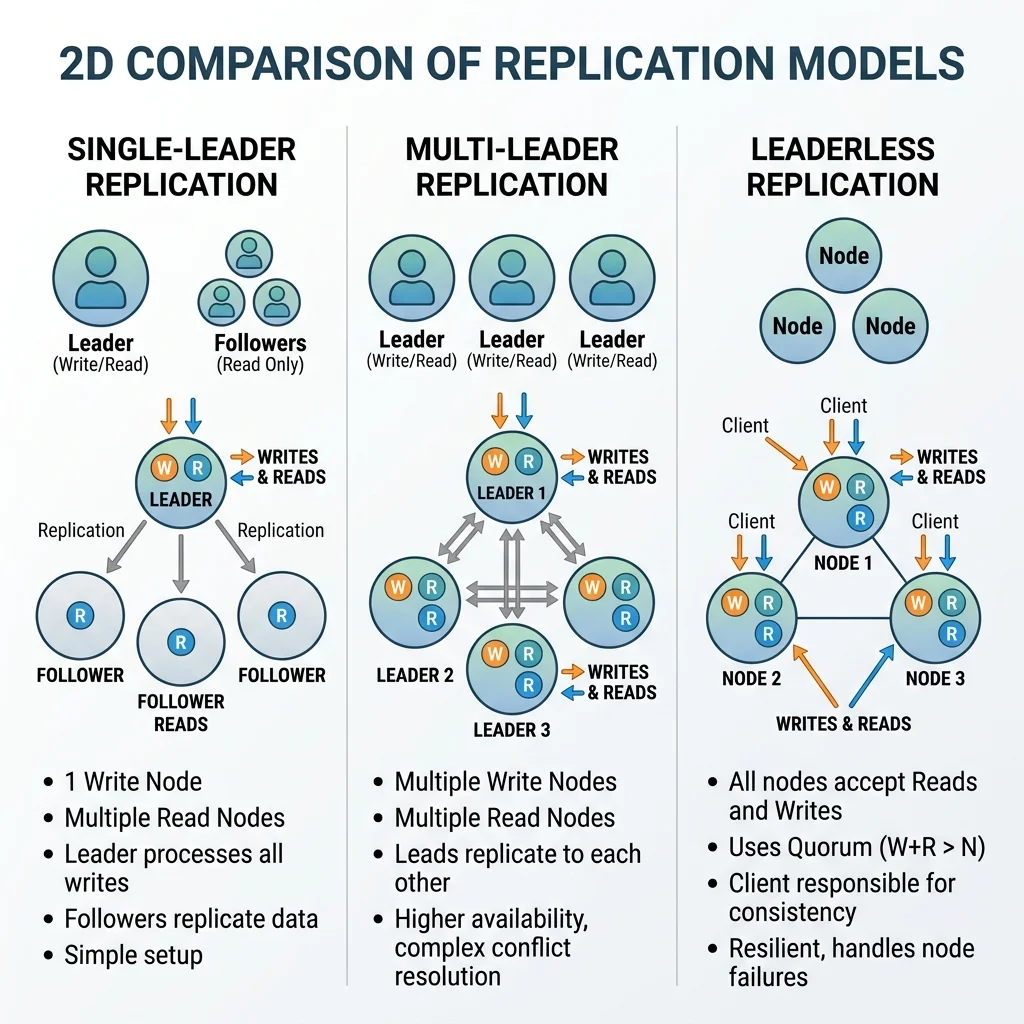
Replication copies data to multiple machines for three purposes: durability (data survives machine failures), availability (the system keeps serving if a node goes down), and read scaling (distribute reads across copies). The fundamental trade-off is between consistency (how quickly replicas reflect the latest write) and performance (how fast writes are acknowledged). There are three main replication topologies — single-leader, multi-leader, and leaderless — each with distinct strengths and failure modes. Understanding when to use which is essential for designing systems that are both reliable and performant.
How It Actually Works
Single-Leader Replication (Primary-Replica)
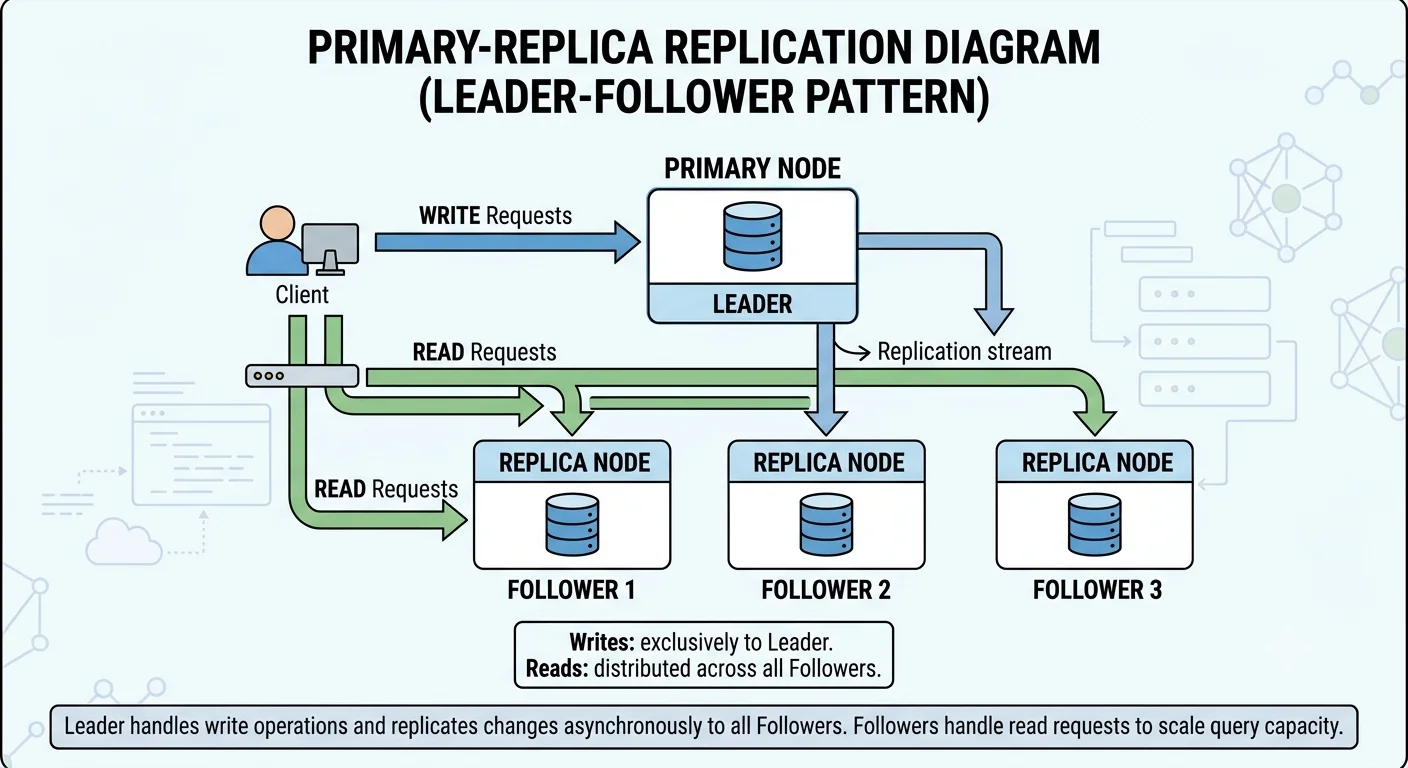
The most common model. One node (the leader/primary) handles all writes. Replicas (followers) receive a copy of every write via a replication log.
Client writes ──▶ Leader (Primary)
                     │
              replication log
              ┌──────┼──────┐
              ▼      ▼      ▼
          Replica  Replica  Replica
          (read)   (read)   (read)
              ▲      ▲      ▲
Client reads ─┘      │      │
Client reads ────────┘      │
Client reads ───────────────┘| Aspect | Description |
|---|---|
| Writes | Go to the leader only |
| Reads | Can go to any replica (or the leader) |
| Replication mode | Synchronous or asynchronous |
| Failover | If leader dies, promote a replica to leader |
| Used by | PostgreSQL, MySQL, MongoDB, Redis Sentinel |
Sync vs Async Replication
| Mode | How It Works | Trade-off |
|---|---|---|
| Synchronous | Write not acknowledged until ≥1 replica confirms | Strong consistency, but higher write latency and lower availability (if sync replica is down, writes block) |
| Asynchronous | Write acknowledged as soon as leader writes locally | Fast writes, but replicas may lag — reads from replicas can be stale |
| Semi-synchronous | At least 1 replica is sync, others are async | Balance: one guaranteed up-to-date replica, others eventually consistent |
Replication Lag
The delay between a write on the leader and when it appears on a replica. Causes:
- Network latency between leader and replica
- Replica is under heavy read load (can't keep up with replication)
- Large transactions (long-running writes block replication)
Impact: A user writes data, then reads from a replica that hasn't received the write yet → stale read. See Consistency Models for how to handle this.
Multi-Leader Replication
Multiple nodes accept writes. Each leader replicates to all others.
Leader A ◀──────────▶ Leader B
(Region: US)          (Region: EU)
   │                     │
   ▼                     ▼
Replicas Replicas| Pros | Cons |
|---|---|
| Lower write latency (write to local leader) | Write conflicts — two leaders modify the same data simultaneously |
| Higher availability (each region is independent) | Conflict resolution is complex (last-write-wins? merge? manual?) |
| Multi-region support | Harder to reason about consistency |
Used by: CouchDB, multi-datacenter MySQL/PostgreSQL setups, collaborative editing (Google Docs uses a variant).
The hard problem — write conflicts:
Leader A: UPDATE users SET name = 'Alice Smith' WHERE id = 123;  (at T1)
Leader B: UPDATE users SET name = 'Alice Johnson' WHERE id = 123; (at T1)

Both succeed locally. When they replicate to each other:
  - Last-Write-Wins (LWW): Compare timestamps, keep the latest → data loss
  - Custom merge: Application-specific logic (e.g., concatenate changes)
  - Flag for manual resolution: Alert the user to resolve the conflict
Leaderless Replication (Dynamo-Style)
No designated leader. Writes and reads go to multiple nodes simultaneously. Consistency is achieved through quorum reads/writes.
Client write ──▶ Node 1 ✓ (success)
               ──▶ Node 2 ✓ (success)
               ──▶ Node 3 ✗ (down — but quorum met: 2 of 3)

Client read  ──▶ Node 1: value = v2
             ──▶ Node 3: value = v1 (stale — was down during write)
             → Return v2 (latest) and trigger read repair on Node 3
Quorum formula: W + R > N guarantees a read will see the latest write.
- N = number of replicas (e.g., 3)
- W = number of write confirmations required (e.g., 2)
- R = number of read confirmations required (e.g., 2)
- W + R > N → at least one node has the latest value
| Pros | Cons |
|---|---|
| No single point of failure (no leader) | No global ordering of writes → conflicts possible |
| High availability (tolerates node failures) | Read repair and anti-entropy add complexity |
| Tunable consistency (adjust W and R) | Sloppy quorums can violate consistency guarantees |
Used by: Cassandra, DynamoDB, Riak, Voldemort.
Failover
When the leader dies in a single-leader setup:
- Detection — Followers notice the leader hasn't sent a heartbeat (timeout: 10–30 seconds)
- Election — Followers agree on a new leader (via Raft, Paxos, or manual promotion)
- Reconfiguration — Clients and other replicas redirect writes to the new leader
- Data reconciliation — If the old leader had unreplicated writes, they're lost (async) or the old leader is stopped (sync)
Danger: Split-brain — If the old leader comes back and both it and the new leader accept writes, you have two divergent copies. Fencing (STONITH — "Shoot The Other Node In The Head") prevents this by ensuring the old leader is terminated.
Seeing It in Action
Scenario: Designing replication for a global e-commerce platform
Architecture:
┌────────────────────────────────────────────────────────┐
│                   US-East Region                       │
│  ┌──────────────┐                                     │
│  │  Primary DB   │─── sync ──▶ Replica (same AZ)     │
│  │  (Leader)     │─── async ─▶ Replica (diff AZ)     │
│  └──────┬────────┘                                     │
│         │ async                                        │
└─────────┼──────────────────────────────────────────────┘
          │
    cross-region async replication
          │
┌─────────▼──────────────────────────────────────────────┐
│                   EU-West Region                       │
│  ┌──────────────┐                                     │
│  │  Read Replica │ (serves EU reads with low latency)  │
│  └──────────────┘                                     │
│  On primary failure: promote to leader (manual/auto)   │
└────────────────────────────────────────────────────────┘
Design decisions:
- Semi-sync in same region: one sync replica (guaranteed up-to-date for failover), one async (performance)
- Async cross-region: ~100ms latency between US and EU makes sync impractical
- EU reads from local replica: low latency for EU users (eventual consistency acceptable for product catalog)
- Writes always go to US primary: strong consistency for inventory and orders
- Failover plan: if US primary dies, promote the sync replica in the same AZ. If the entire US region fails, promote the EU replica (accepting some data loss from async lag)
Interview Questions
Q: What's the difference between synchronous and asynchronous replication? When would you use each? Hint: Sync: write waits for replica confirmation — no data loss on leader failure, but higher latency and availability risk if the replica is slow. Async: write acknowledged immediately — fast, but replica may lag, causing stale reads and potential data loss on failover. Use sync for critical data (financial); async for read scaling with acceptable staleness.
Q: How does a quorum work in leaderless replication? What values of W and R would you choose? Hint: W + R > N ensures overlap (at least one node in the read set has the latest write). With N=3: W=2, R=2 is the standard (tolerates 1 failure). W=1, R=3 prioritizes write speed. W=3, R=1 prioritizes read speed. W=1, R=1 gives no consistency guarantee — pure eventual.
Q: What is split-brain, and how do you prevent it? Hint: Two nodes both believe they're the leader and accept writes — creating divergent data. Prevention: fencing tokens (new leader invalidates old leader's token), STONITH (terminate the old leader), or consensus protocols (Raft/Paxos ensure only one leader). Detection: epoch numbers that increment on each leader election.
Q: Your replica has 30 seconds of replication lag. A user writes data and immediately reads it from the replica. What happens, and how do you fix it? Hint: The user sees stale data (their write hasn't replicated yet). Fixes: 1) Read-your-writes consistency: route the user's reads to the leader after a write. 2) Sticky sessions: always route a user to the same replica. 3) Causal tokens: track the write's position in the replication log and wait for the replica to reach it.
Q: When would you choose multi-leader replication over single-leader? Hint: Multi-region deployment where write latency to a single leader in another region is unacceptable. Example: a collaborative editing app where users in Tokyo and London both need fast writes. Trade-off: write conflicts must be resolved (LWW, merge, or manual). If you can tolerate all writes going to one region, single-leader is simpler and avoids conflicts.
References
- Designing Data-Intensive Applications by Martin Kleppmann — Chapter 5: Replication
- PostgreSQL Streaming Replication — official replication docs
- MySQL Replication — MySQL replication setup and monitoring
Dive Deeper
- Raft Consensus Algorithm — interactive visualization of leader election and log replication
- Amazon Dynamo Paper — the foundational paper on leaderless replication
- GitHub — MySQL High Availability — real-world replication and failover at scale