
Transactions & Isolation Levels
In a Nutshell
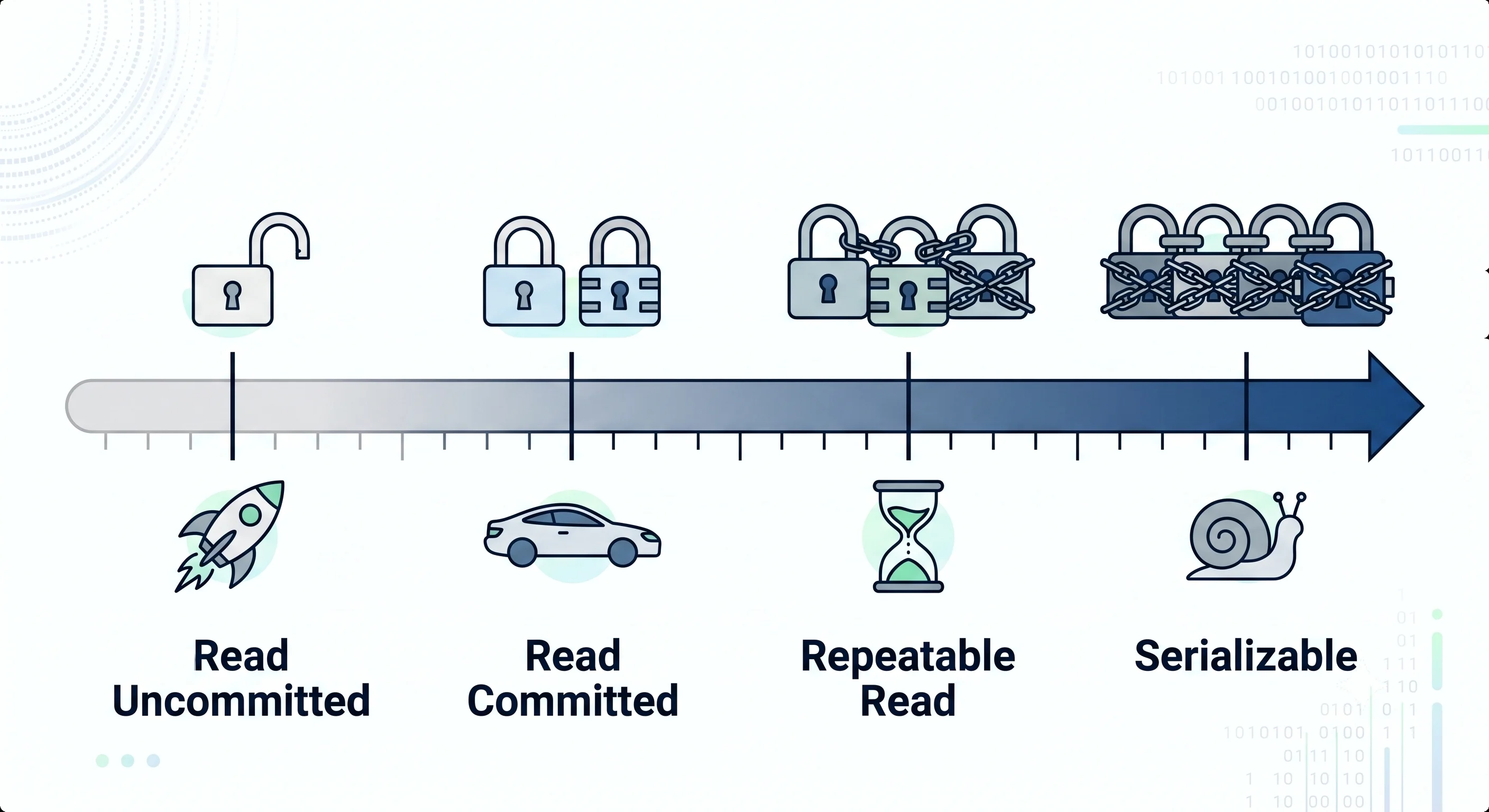
A transaction groups multiple database operations into a single unit that either fully succeeds or fully rolls back. But the hard question isn't what a transaction is — it's how much concurrent transactions can see of each other's work. This is controlled by the isolation level, and it's a trade-off: stronger isolation means more correctness guarantees but lower concurrency and higher latency. Most databases offer four standard levels, each permitting or preventing specific anomalies. Choosing the right level — not just the strongest — is a critical design decision.
How It Actually Works
The Four Standard Isolation Levels
| Level | Speed | Safety | What It Prevents | What It Allows |
|---|---|---|---|---|
| Read Uncommitted | Fastest | Weakest | Nothing | Dirty reads, non-repeatable reads, phantoms |
| Read Committed | Fast | Moderate | Dirty reads | Non-repeatable reads, phantoms |
| Repeatable Read | Moderate | Strong | Dirty reads, non-repeatable reads | Phantoms (in some implementations) |
| Serializable | Slowest | Strongest | Everything | Nothing — behaves as if transactions run one at a time |
The Anomalies Explained
Dirty Read
Reading data that another transaction wrote but hasn't committed yet.
T1: UPDATE accounts SET balance = 0 WHERE user = 'Alice';
T2: SELECT balance FROM accounts WHERE user = 'Alice';  → sees 0
T1: ROLLBACK;  -- Alice's balance is actually still $100
T2: Already acted on the $0 value — incorrect!
Prevented by: Read Committed and above.
Non-Repeatable Read
Reading the same row twice within a transaction and getting different values.
T1: SELECT balance FROM accounts WHERE user = 'Alice';  → $100
T2: UPDATE accounts SET balance = 50 WHERE user = 'Alice'; COMMIT;
T1: SELECT balance FROM accounts WHERE user = 'Alice';  → $50 (changed!)
Prevented by: Repeatable Read and above.
Phantom Read
A query returns different rows when executed twice — new rows appear (or disappear).
T1: SELECT COUNT(*) FROM orders WHERE status = 'pending';  → 5
T2: INSERT INTO orders (status) VALUES ('pending'); COMMIT;
T1: SELECT COUNT(*) FROM orders WHERE status = 'pending';  → 6 (phantom!)
Prevented by: Serializable only (in standard SQL). PostgreSQL's Repeatable Read also prevents phantoms via MVCC.
Lost Update
Two transactions read the same value, modify it, and write it back — one update overwrites the other.
T1: Read balance = $100
T2: Read balance = $100
T1: Write balance = $100 - $30 = $70
T2: Write balance = $100 - $50 = $50  ← T1's update is lost!
Prevented by: Repeatable Read (with FOR UPDATE locking) or Serializable.
How Databases Implement Isolation
| Mechanism | How It Works | Used By |
|---|---|---|
| Locks | Transactions acquire locks on rows; others wait | MySQL (some cases), SQL Server |
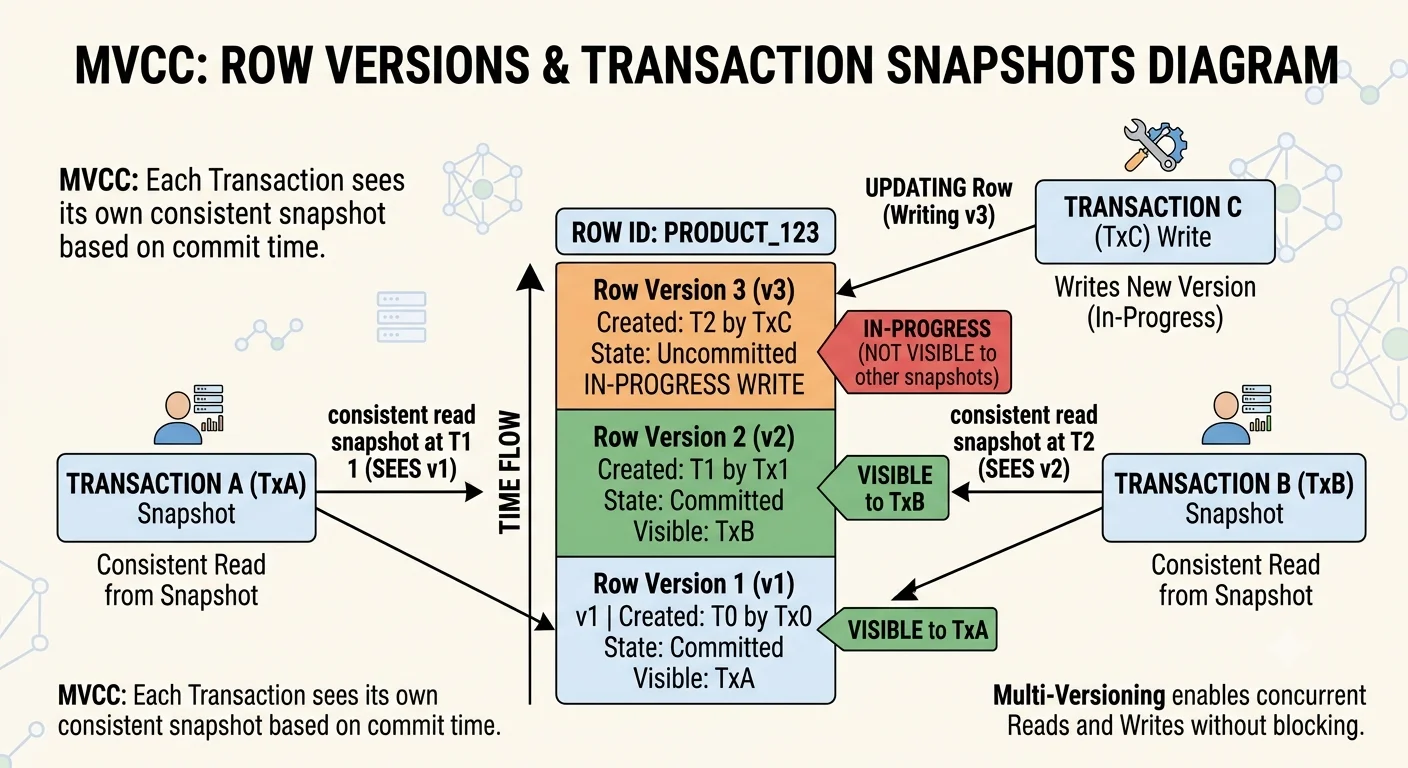
| MVCC (Multi-Version Concurrency Control) | Each transaction sees a snapshot of the database; writes create new versions | PostgreSQL, MySQL InnoDB, Oracle |
| SSI (Serializable Snapshot Isolation) | MVCC + dependency tracking to detect conflicts | PostgreSQL (Serializable), CockroachDB |
MVCC is the dominant approach because it allows readers and writers to not block each other — a huge concurrency advantage over pure locking.
Default Isolation Levels
| Database | Default Level | Notes |
|---|---|---|
| PostgreSQL | Read Committed | Offers Serializable via SSI |
| MySQL (InnoDB) | Repeatable Read | Close to snapshot isolation |
| SQL Server | Read Committed | Also offers Snapshot Isolation |
| Oracle | Read Committed | Serializable available but rarely used |
| CockroachDB | Serializable | Default — strongest guarantee |
| SQLite | Serializable | Single-writer model |
Seeing It in Action
Scenario: Preventing double-booking in a reservation system
-- Problem: Two users try to book the same time slot simultaneously

-- WRONG (Read Committed — non-repeatable read possible):
BEGIN;
  SELECT * FROM slots WHERE room = 'A' AND time = '10:00' AND booked = false;
  -- Both T1 and T2 see the slot as available
  UPDATE slots SET booked = true, booked_by = 'user1' WHERE room = 'A' AND time = '10:00';
COMMIT;
-- Both transactions succeed → double-booked!

-- CORRECT (Option 1: SELECT FOR UPDATE — pessimistic locking):
BEGIN;
  SELECT * FROM slots WHERE room = 'A' AND time = '10:00' AND booked = false FOR UPDATE;
  -- T2 blocks here until T1 commits/rollbacks
  UPDATE slots SET booked = true, booked_by = 'user1' WHERE room = 'A' AND time = '10:00';
COMMIT;
-- T2 now sees booked = true → booking rejected

-- CORRECT (Option 2: Serializable isolation):
SET TRANSACTION ISOLATION LEVEL SERIALIZABLE;
BEGIN;
  SELECT * FROM slots WHERE room = 'A' AND time = '10:00' AND booked = false;
  UPDATE slots SET booked = true, booked_by = 'user1' WHERE room = 'A' AND time = '10:00';
COMMIT;
-- Database detects the conflict and aborts one transaction
-- Application retries the aborted transaction
Interview Questions
Q: What isolation level would you use for a financial transaction system? Why? Hint: Serializable or Repeatable Read with explicit locking (SELECT FOR UPDATE). Financial transactions cannot tolerate lost updates or phantom reads. The performance cost of stronger isolation is justified by the correctness requirement. CockroachDB defaults to Serializable for this reason.
Q: Explain the difference between optimistic and pessimistic concurrency control. Hint: Pessimistic: lock the resource before modifying (SELECT FOR UPDATE) — prevents conflicts but reduces concurrency. Optimistic: proceed without locks, check for conflicts at commit time (version numbers, SSI) — higher concurrency but requires retry logic for conflicts. Use pessimistic for high-contention resources; optimistic for low-contention.
Q: What is MVCC, and why is it important? Hint: Multi-Version Concurrency Control keeps multiple versions of each row. Readers see a consistent snapshot from their transaction's start time; writers create new versions. Key benefit: readers never block writers and vice versa — unlike locking where a write lock blocks all reads. Used by PostgreSQL, MySQL InnoDB, Oracle.
Q: Your application is experiencing deadlocks. What do you do? Hint: 1) Identify the queries involved (database logs). 2) Ensure consistent lock ordering (always lock table A before table B). 3) Keep transactions short (less time holding locks). 4) Use lower isolation levels where safe. 5) Add retry logic — deadlocks are expected in concurrent systems; the database aborts one transaction, and the application should retry.
Q: PostgreSQL defaults to Read Committed. When would you switch to Repeatable Read or Serializable? Hint: Repeatable Read: when a transaction reads the same data twice and needs consistent results (reports, aggregations within a transaction). Serializable: when concurrent transactions could produce incorrect results that no weaker level prevents (booking systems, inventory management). Always benchmark — stronger isolation reduces throughput.
References
- Designing Data-Intensive Applications by Martin Kleppmann — Chapter 7: Transactions (weak isolation levels section)
- PostgreSQL Transaction Isolation — official isolation level documentation
- MySQL InnoDB Transaction Isolation — MySQL isolation specifics
Dive Deeper
- A Critique of ANSI SQL Isolation Levels — the seminal paper revealing gaps in the SQL standard's definitions
- Hermitage — Testing Transaction Isolation — Martin Kleppmann's test suite for real-world isolation behavior
- CockroachDB — Transaction Contention — practical advice on handling contention in distributed SQL