
Redis vs Memcached
In a Nutshell
When you need a fast, in-memory, distributed cache, the two classic choices are Redis and Memcached. Both store data in RAM and serve it in well under a millisecond, and for pure key-value caching they perform similarly. The difference is scope: Memcached is a deliberately simple, multi-threaded key-value cache that does one thing extremely well. Redis is a richer "data structures server" — it offers lists, sets, sorted sets, hashes, pub/sub, persistence, replication, transactions, and more, making it useful for far more than caching. For most new systems Redis is the default because its versatility rarely hurts and often helps; Memcached shines for the narrow case of a simple, huge, multi-core cache.
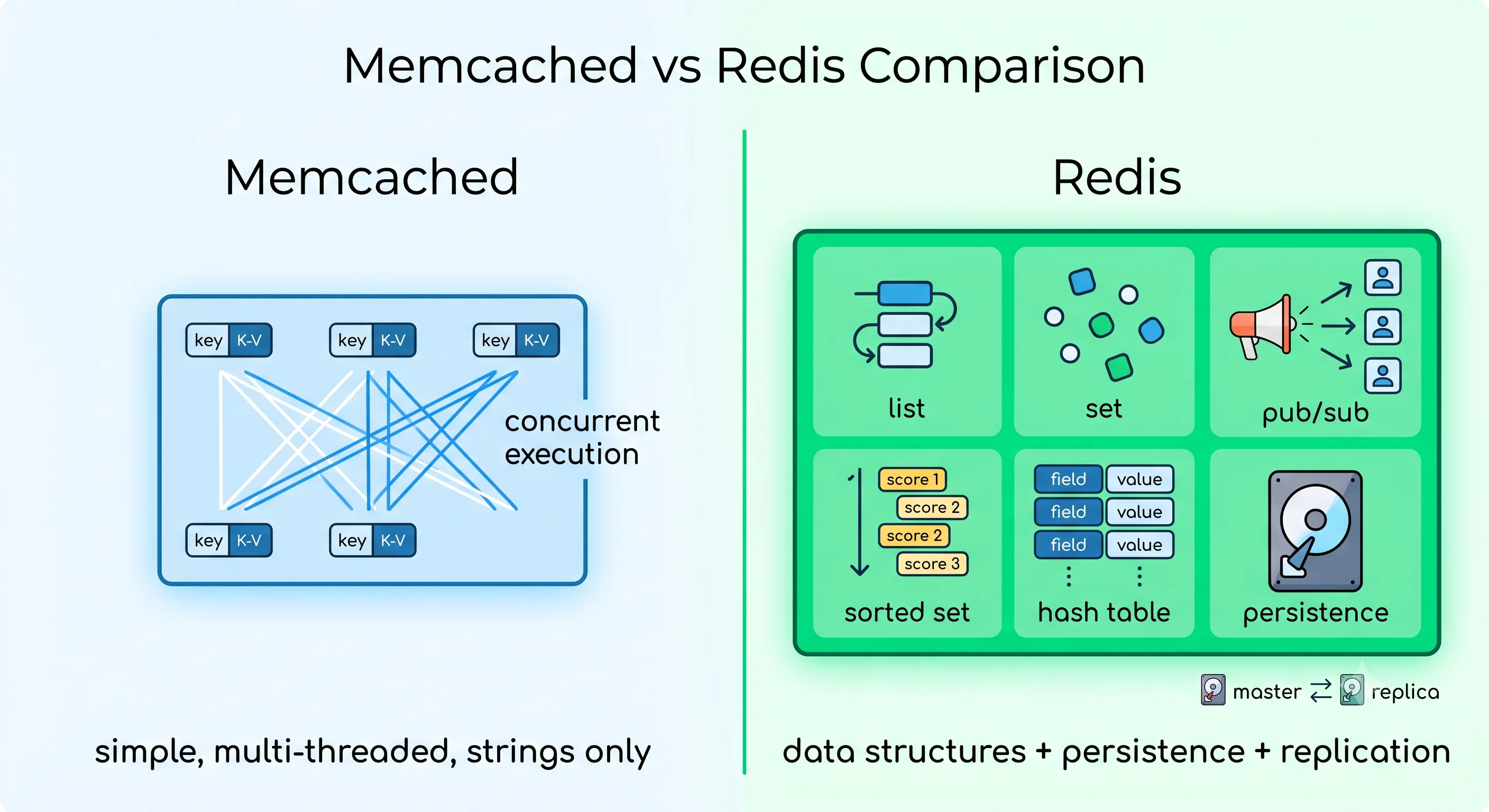
How It Actually Works
Feature Comparison
| Feature | Memcached | Redis |
|---|---|---|
| Data types | Strings/blobs only | Strings, lists, sets, sorted sets, hashes, streams, bitmaps, HLL, geo |
| Threading | Multi-threaded (scales across cores) | Mostly single-threaded core (6.0+ adds I/O threads) |
| Persistence | None (pure cache) | Optional (RDB snapshots + AOF log) |
| Replication | No (client-side sharding only) | Yes (primary-replica) |
| High availability | External tooling | Redis Sentinel / Cluster |
| Clustering | Client-side sharding | Built-in Redis Cluster |
| Pub/Sub & streams | No | Yes |
| Transactions / scripts | No | MULTI/EXEC, Lua scripting |
| Eviction policies | LRU | Many (LRU, LFU, TTL variants) |
| Max value size | 1 MB (default) | 512 MB |
When Memcached's Simplicity Wins
Memcached's multi-threaded design lets it fully use many CPU cores on a single large node, and its lack of features means less overhead and a smaller memory footprint per item. It's ideal when:
- You need a simple, large, pure cache of string values (HTML fragments, serialized objects, session blobs).
- You want to scale vertically across many cores on big machines.
- You don't need persistence, replication, or data structures.
Its LRU is simpler and its memory model (slab allocation) is predictable for uniform object sizes.
When Redis's Richness Wins
Redis is more than a cache — its data structures let you push logic into the datastore:
| Redis Capability | Enables |
|---|---|
| Sorted sets | Leaderboards, rate limiters, priority queues, time-ordered feeds |
| Lists | Simple queues, recent-activity streams |
| Hashes | Storing objects field-by-field (partial updates) |
| Sets | Unique tracking (unique visitors, tags), set operations |
| Pub/Sub & Streams | Real-time messaging, WebSocket backplanes, event pipelines |
| INCR / atomic ops | Counters, distributed locks, rate limiting |
| Persistence | Warm restarts (cache survives a reboot); lightweight datastore |
| Replication + Cluster | HA and horizontal scaling built in |
Because of this, Redis often serves double duty — cache and session store and rate limiter and pub/sub backplane — reducing the number of systems you operate.
The Threading Nuance
Redis's single-threaded core is a feature, not a bug: it means atomic operations without locks and predictable performance, and it's rarely the bottleneck (network and memory usually saturate first). Memcached's multithreading helps when you're CPU-bound on a single huge node with simple gets/sets. In practice both are extremely fast; the choice is driven by features, not raw throughput.
Persistence: Cache vs Data Store
Memcached: pure cache. Restart = empty cache = a cold-start stampede
           on the origin as everything reloads.

Redis:     optional persistence.
  RDB → periodic point-in-time snapshots (compact, some data loss window)
  AOF → append-only log of every write (durable, larger, replayable)
  → cache survives restarts (warm), and Redis can act as a lightweight DB.
  ⚠️ Persistence adds overhead; for a pure cache you may disable it.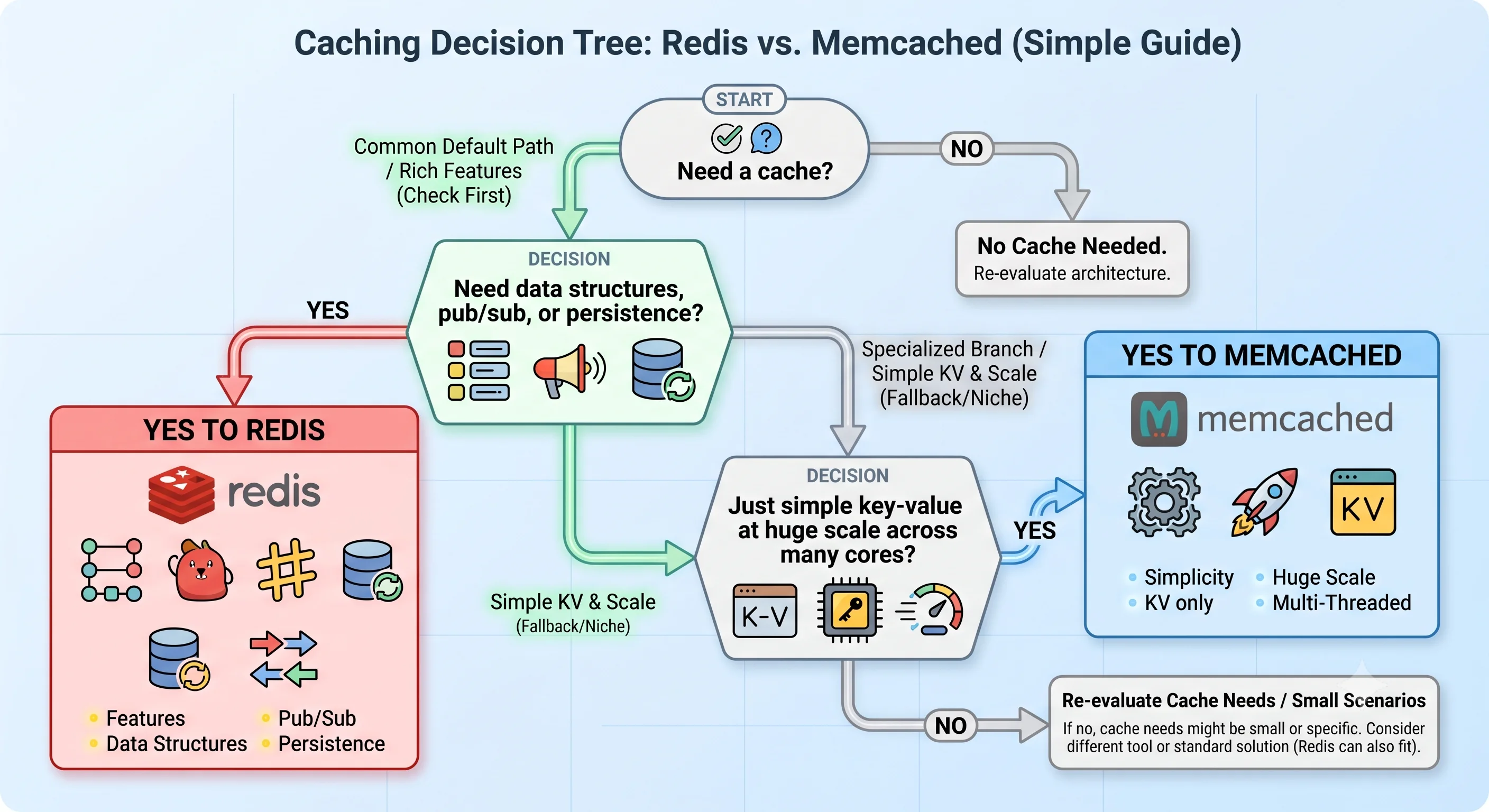
Seeing It in Action
Scenario: Choosing between them for different needs — and why Redis usually wins.
Use case 1 — Session store:
  Redis. Sessions benefit from persistence (survive a Redis restart →
  users don't all get logged out) and TTL-based expiry. Memcached would
  lose all sessions on restart.

Use case 2 — Leaderboard (top 100 players by score, live):
  Redis sorted sets. ONE data structure does it:
    ZADD leaderboard 4200 "player:7"
    ZREVRANGE leaderboard 0 99 WITHSCORES   → top 100 instantly
  Memcached can't do this — you'd rebuild ranking in app code.

Use case 3 — Rate limiting (100 req/min per user):
  Redis atomic INCR + EXPIRE, or a sorted-set sliding window.
  Memcached's lack of atomic multi-step ops makes this fragile.

Use case 4 — Simple huge fragment cache on one big multi-core box:
  Memcached. Pure string blobs, no features needed, and its
  multi-threading fully uses the machine's cores. A legitimate win.

Default recommendation for a new system:
  Start with Redis. Its versatility means one system often covers
  cache + sessions + rate limiting + pub/sub, and its features rarely
  get in the way. Reach for Memcached only for the narrow simple-cache-
  at-scale case where its multi-threaded simplicity is a real advantage.
The bottom line: for pure key-value caching they're comparable, so the decision hinges on whether you'll benefit from Redis's data structures, persistence, and replication. Since most systems eventually want some of those, Redis is the pragmatic default — but Memcached remains an excellent, lean choice for a simple, massive, multi-core cache.
Interview Questions
Q: What are the main differences between Redis and Memcached? Hint: Memcached is a simple, multi-threaded, strings-only key-value cache with no persistence or replication. Redis is a single-threaded-core "data structures server" offering lists/sets/sorted-sets/hashes/streams, pub/sub, optional persistence (RDB/AOF), replication, clustering, transactions, and Lua scripting. For pure key-value caching they perform similarly; Redis wins on versatility, Memcached on lean multi-core simplicity.
Q: When would you specifically choose Memcached over Redis? Hint: For a simple, very large, pure key-value cache of string/blob values where you don't need data structures, persistence, or replication — and you want to fully utilize many CPU cores on big machines (Memcached is multi-threaded). Its predictable slab memory model suits uniform object sizes. It's a deliberately narrow, do-one-thing-well tool.
Q: Redis's core is single-threaded. Why isn't that a problem? Hint: The single-threaded core gives lock-free atomic operations and predictable performance, and Redis is rarely CPU-bound — network and memory usually saturate first. Redis 6+ adds I/O threads for network handling. You scale Redis horizontally via Cluster/sharding rather than threads. Memcached's multithreading only helps in CPU-bound single-node simple-cache scenarios.
Q: How does Redis persistence work and why does it matter for a cache? Hint: RDB takes periodic point-in-time snapshots (compact, small data-loss window); AOF logs every write for durability (larger, replayable). For a cache, persistence means it survives restarts "warm" — avoiding a cold-start stampede where an empty cache dumps all traffic onto the origin. Memcached has no persistence, so a restart empties it entirely.
Q: Give an example where a Redis data structure replaces application logic. Hint: A live leaderboard with sorted sets:
ZADDto set scores andZREVRANGE 0 99to get the top 100 instantly — ranking maintained by Redis, not rebuilt in app code. Others: atomicINCR+EXPIREfor rate limiting, sets for unique-visitor counting, lists for simple queues, pub/sub for a WebSocket backplane. Memcached would push all this into the application.
References
- Redis documentation — data types, persistence, clustering
- Memcached wiki — architecture and usage
- AWS: Redis vs Memcached — a practical comparison
Dive Deeper
- Redis in Action by Josiah Carlson — data-structure-driven design patterns
- Facebook: Scaling Memcache — Memcached at massive scale
- Redis persistence deep dive — RDB vs AOF trade-offs